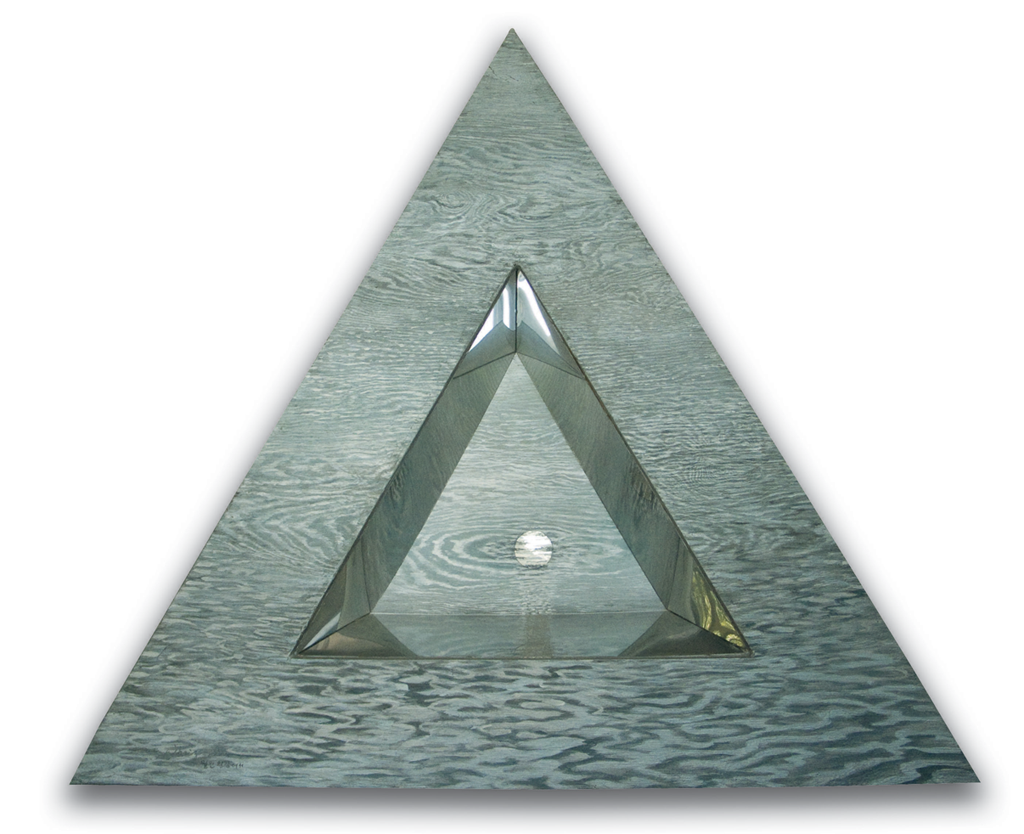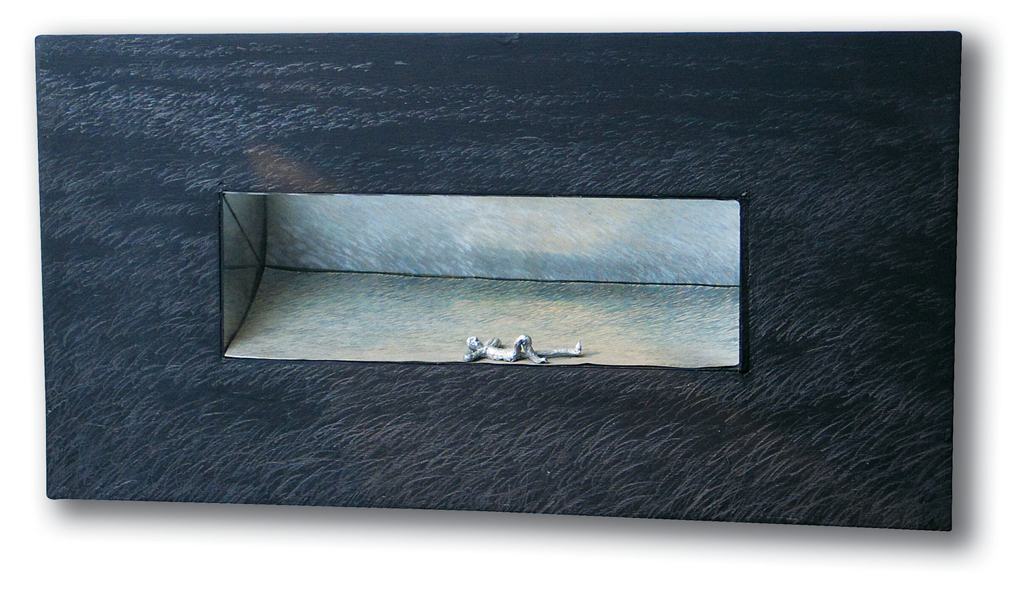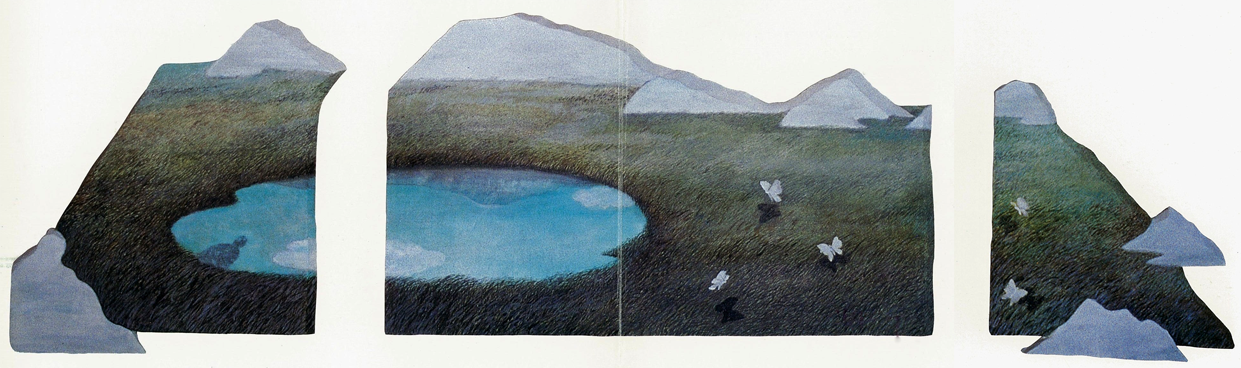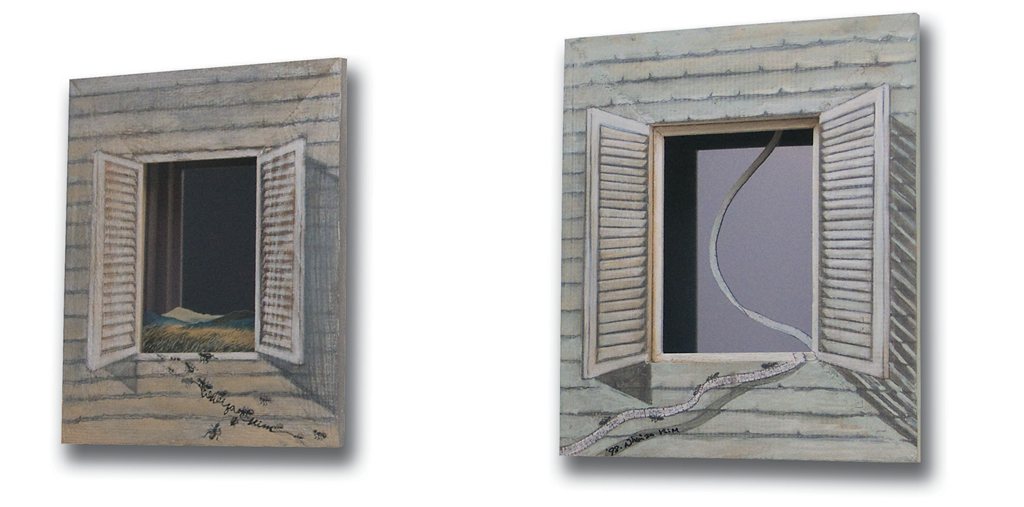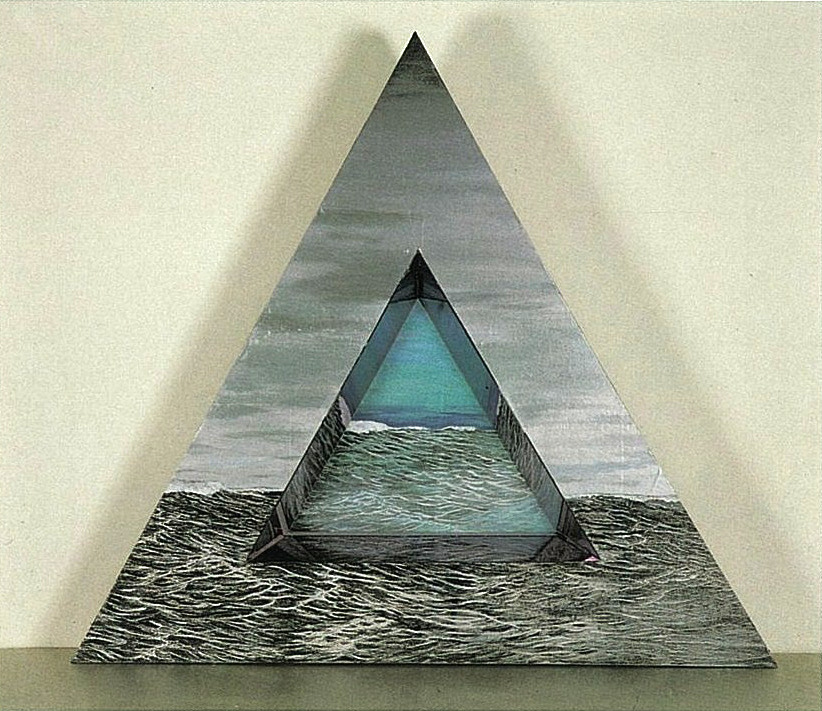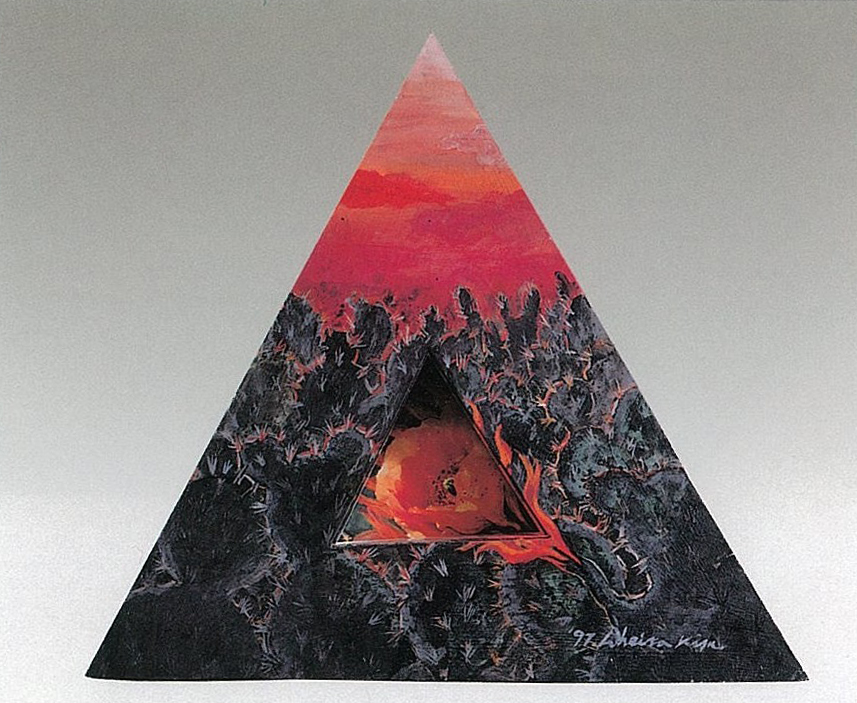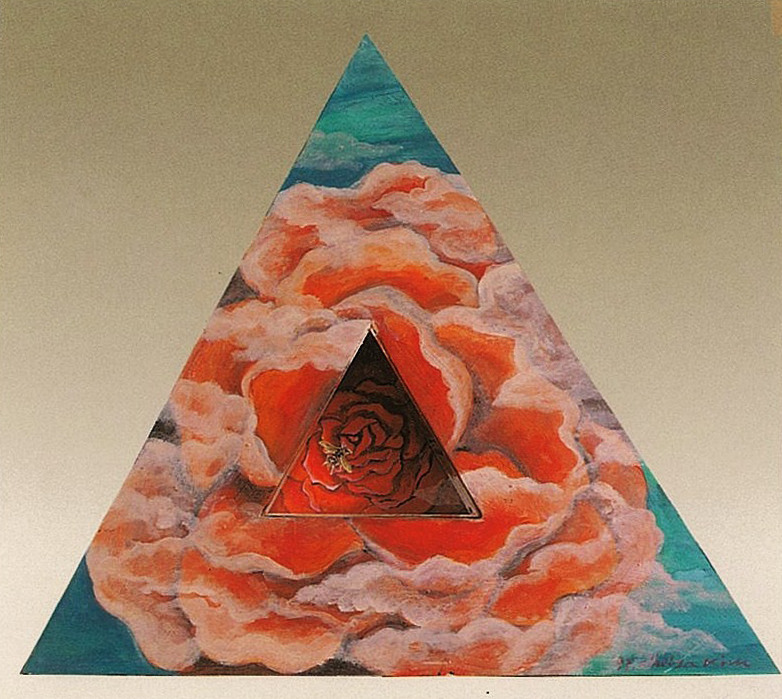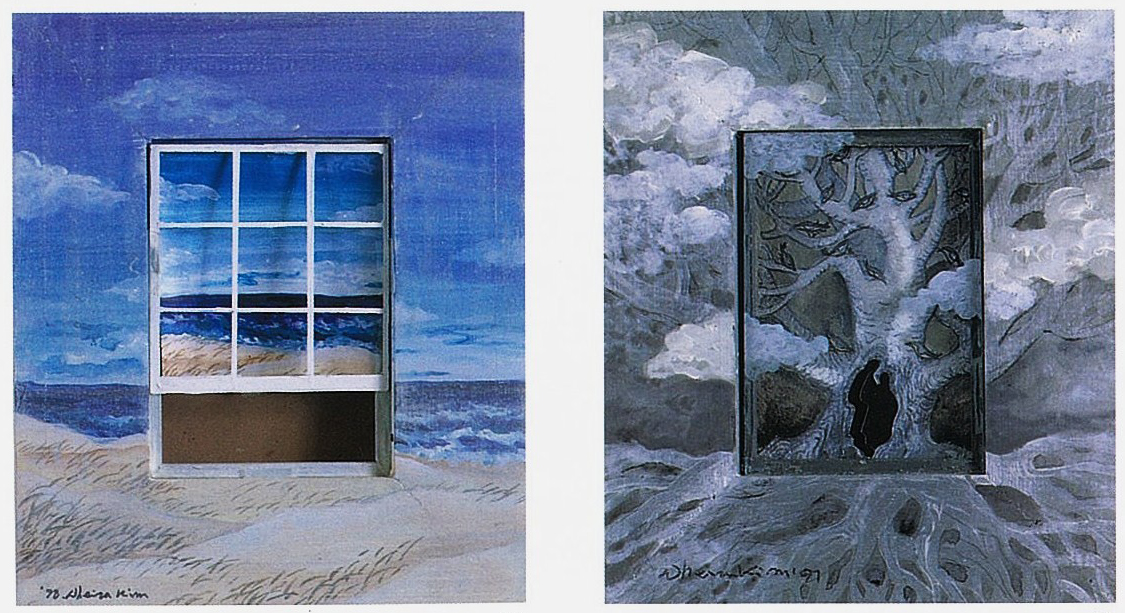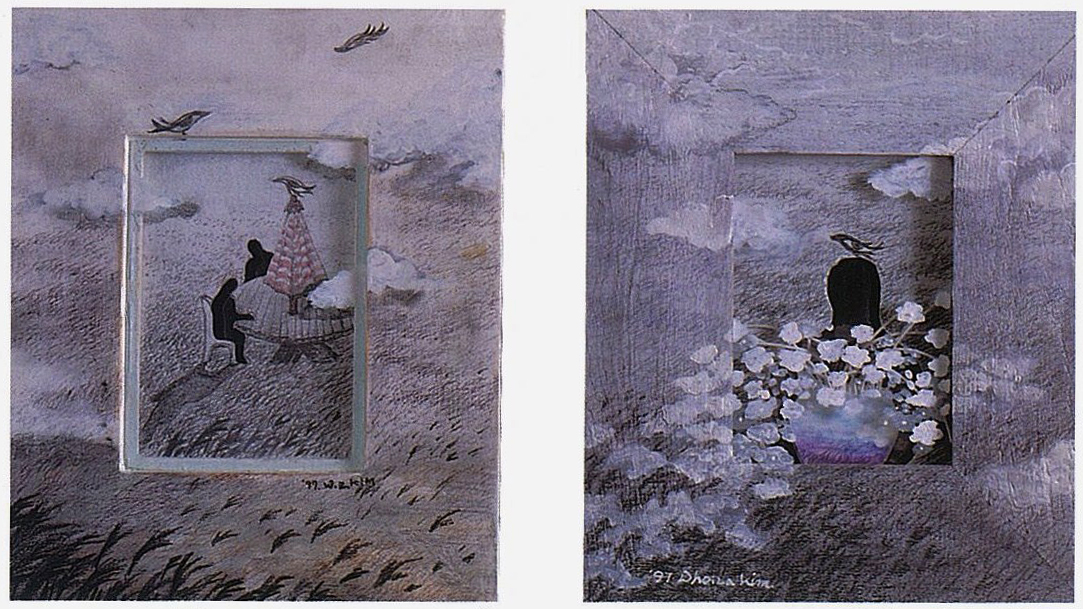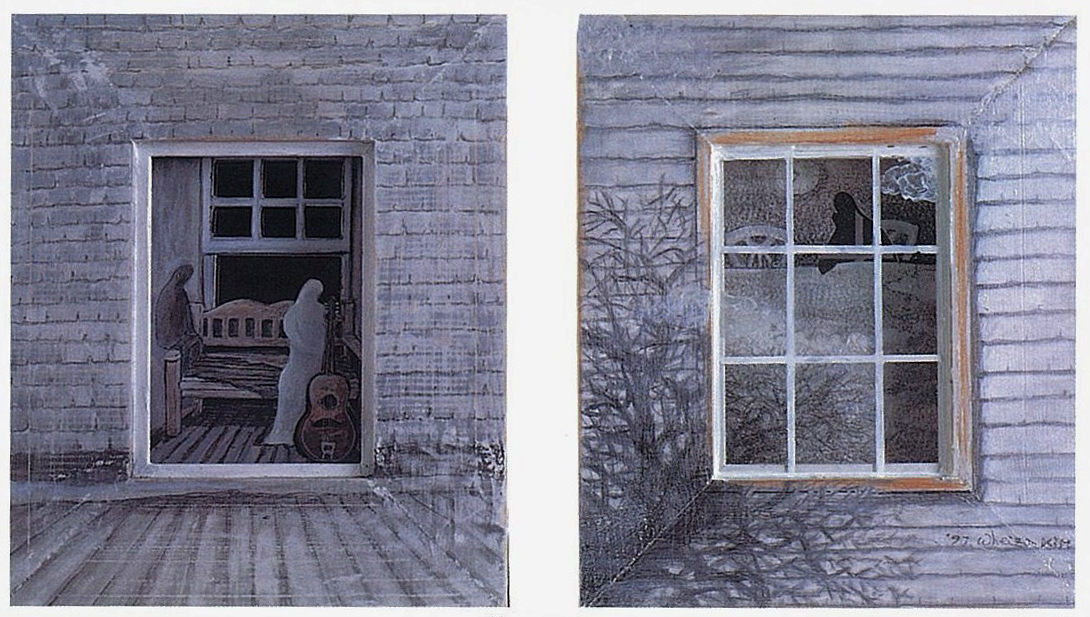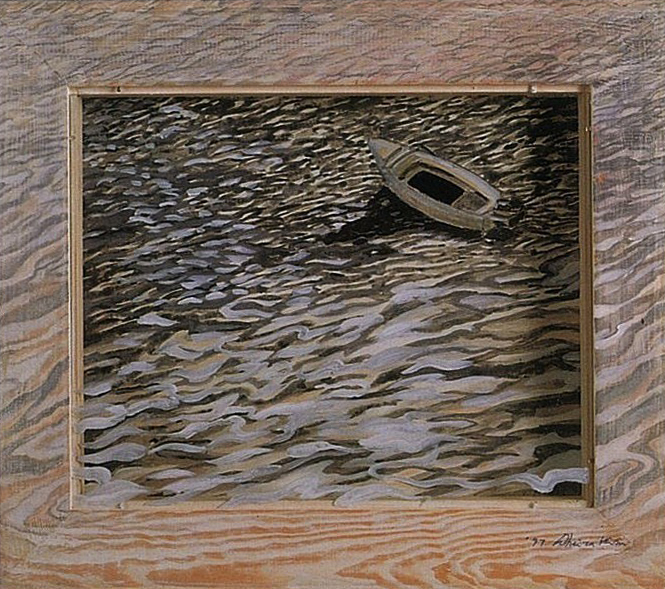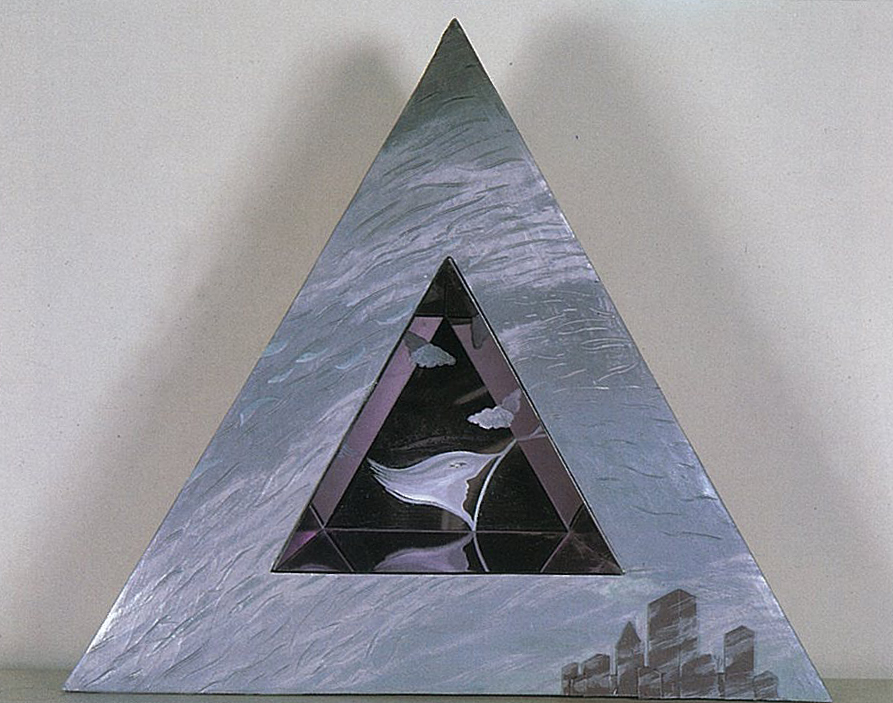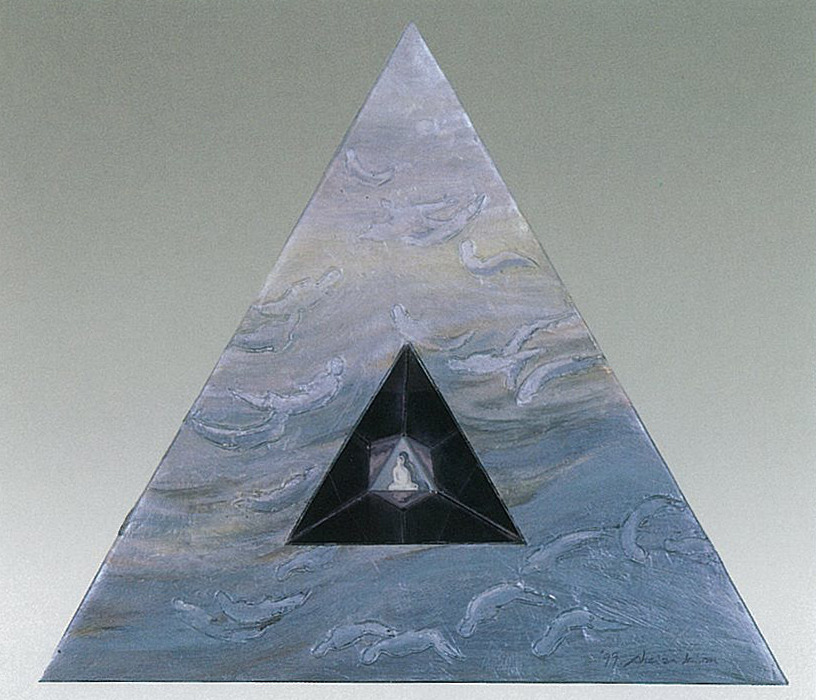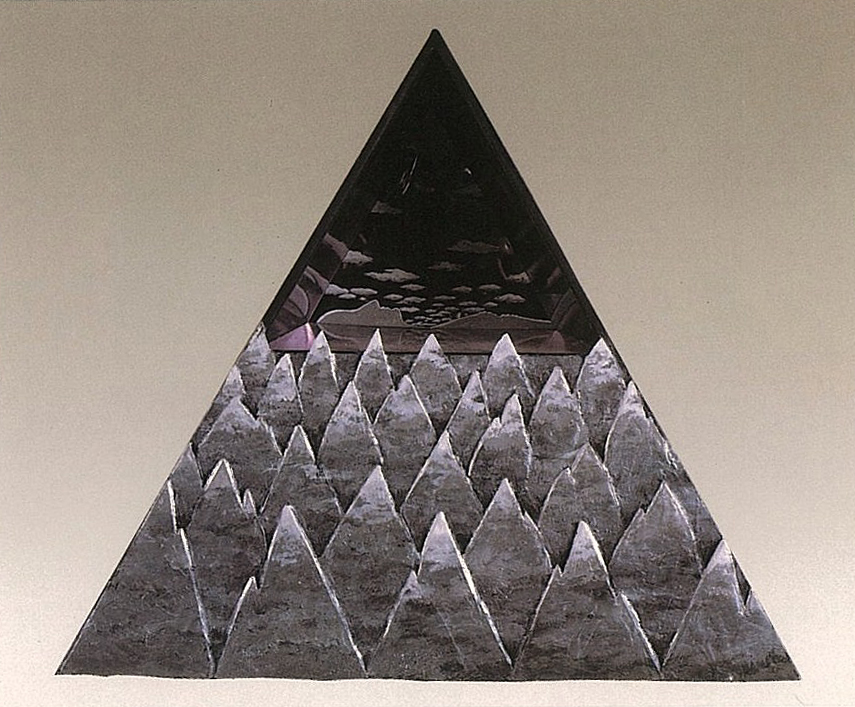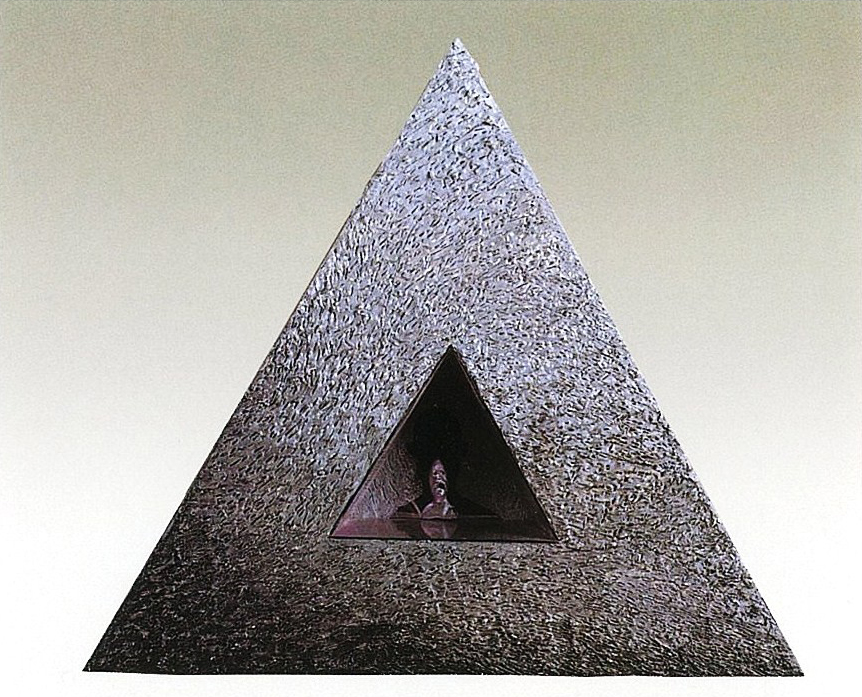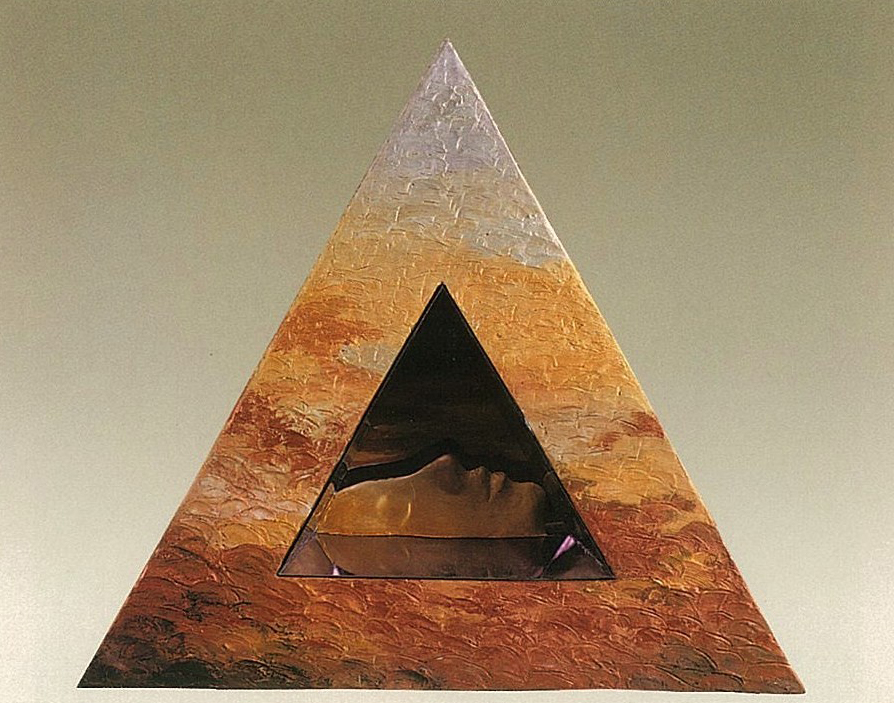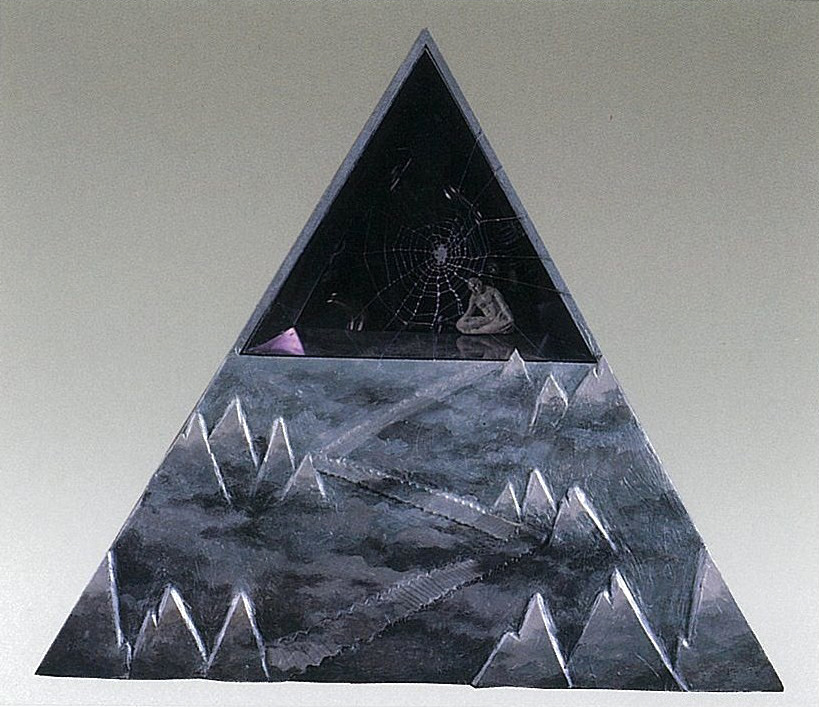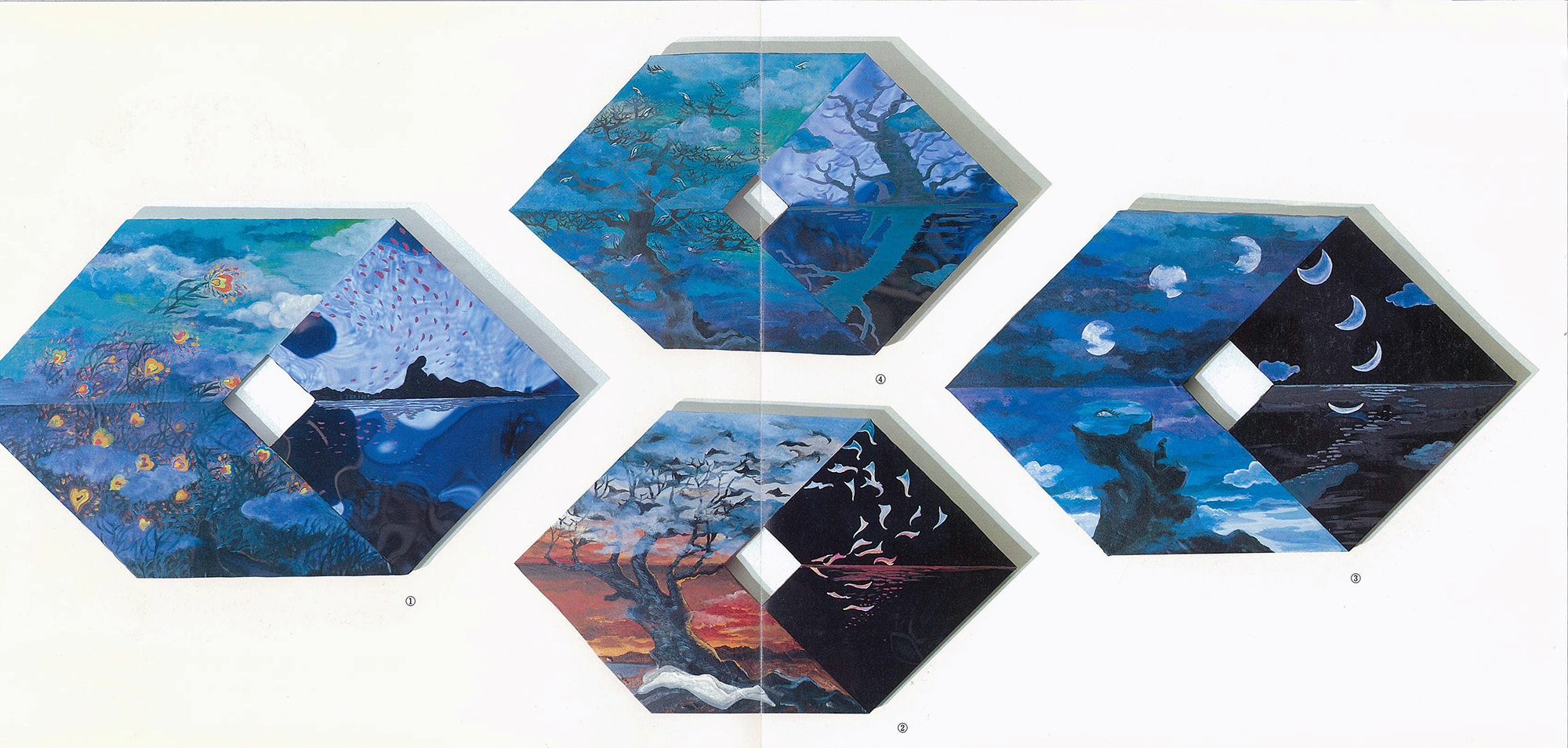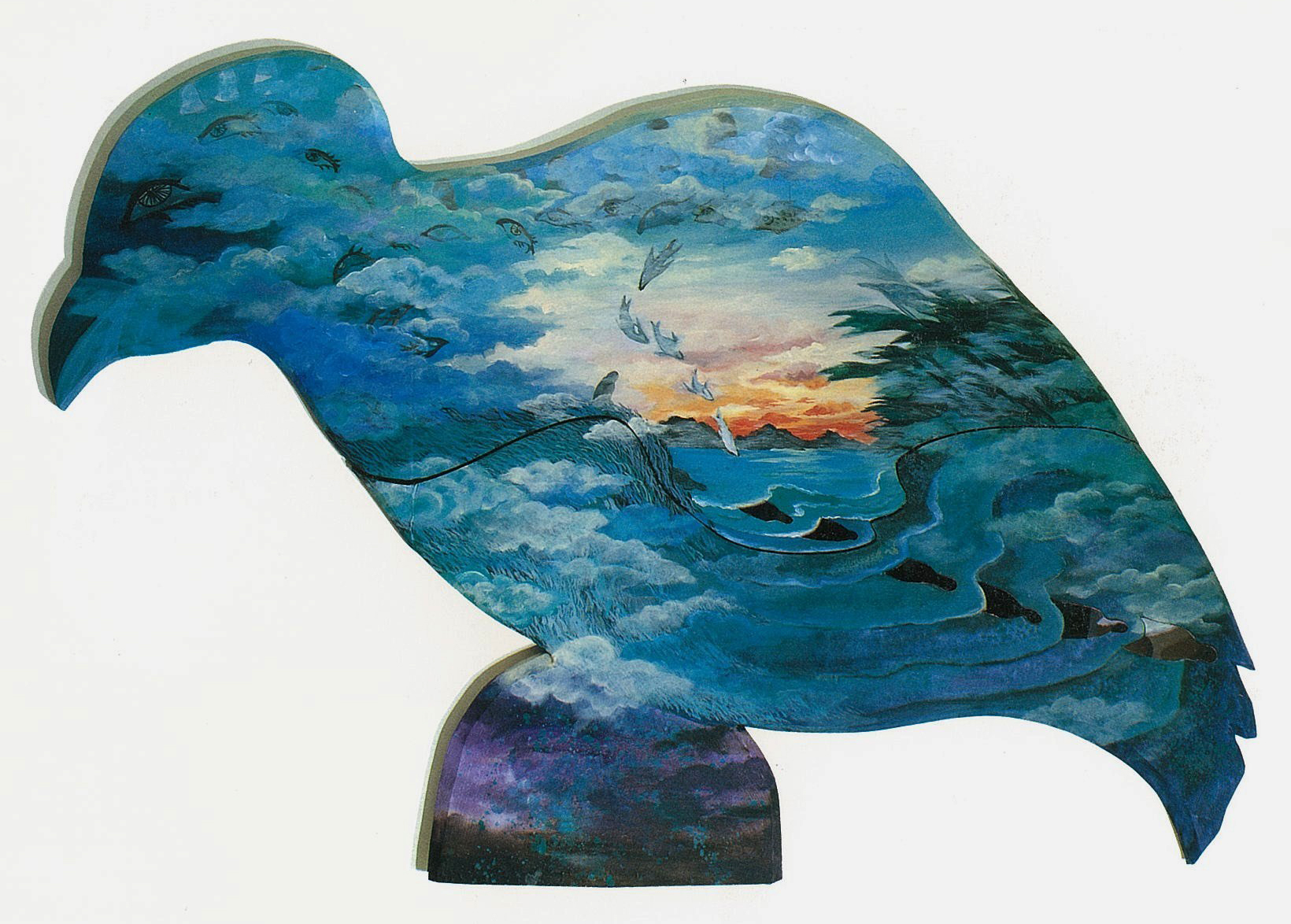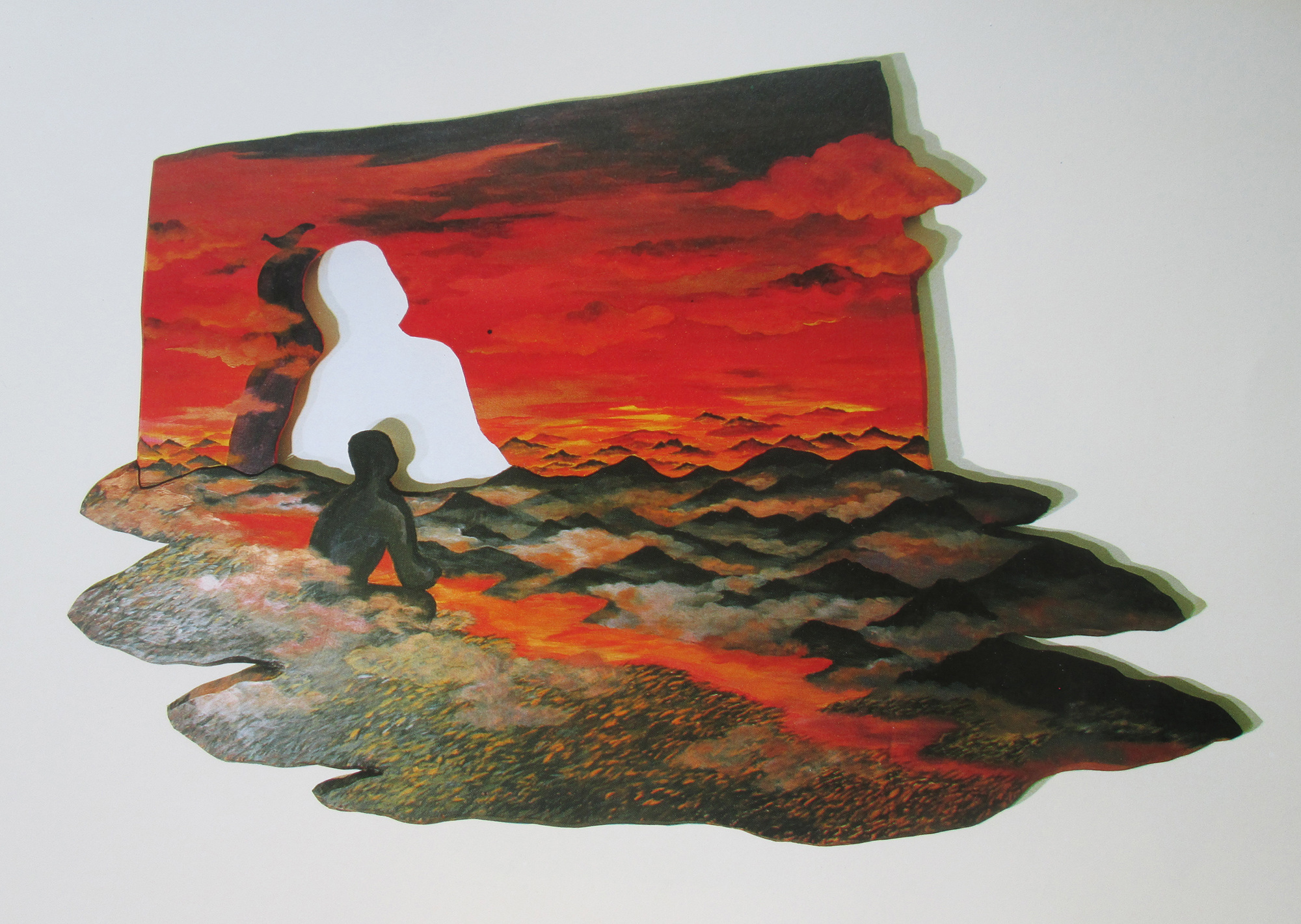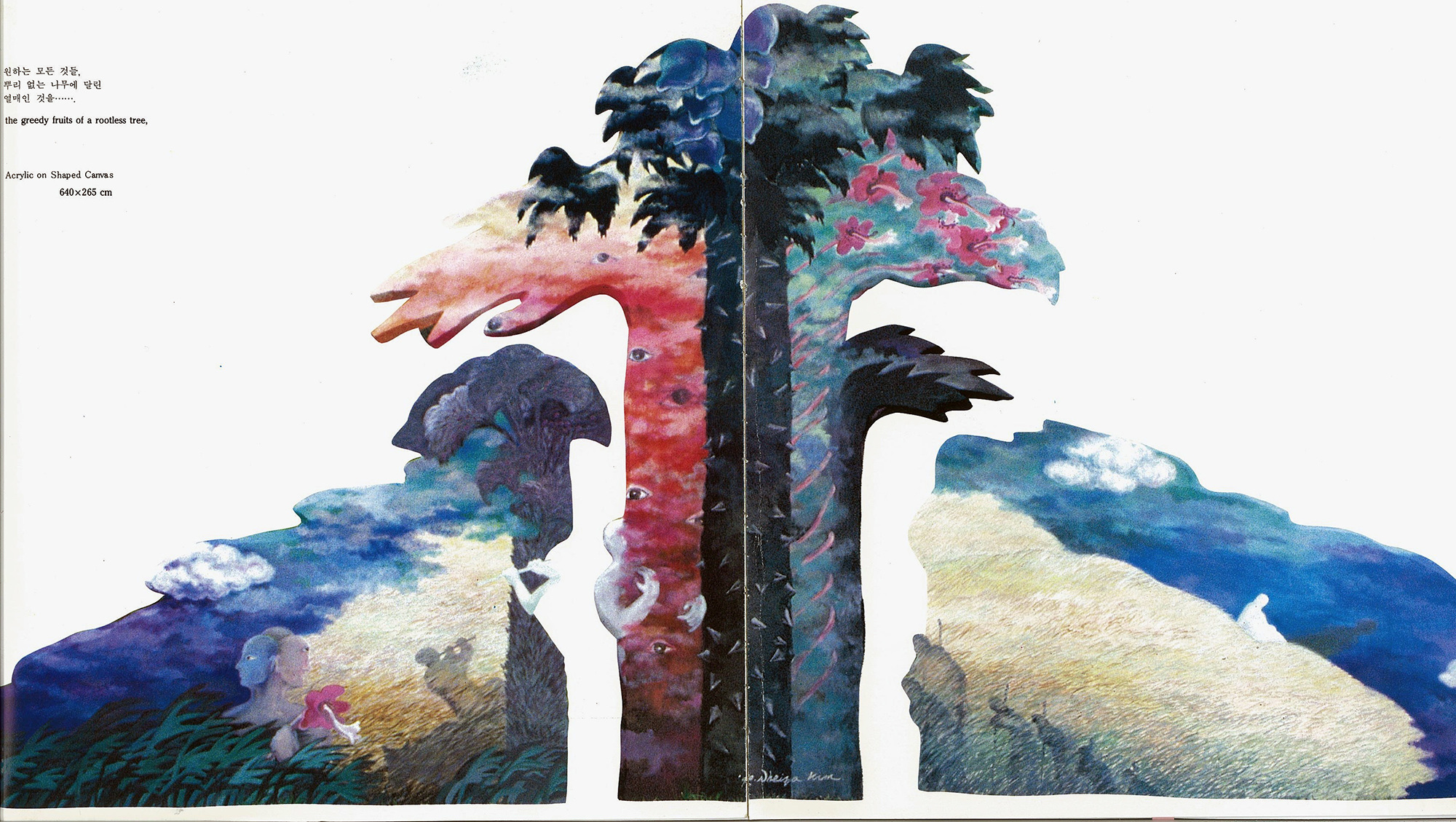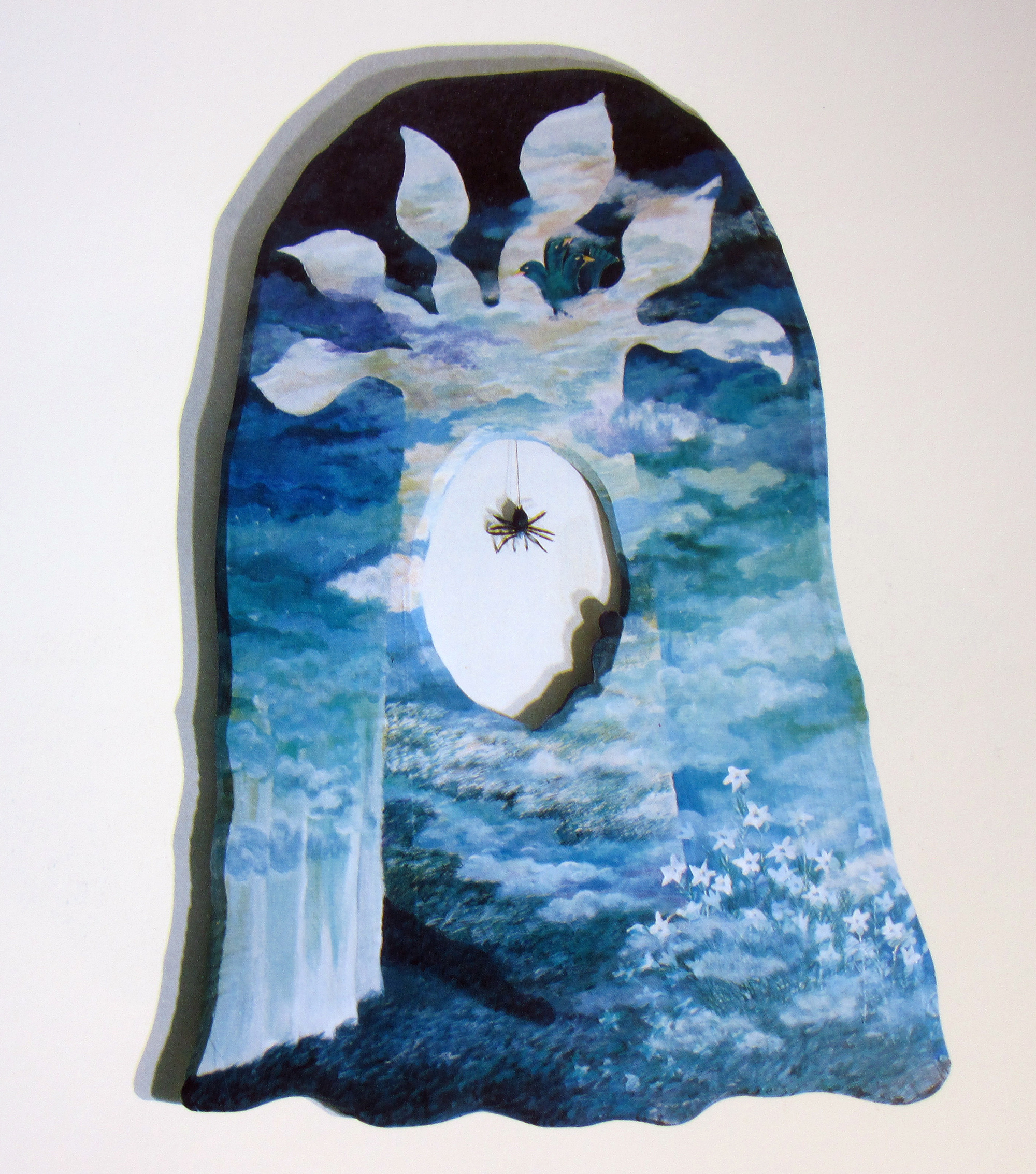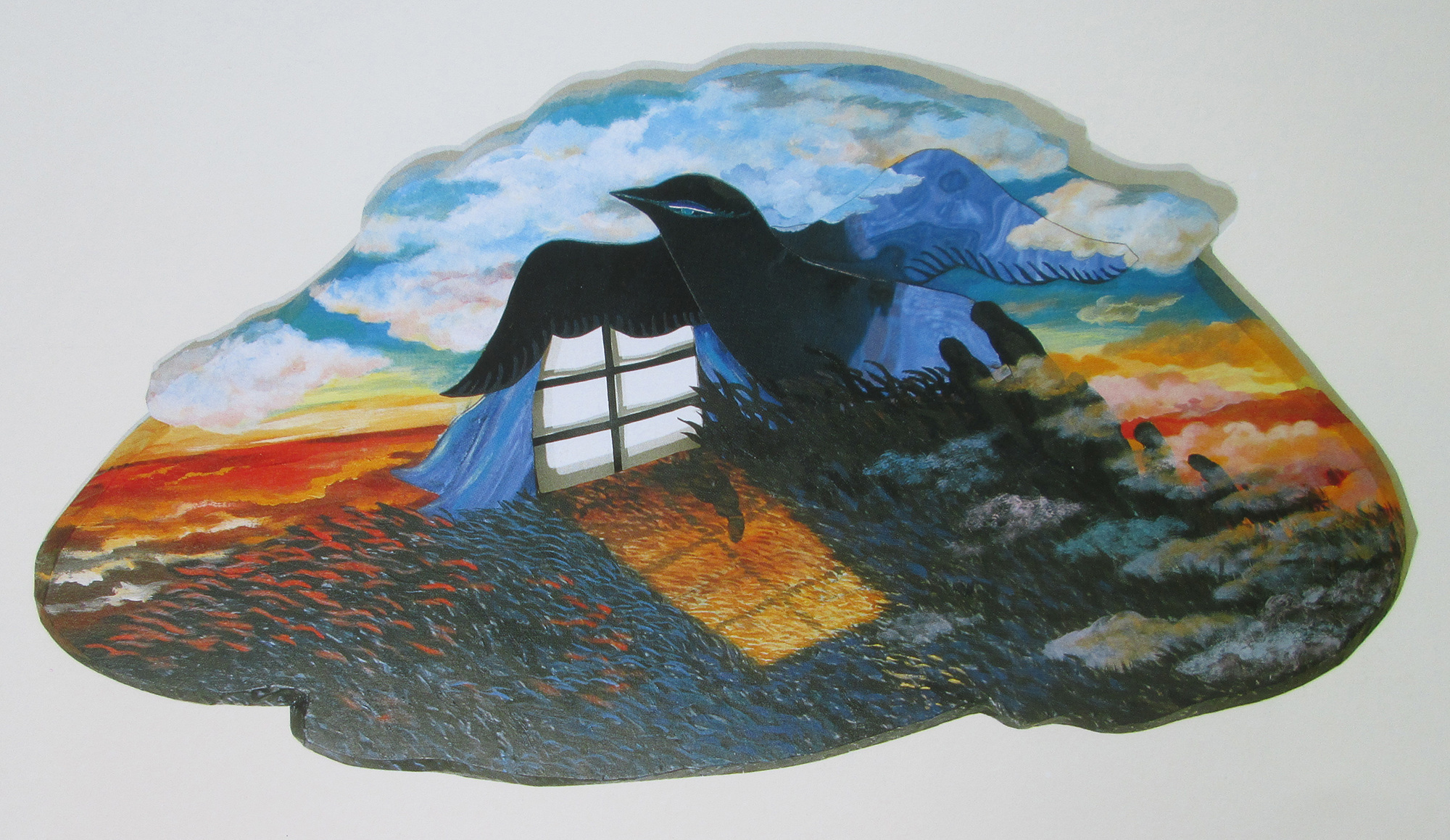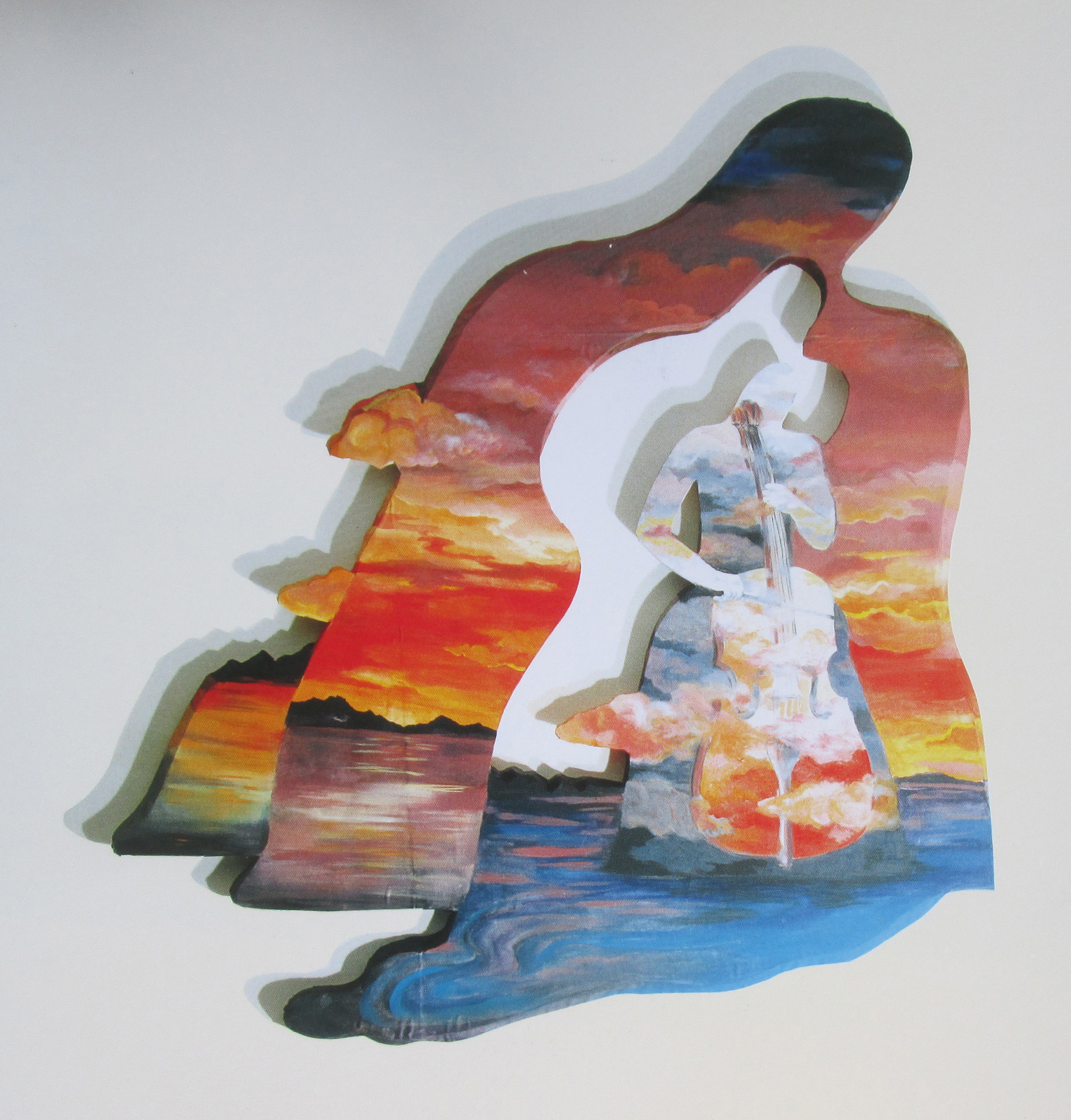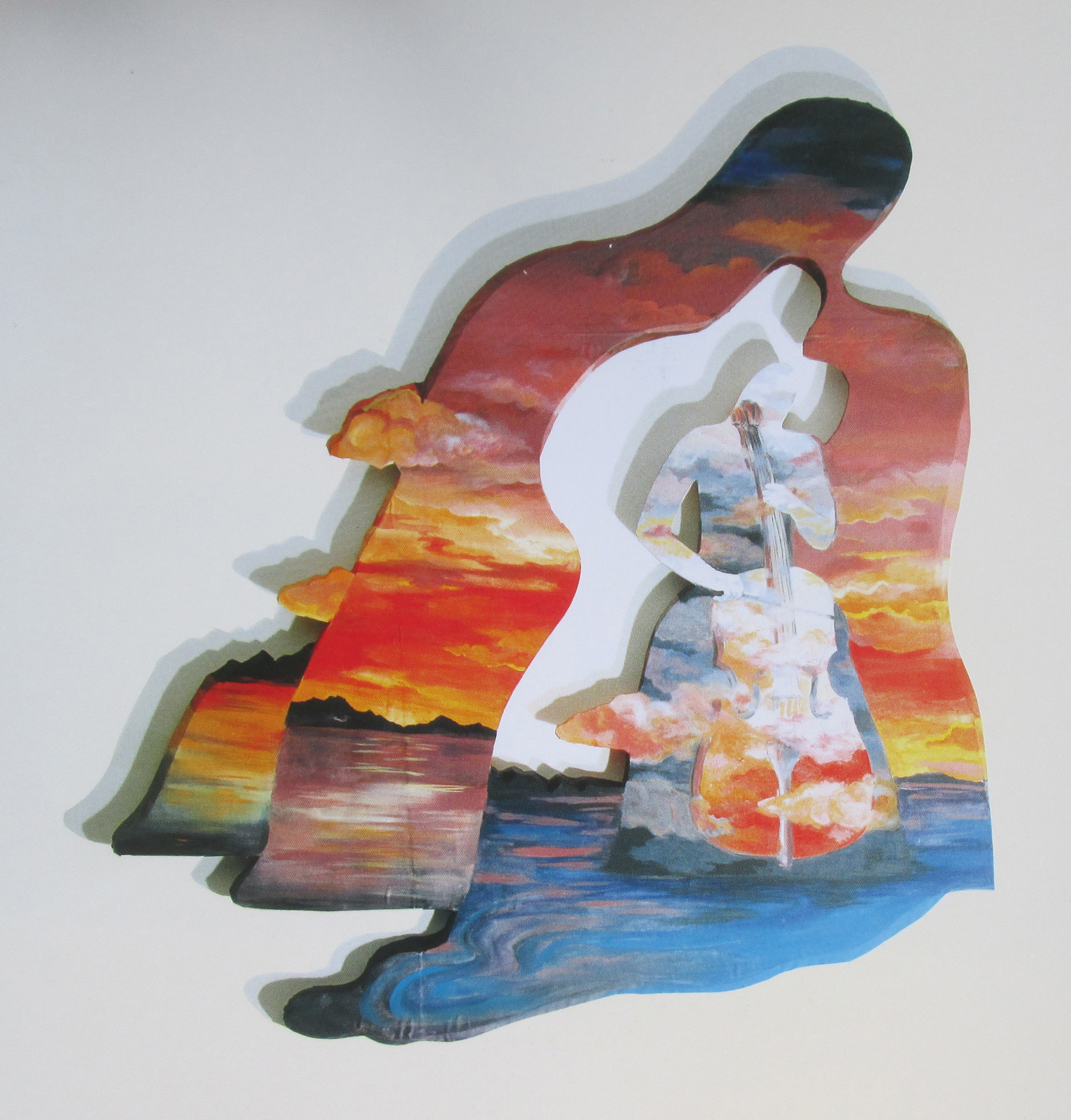
Standing at the riverside beneath the setting sun I can hear the cloud man performing discourses on the secrets of the universe.
1995 Acrylic on shaped canvas 137 x 147 cm
Provenance
Artist Collection, 2026
About The Work
Wheiza Kim’s work begins with an exploration of the relationship between the visible and the invisible, external reality and the human interior, and matter and consciousness. Moving across the boundaries of painting, sculpture, and installation, her works repeatedly incorporate trees, wood grain, mirrors, triangles, wind and waves, the sky, and the sea. These elements function not simply as subject matter but as formal devices through which Kim examines how human beings perceive the world and how the mind operates. Throughout her practice, she has continuously questioned whether what we believe to be reality is the world itself or an image formed through sensation, memory, the unconscious, and desire.
One of the most important devices running throughout her practice is the mirror. For Kim, the mirror is both an object that has long served as a metaphor for the human mind in Eastern and Western traditions and a medium that destabilizes the boundary between reality and image. A mirror contains no image of its own, yet the moment something is placed before it, an image appears. Kim relates this property to the workings of the human mind. The mind, originally empty, encounters the external world and produces memories, desires, attachments, and emotions, whose resulting images are then perceived as reality itself. This understanding is connected to Kim’s longstanding engagement with Buddhist Yogācāra thought and meditation, as well as Carl Jung’s theories of the unconscious.
→ World → Sensation and Memory → Mind → Image → A Renewed Perception of the World
This cyclical structure can be understood as a fundamental perceptual framework underlying Kim’s practice.
Kim does not use mirrors merely as symbols. She physically incorporates them into her works, arranging them so that images on the front and back, as well as the interior and exterior of the work, are reflected into one another. The appearance of a work continuously changes according to the viewer’s position and the direction of light, and at times the viewer’s own face becomes incorporated into the work. The work is therefore completed not as a fixed image but through a relational sequence:
→ Artwork → Mirror → Space → Viewer → Artwork
For this reason, Kim’s works are closer to structures combining painting, relief, object, and installation than to conventional two-dimensional painting.
This structure becomes particularly apparent in her box-like works. Beyond the painted surface, images within the structure become visible, while mirrors installed inside reflect paintings on otherwise invisible reverse surfaces back toward the viewer. Real space, reflected space, painted image, mirror image, and the viewer’s own reality consequently overlap within a single work.
Art critic Lee Joo-heon interprets these works by relating the exterior surface of the box to the external world perceived through the senses, its interior imagery to the subconscious, and the mirror to the unconscious or deeper layers of consciousness. This helps explain why the act of “seeing” in Kim’s work expands beyond a purely visual experience into a process of looking into one’s own mind.