Press
August, 2026
Kim Bog-gi | Publisher, Art in Culture
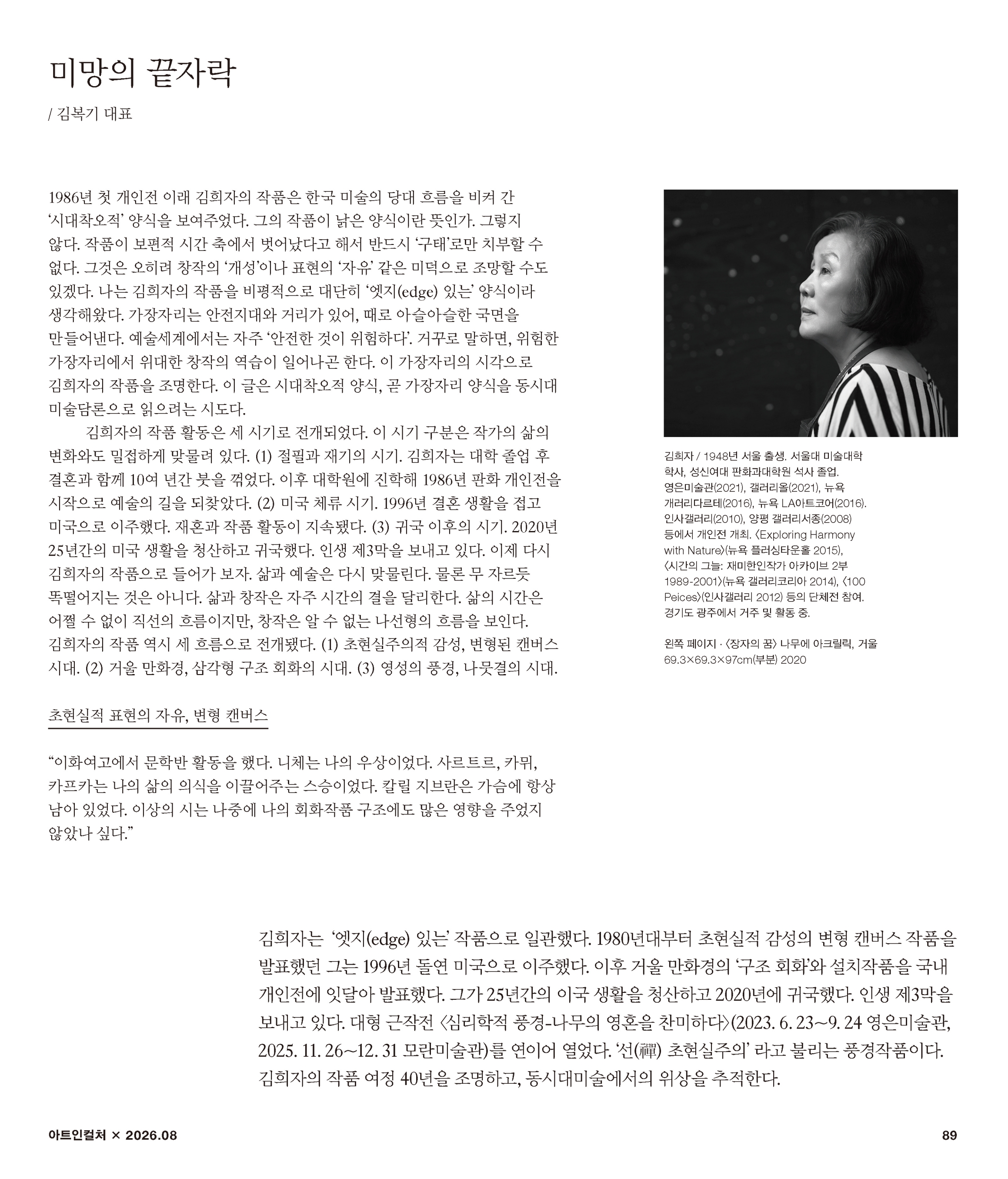
Since her first solo exhibition in 1986, Wheiza Kim’s work has exhibited an “anachronistic” style that has stood apart from the prevailing currents of Korean art. Does this mean that her work is stylistically outdated? Not at all. Just because an artist’s work falls outside the conventional timeline of art history does not mean it should necessarily be dismissed as obsolete. On the contrary, it may be appreciated for such virtues as creative “individuality” and expressive “freedom.” I have long regarded Kim’s work as critically distinctive, possessing a decidedly sharp “edge.”
The edge lies far from any zone of safety and sometimes creates precarious situations. In the world of art, what is “safe” is often dangerous. Conversely, remarkable acts of creation frequently emerge from the perilous margins. It is from this perspective of the edge that I examine Kim’s work. This essay attempts to read her anachronistic style—her art of the margins—through the discourse of contemporary art.
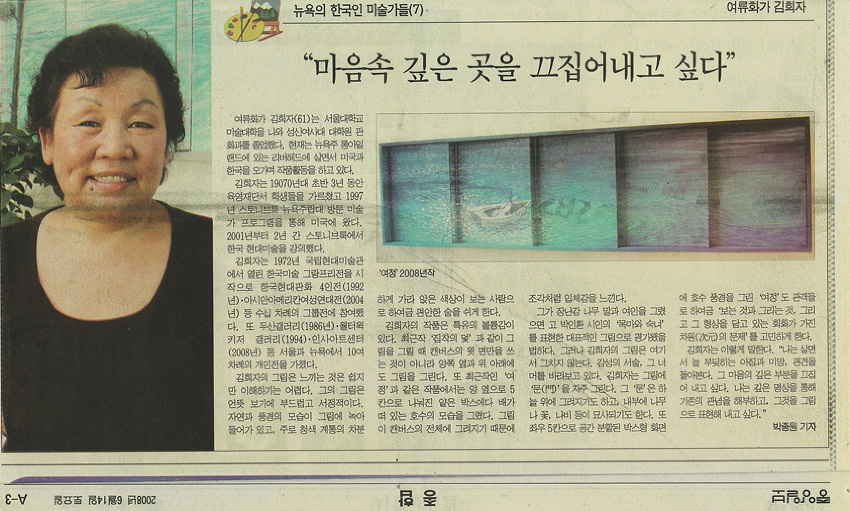
Kim’s artistic career has unfolded in three periods, closely intertwined with changes in her personal life. (1) The period of artistic withdrawal and return. After graduating from university, Kim married and put down her brushes for more than a decade. She subsequently entered graduate school and reclaimed her artistic path, beginning with her first solo exhibition of prints in 1986. (2) The period of residence in the United States. In 1996, she ended her marriage and moved to the United States, where she remarried and continued her artistic practice. (3) The period following her return to Korea. In 2020, she concluded twenty-five years of life in America and returned to Korea, entering the third chapter of her life.
Let us now return to Kim’s work itself. Life and art are intertwined once again, although the relationship is never neatly divided. Life and artistic creation often follow different temporal rhythms. The course of life inevitably proceeds in a linear direction, whereas artistic creation follows an unpredictable spiral. Kim’s work likewise developed through three successive currents: (1) surrealist sensibility and the era of shaped canvases; (2) mirror kaleidoscopes and the era of triangular structural painting; and (3) spiritual landscapes and the era of wood grain.
Freedom of Surrealist Expression: Shaped Canvases
“I was a member of the literary club at Ewha Girls’ High School. Nietzsche was my idol. Sartre, Camus, and Kafka were mentors who guided my understanding of life. Kahlil Gibran always remained close to my heart. I suspect that the poetry of Yi Sang also had a considerable influence on the structure of my paintings later on.”
Throughout her career, Kim has consistently produced works with an “edge.” Having begun presenting shaped canvases imbued with surrealist sensibility in the 1980s, she abruptly moved to the United States in 1996. She subsequently presented a succession of mirror-kaleidoscope “structural paintings” and installations in solo exhibitions in Korea. In 2020, she returned to Korea after twenty-five years abroad and entered the third chapter of her life.
She went on to hold major exhibitions of recent work under the title 《Psychological Scenery: Homage to Tree Soul》 at Youngeun Museum of Contemporary Art (June 23–September 24, 2023) and Moran Museum of Art (November 26–December 31, 2025). These landscape works have been described as “Zen Surrealism.” This essay examines forty years of Kim’s artistic development and traces her position within contemporary art.
Kim originally dreamed of becoming a poet or novelist. Upon entering art school, she was exposed to Western modernism but soon lost interest in the dryness of formalist abstraction. Her first encounter with the art world had begun on the wrong footing. After graduating from university in 1970, she received three selections in the nonfigurative Western painting division of the National Art Exhibition of Korea, beginning in 1973. Black-and-white photographs in the exhibition catalogues document her works 〈The Dwelling of Time〉, 〈Beautiful Story〉, and 〈Image of Copper〉. I have not seen the originals. They contain warp-and-weft structures, labyrinthine lines, and patterned imagery.
Although they do not represent recognizable objects, they evoke abstract images bearing the accumulated traces of time, like woven straw mats or earthen walls. Yet Kim experienced firsthand the severe limitations imposed on women artists within the National Art Exhibition system. “The jurors and professors gave me an unequivocal answer: ‘Awards are useful only for men. For women who will become mothers, they are worthless—a waste of time!’ The path to becoming an artist was effectively closed to women. When I married, I put down my brushes.”¹)
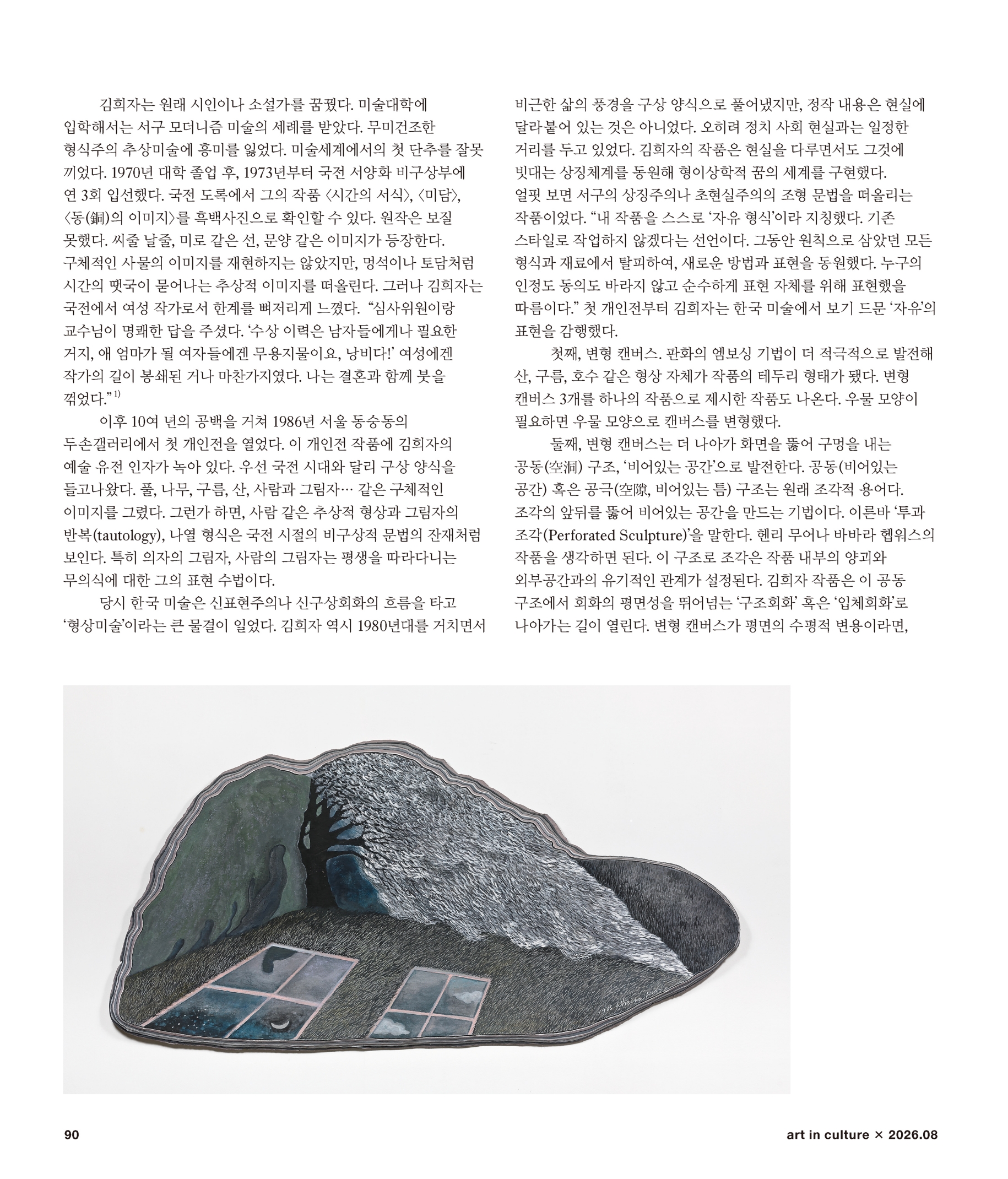
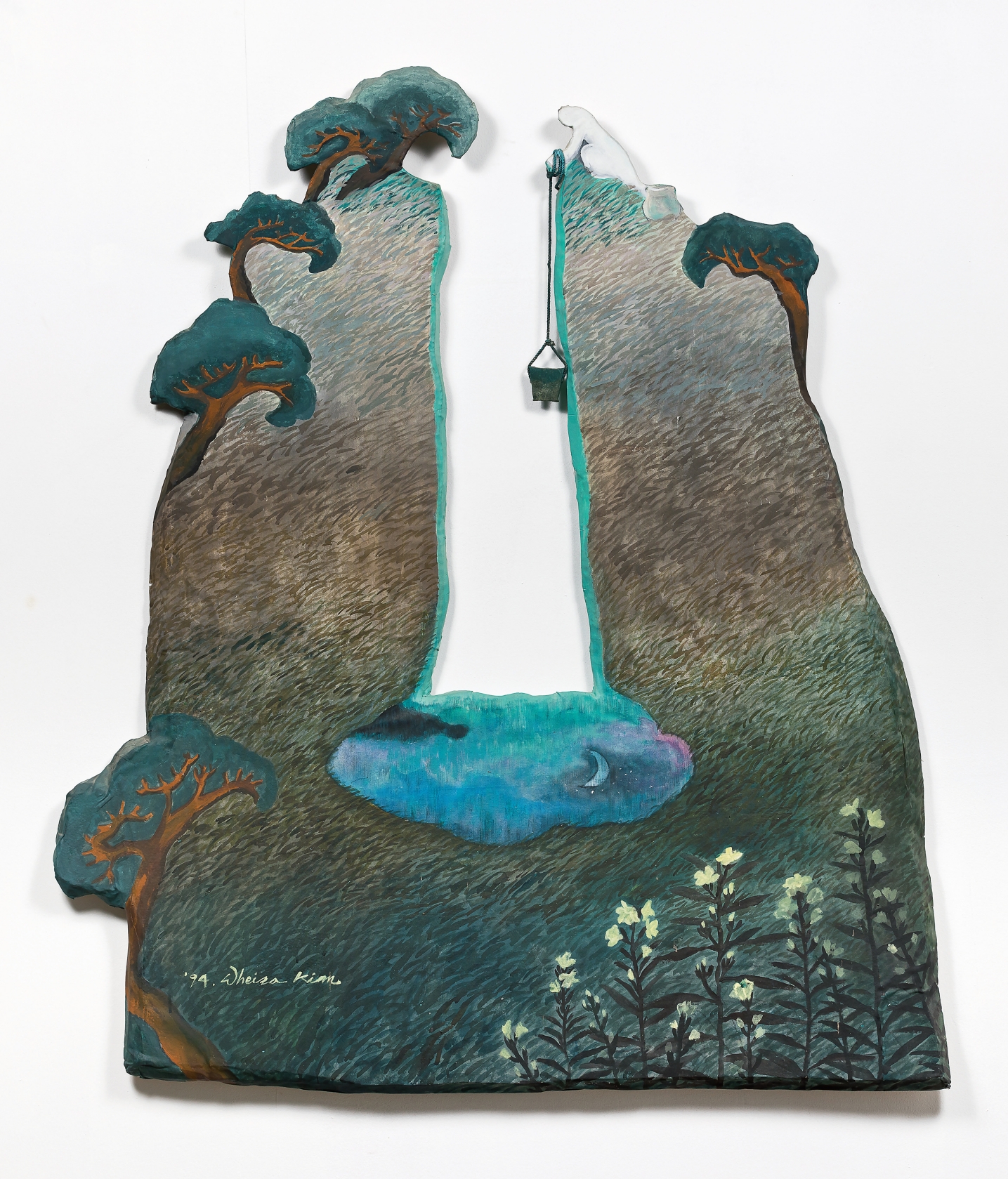
Following a hiatus of more than ten years, Kim held her first solo exhibition at Dooson Gallery in Dongsung-dong, Seoul, in 1986. The artistic DNA of her practice was already embedded in the works shown there. Unlike her earlier National Art Exhibition period, she now adopted a figurative approach, depicting recognizable images such as grass, trees, clouds, mountains, people, and shadows.
At the same time, the repetition and serial arrangement of abstract humanlike forms and their shadows appeared to retain traces of the nonfigurative vocabulary of her earlier work. Shadows cast by chairs and human figures, in particular, became a lifelong means through which she expressed the unconscious.
At the time, Korean art was experiencing a major wave of “figurative art,” influenced by Neo-Expressionism and New Figuration. During the 1980s, Kim also rendered familiar scenes of everyday life in a figurative idiom, but her subject matter was not firmly anchored in immediate reality. Rather, it maintained a certain distance from political and social circumstances. Although her work engaged with reality, it employed a symbolic system through which she constructed a metaphysical world of dreams.
At first glance, her works recalled the formal language of Western Symbolism and Surrealism. “I described my own work as ‘free form.’ It was a declaration that I would no longer work within established styles. I broke away from all the forms and materials I had previously regarded as principles and adopted new methods and modes of expression. I sought neither recognition nor agreement from anyone. I simply expressed myself for the sake of expression itself.” From her very first solo exhibition, Kim pursued a degree of expressive “freedom” rarely encountered in Korean art.
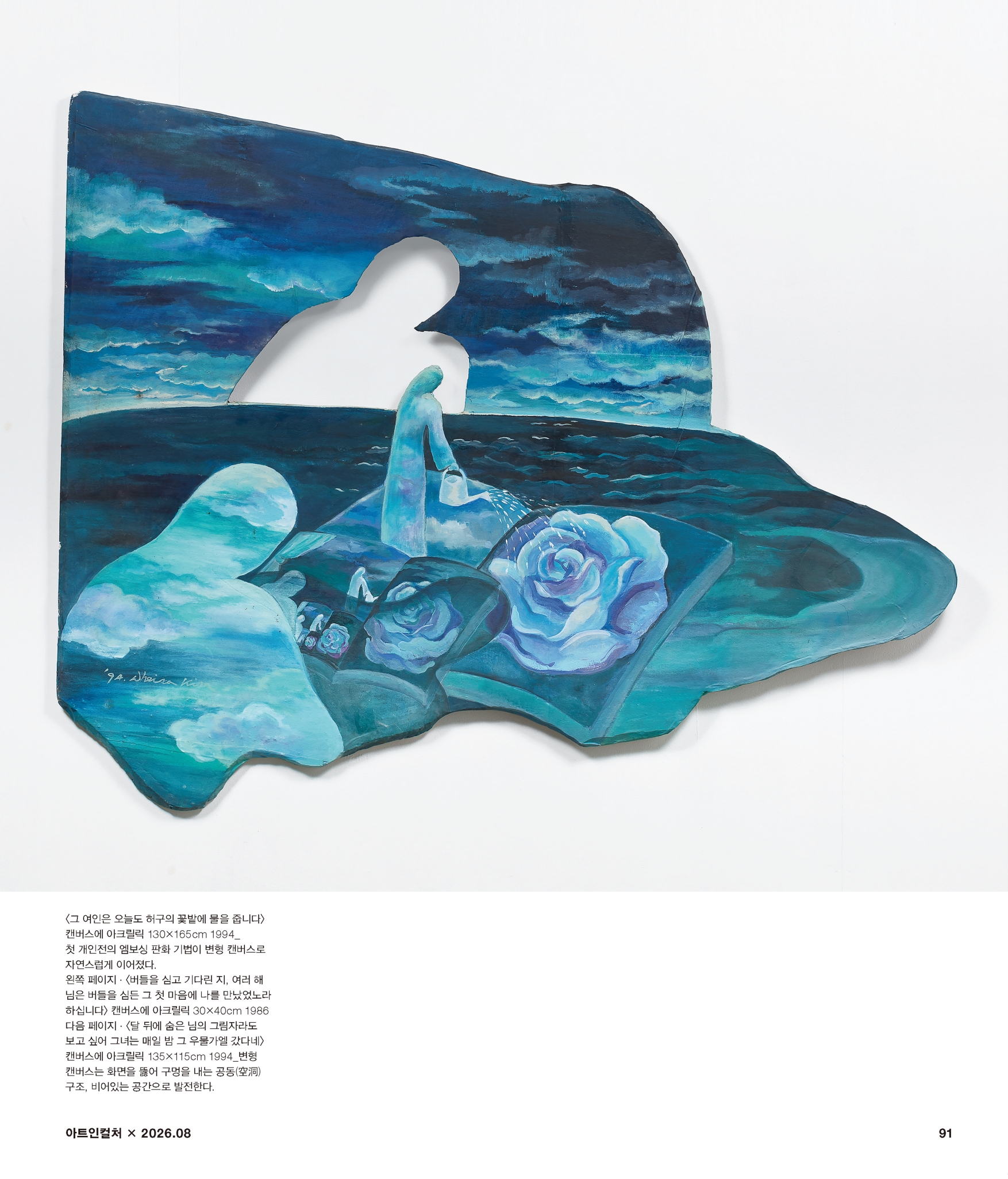
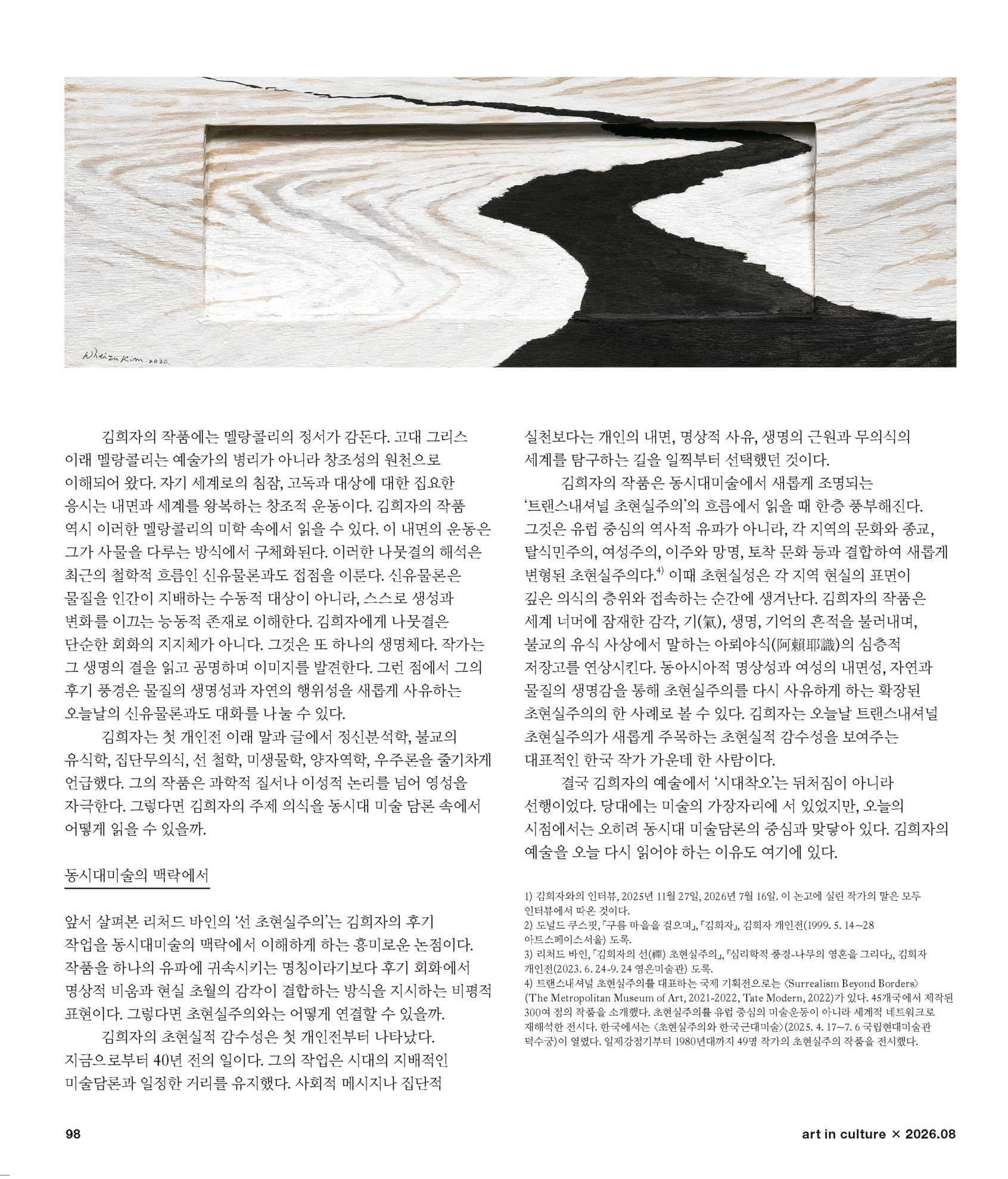
First, the shaped canvas. The embossing techniques of printmaking developed into a more assertive formal language, in which the contours of mountains, clouds, and lakes became the actual outlines of the artworks. Some works combined three shaped canvases into a single composition. When the image called for the shape of a well, she transformed the canvas into the shape of a well.
Second, the shaped canvas developed further into a cavity structure, in which openings were cut through the picture plane to create “empty spaces.” A cavity, or void, and a gap or aperture are concepts originally associated with sculpture. They refer to techniques that create empty spaces by penetrating the front and back of a sculptural form, as in so-called “perforated sculpture.” The works of Henry Moore and Barbara Hepworth provide familiar examples.
Through such structures, an organic relationship is established between the sculptural mass within the work and the space surrounding it. In Kim’s work, these cavities opened a path beyond the flatness of painting toward “structural painting” or “three-dimensional painting.” If the shaped canvas represents a horizontal transformation of the picture plane, the cavity structure constitutes its three-dimensional transformation.
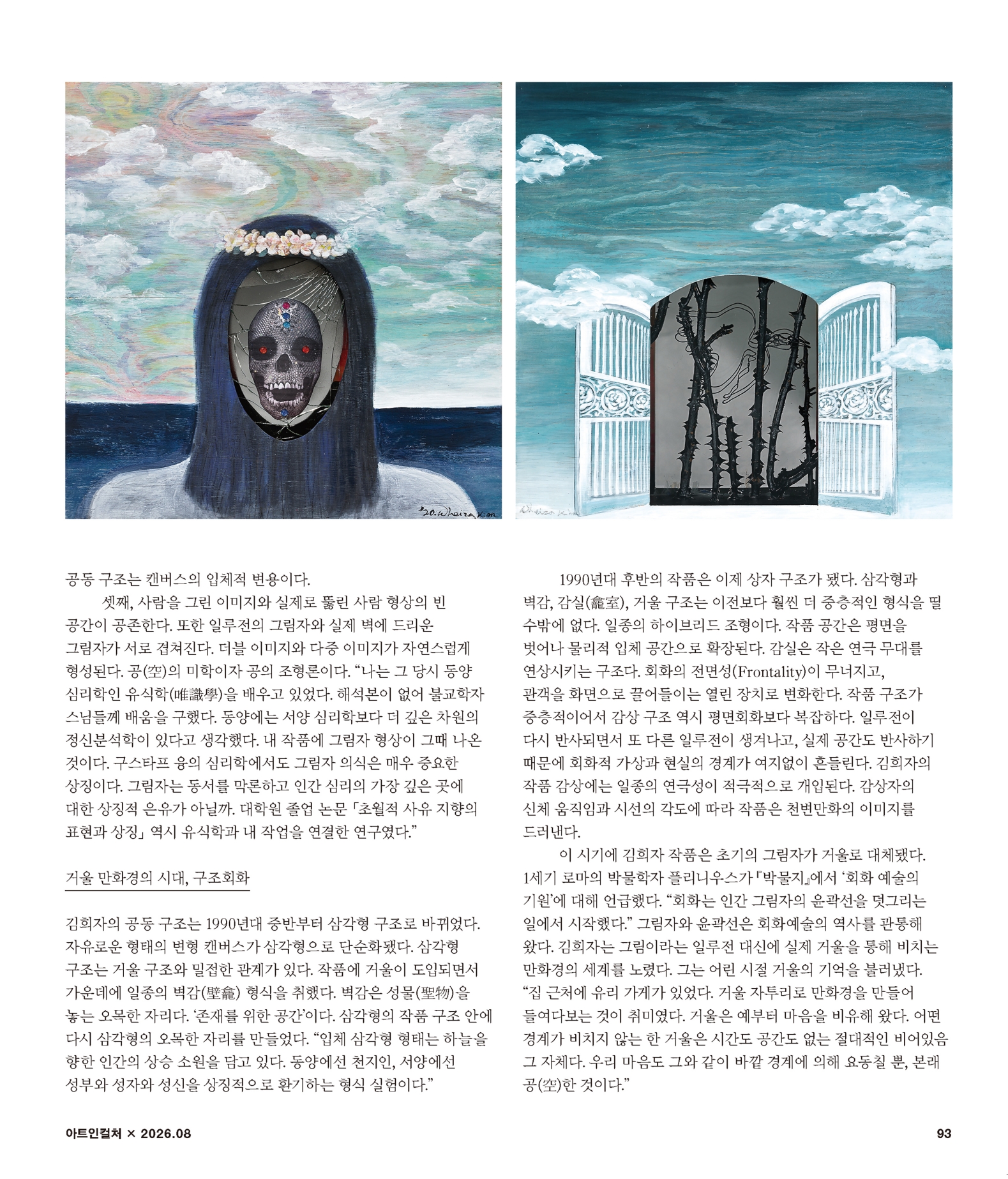
Third, painted images of human figures coexist with actual human-shaped voids cut through the surface. Illusionistic shadows also overlap with shadows cast onto real walls. Double and multiple images arise naturally. This is both an aesthetics and a formal theory of emptiness. “At the time, I was studying Yogācāra (唯識學), which I regarded as ‘Eastern psychology.’ Since no translated texts were available, I sought instruction from Buddhist scholar-monks. I believed that the East possessed a form of psychological analysis operating at a deeper level than Western psychology.
It was then that shadow imagery began to appear in my work. In the psychology of Carl Gustav Jung, the shadow is also a profoundly important symbol. Might the shadow be a symbolic metaphor for the deepest reaches of the human psyche, in both East and West? My graduate thesis, ‘Expression and Symbolism Oriented Toward Transcendental Thought,’ likewise explored the relationship between Yogācāra and my work.”
The Era of Mirror Kaleidoscopes: Structural Painting
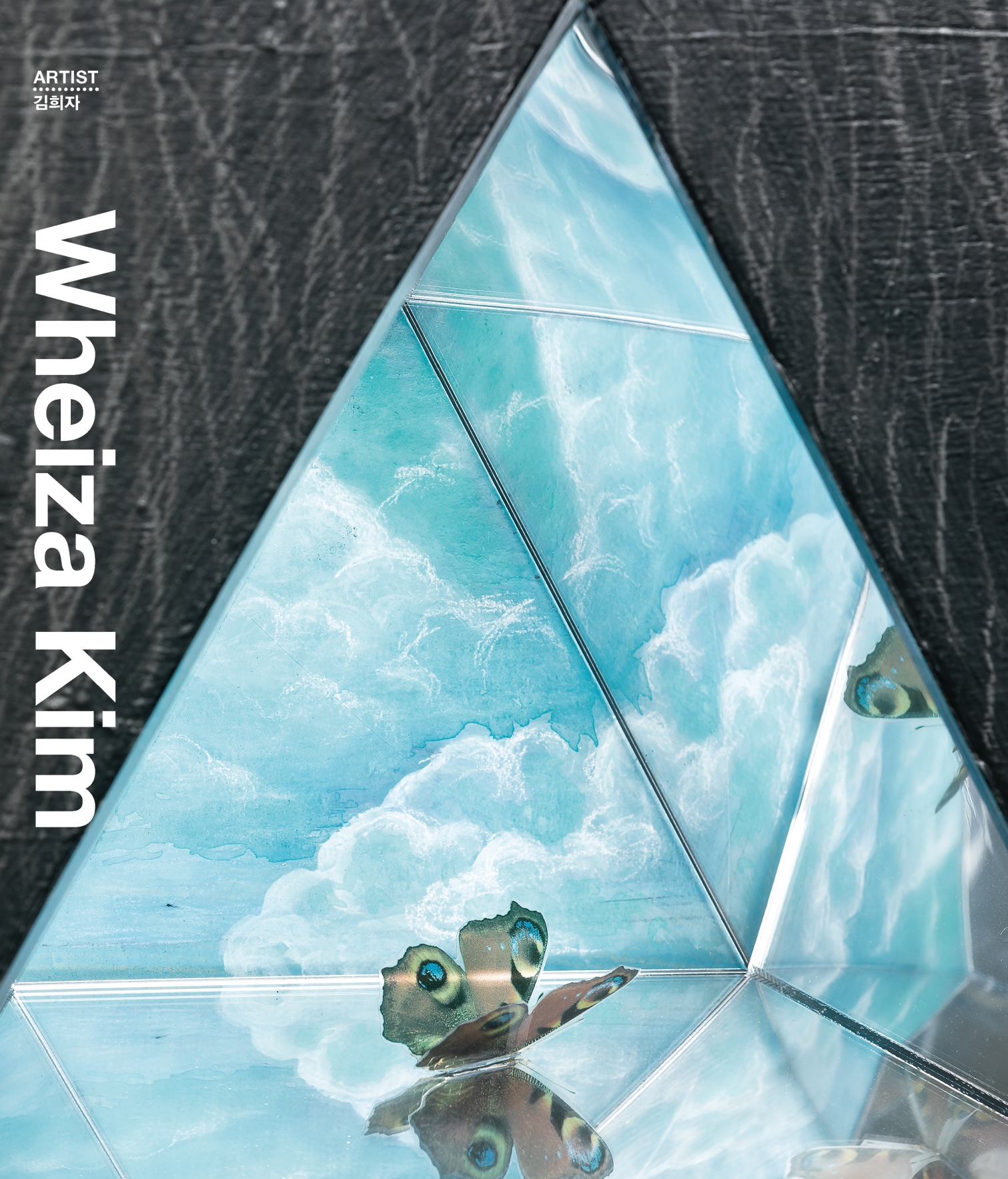
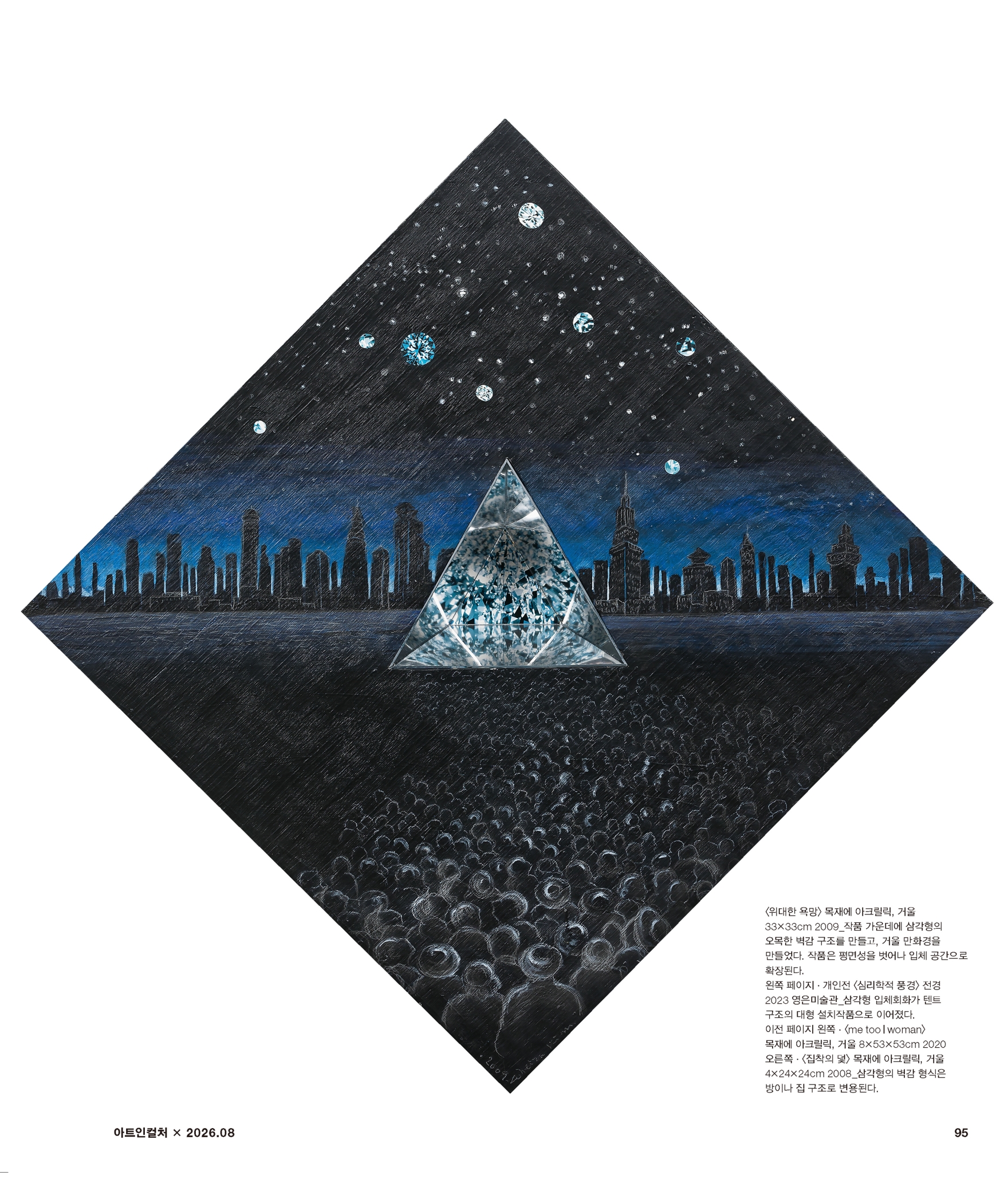
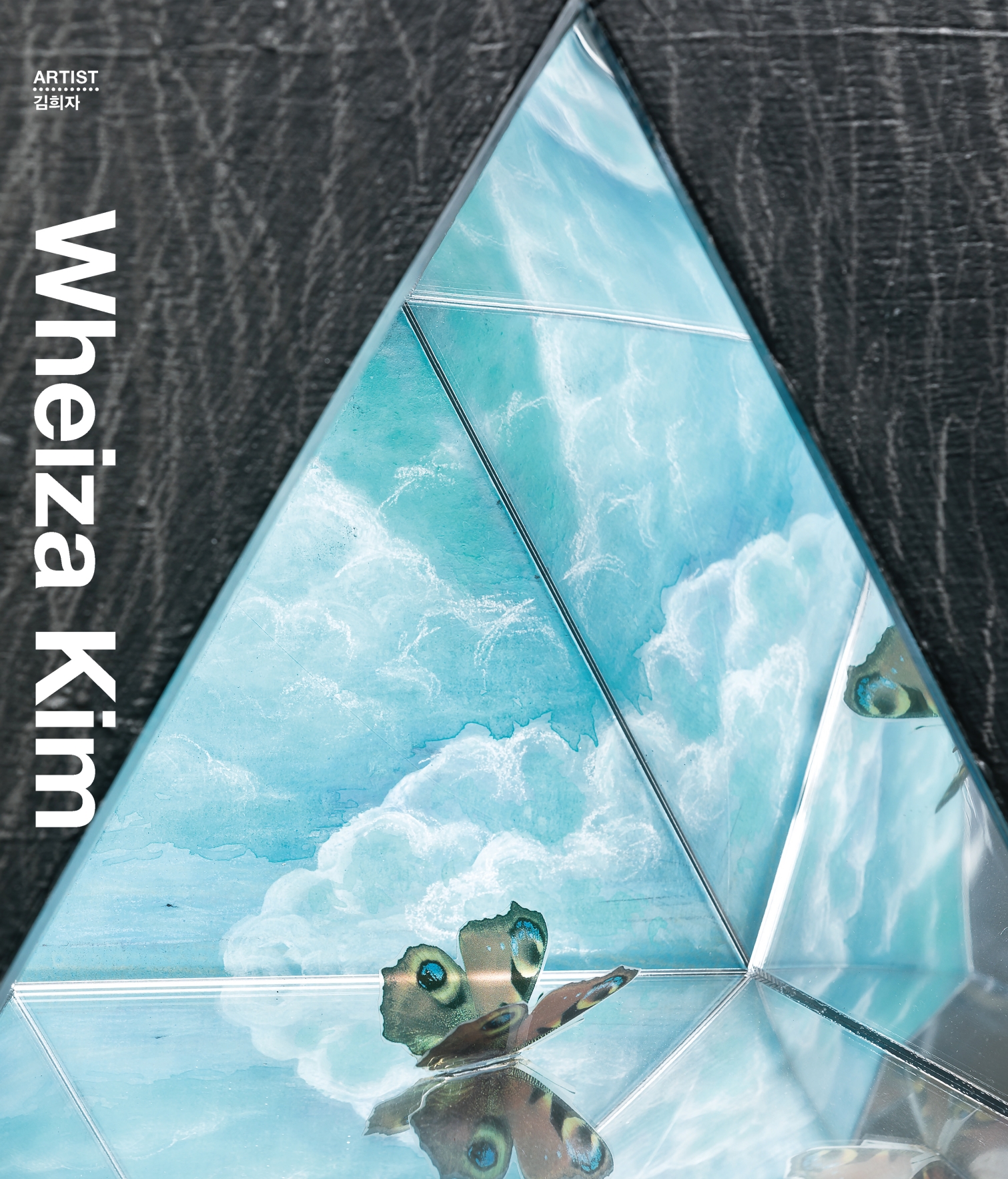
From the mid-1990s onward, the cavity structures in Kim’s work began to evolve into triangular configurations. The freely shaped canvases were simplified into triangles. This triangular structure was closely related to her use of mirrors. As mirrors entered her work, a kind of niche emerged at the center of the composition.
A niche is a recessed space intended to hold a sacred object—a “space for being.” Within the triangular structure of the work, Kim created another triangular recess. “The three-dimensional triangular form embodies the human aspiration to ascend toward heaven. It is a formal experiment that symbolically evokes heaven, earth, and humanity in the East, and the Father, the Son, and the Holy Spirit in the West.”
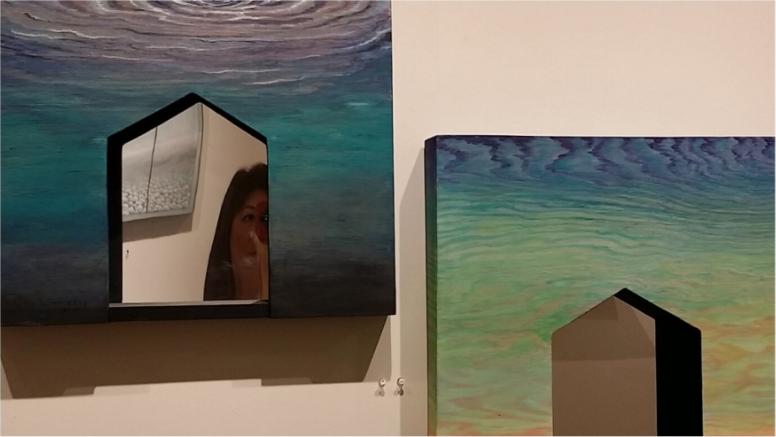
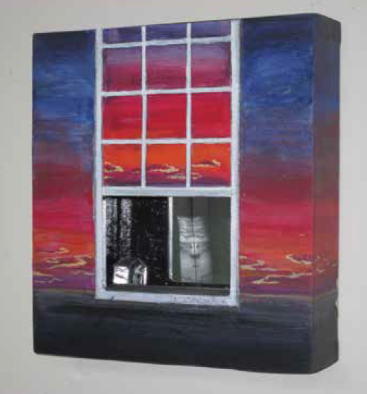
By the late 1990s, her works had developed into box structures. The combination of triangles, niches, recessed chambers, and mirrors inevitably produced far more layered forms than before. These were hybrid constructions of a kind. The pictorial space expanded beyond the flat surface into physical three-dimensional space. The recessed chamber resembled a miniature theatrical stage. The frontality of painting was disrupted, and the work became an open apparatus drawing viewers into the picture.
Because the structures were multilayered, the act of viewing became more complex than in conventional painting. Illusions were reflected to generate further illusions, while reflections of actual space destabilized the boundary between pictorial fiction and reality. A form of theatricality actively entered the experience of Kim’s work. As viewers moved their bodies and changed the angles of their gaze, the works revealed endlessly shifting images.
During this period, mirrors replaced the shadows that had characterized Kim’s early work. Pliny the Elder, the first-century Roman naturalist, discussed the “origin of painting” in his 《Natural History》: “Painting began with the tracing of the outline of a human shadow.” Shadows and outlines have remained fundamental throughout the history of painting. Rather than relying on the illusion of a painted image, Kim sought the kaleidoscopic world revealed through actual mirrors.
She recalled her childhood memories of mirrors. “There was a glass shop near my home. I enjoyed making kaleidoscopes out of scraps of mirror and looking through them. Since ancient times, mirrors have served as metaphors for the mind. Unless something from the external world is reflected in them, mirrors are absolute emptiness itself, without time or space. Our minds are likewise originally empty (空), disturbed only by the external conditions they encounter.”
The small works based on the niche format grew in scale and took on diverse forms. Kim painted images on their surfaces and constructed three-dimensional boxes that produced further reflections. She treated surfaces and interiors, inside and outside, in different ways. By combining unexpected images within and around the niches, she sought visual shock. This resembled the Surrealist technique of dépaysement.
At times, the viewer’s face was reflected in the mirror and appeared to be drawn into the artwork. Kim sought an interactive relationship between the work and its audience. The triangular structures subsequently developed into rectangular three-dimensional forms, while the niches were transformed into shapes resembling doors or houses. These three-dimensional works naturally increased in scale.
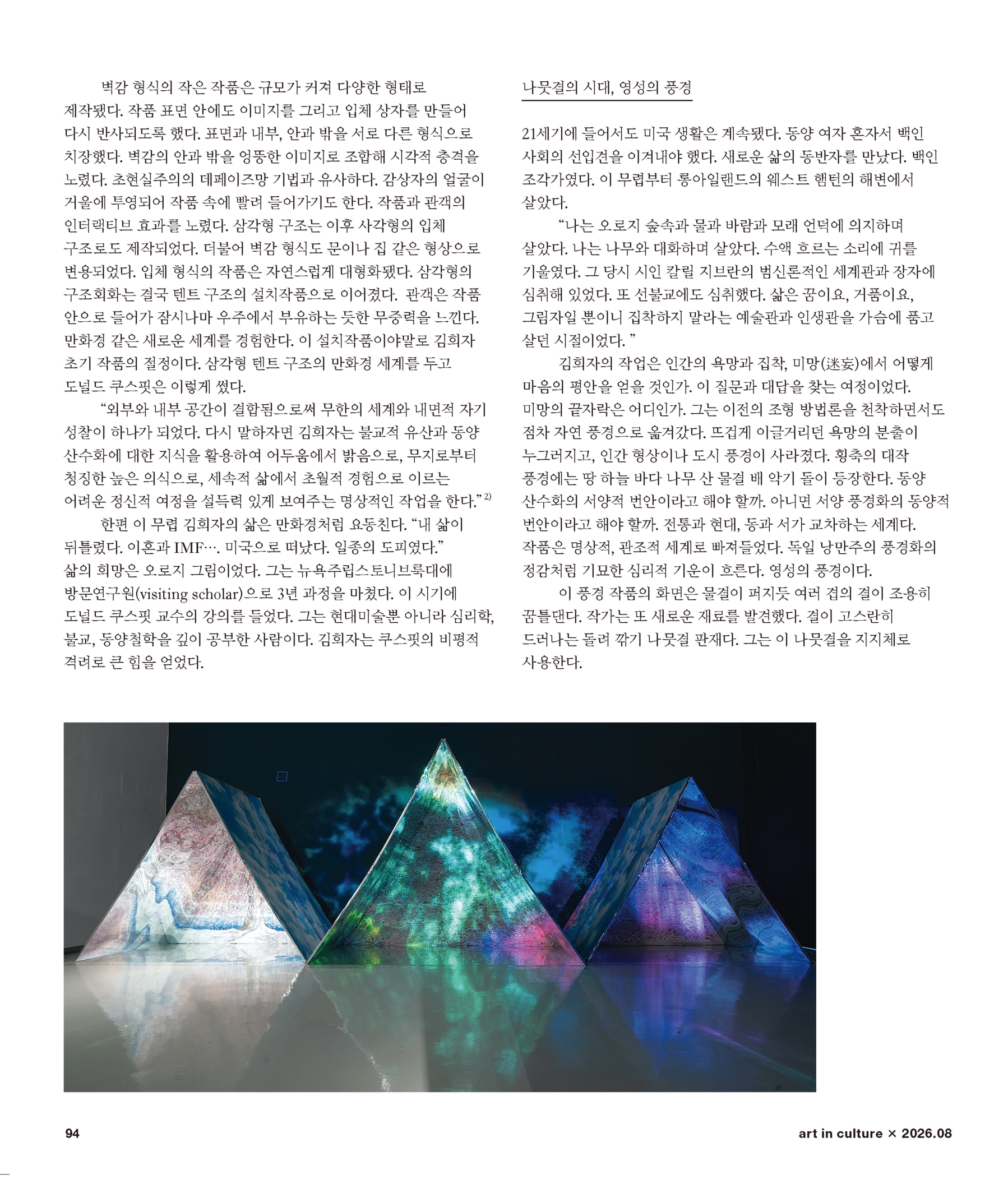
Ultimately, triangular structural painting evolved into tent-like installations. Viewers could enter the works and, for a moment, experience a sensation of weightlessness, as though floating in the universe. They encountered a new world resembling a kaleidoscope. These installations represent the culmination of Kim’s early practice. Writing about the kaleidoscopic world of her triangular tent structures, Donald Kuspit observed:
“Through the union of exterior and interior space, the infinite world and inward self-reflection became one. In other words, drawing on her Buddhist heritage and her knowledge of East Asian landscape painting, Kim creates meditative works that convincingly convey the difficult spiritual journey from darkness to light, from ignorance to a higher state of clear consciousness, and from secular life to transcendental experience.”²)
Meanwhile, Kim’s own life was undergoing kaleidoscopic upheaval. “My life became twisted. Divorce, the IMF crisis… I left for America. It was a kind of escape.” Painting remained her only hope. She completed a three-year program as a visiting scholar at the State University of New York at Stony Brook. During this period, she attended lectures by Professor Donald Kuspit, who had studied not only contemporary art but also psychology, Buddhism, and Eastern philosophy in depth. Kim drew considerable strength from Kuspit’s critical encouragement.
The Era of Wood Grain: Spiritual Landscapes
Kim continued living in the United States into the twenty-first century. As an Asian woman living on her own, she had to overcome prejudices within predominantly white society. She met a new life partner, a white sculptor. Around this time, she began living near the beaches of Westhampton on Long Island.
“I lived relying solely on the forests, water, wind, and sand dunes. I lived in conversation with trees. I listened to the sound of sap flowing through them. At the time, I was deeply immersed in the pantheistic worldview of the poet Kahlil Gibran and in the philosophy of Zhuangzi. I was also devoted to Zen Buddhism. It was a period when I embraced an understanding of art and life that urged me not to cling to things, for life is nothing but a dream, a bubble, and a shadow.”
Kim’s artistic practice has been a journey in search of an answer to a fundamental question: How can one attain peace of mind amid human desire, attachment, and delusion (迷妄)? Where does delusion come to an end? While continuing to explore her earlier formal methods, she gradually turned toward natural landscapes. The once-intense eruptions of desire subsided, and human figures and urban scenes disappeared. Her large horizontal landscapes came to feature earth, sky, sea, trees, mountains, waves, boats, musical instruments, and stones.
Should we call them Western reinterpretations of East Asian landscape painting? Or Eastern reinterpretations of Western landscape painting? They constitute a world in which tradition and modernity, East and West, intersect. Her work moved increasingly toward a meditative and contemplative realm. Like the emotional atmosphere of German Romantic landscape painting, a strange psychological presence permeates these scenes. They are spiritual landscapes.
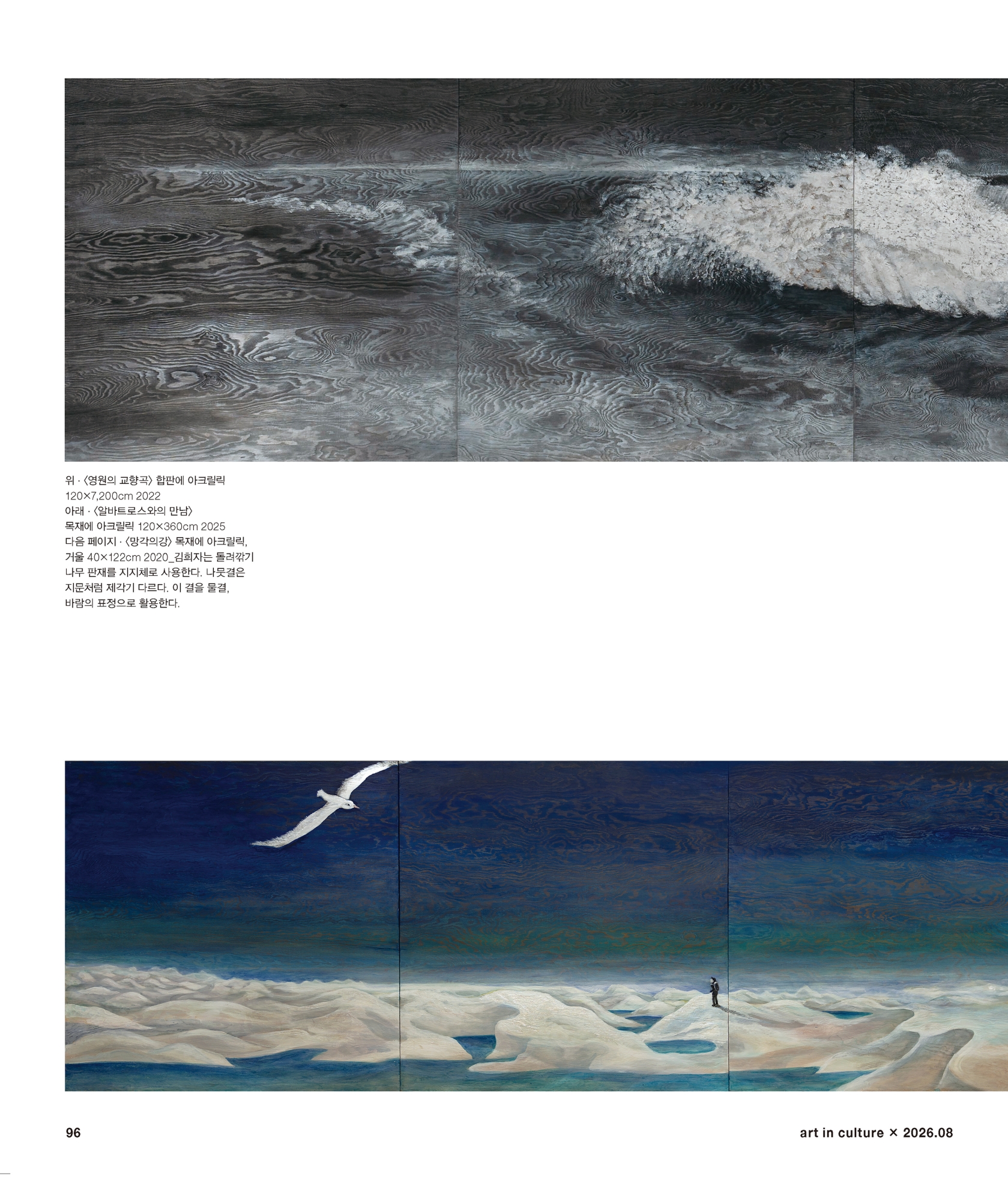
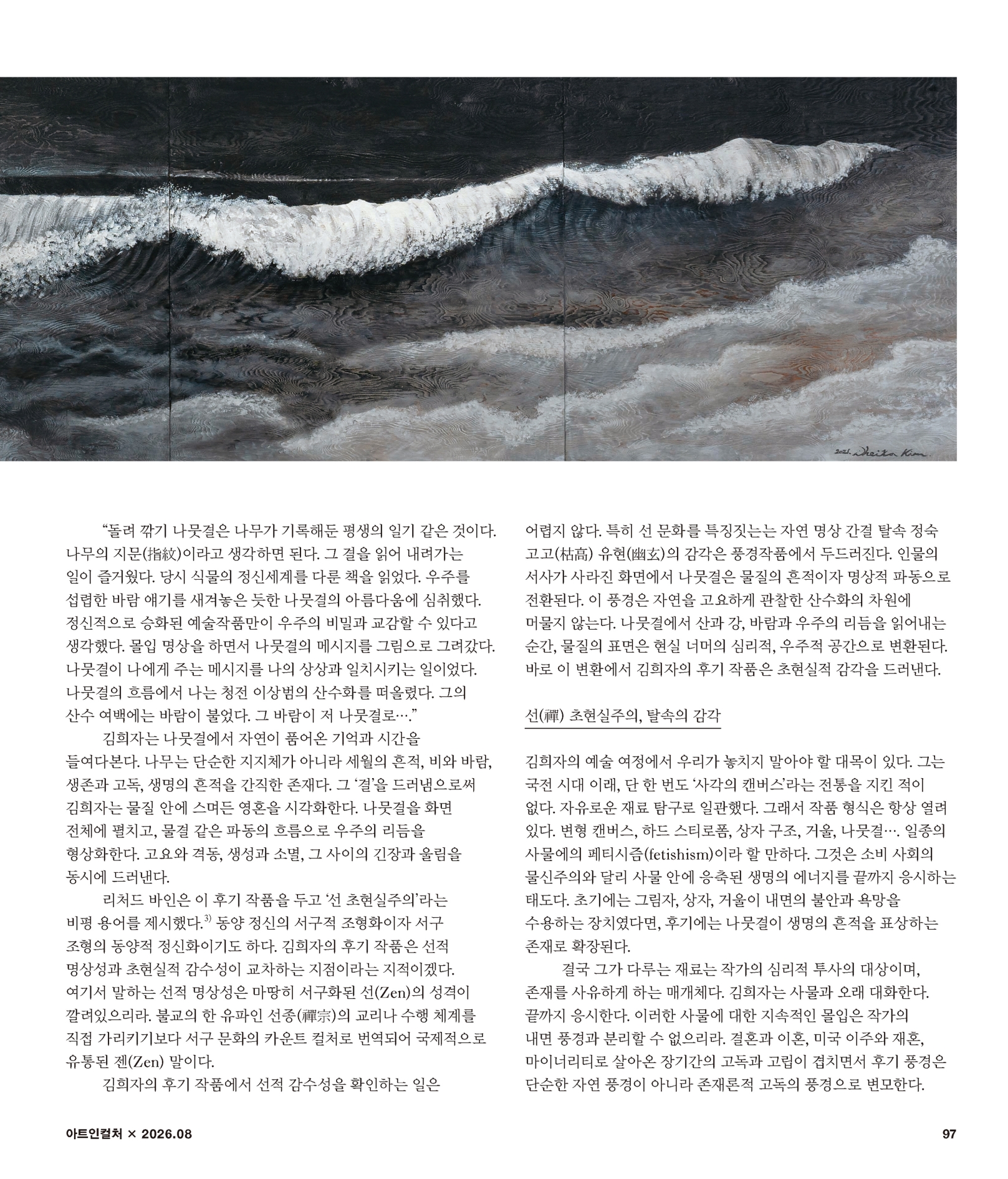
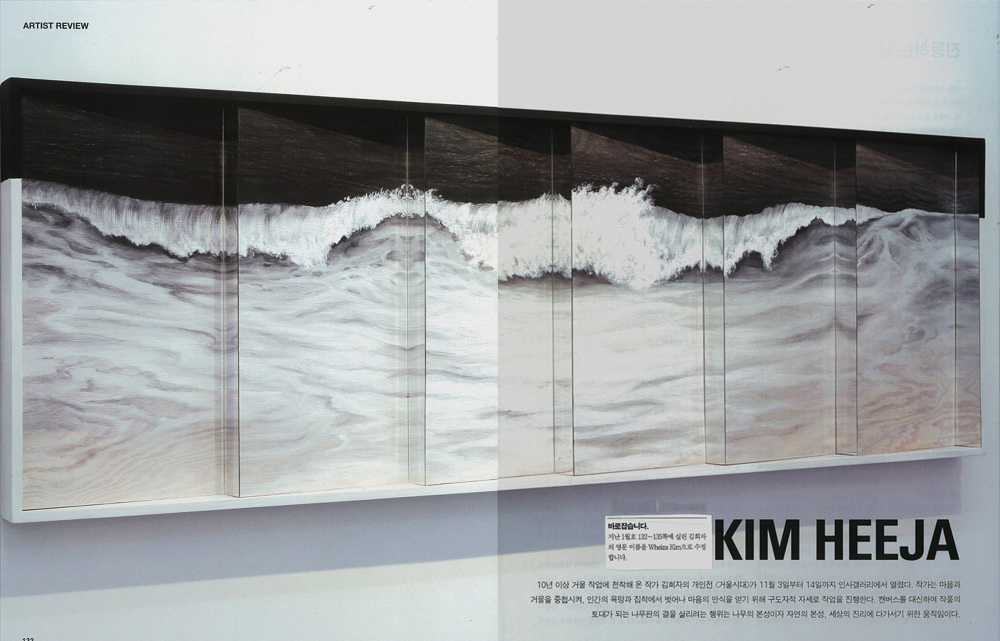
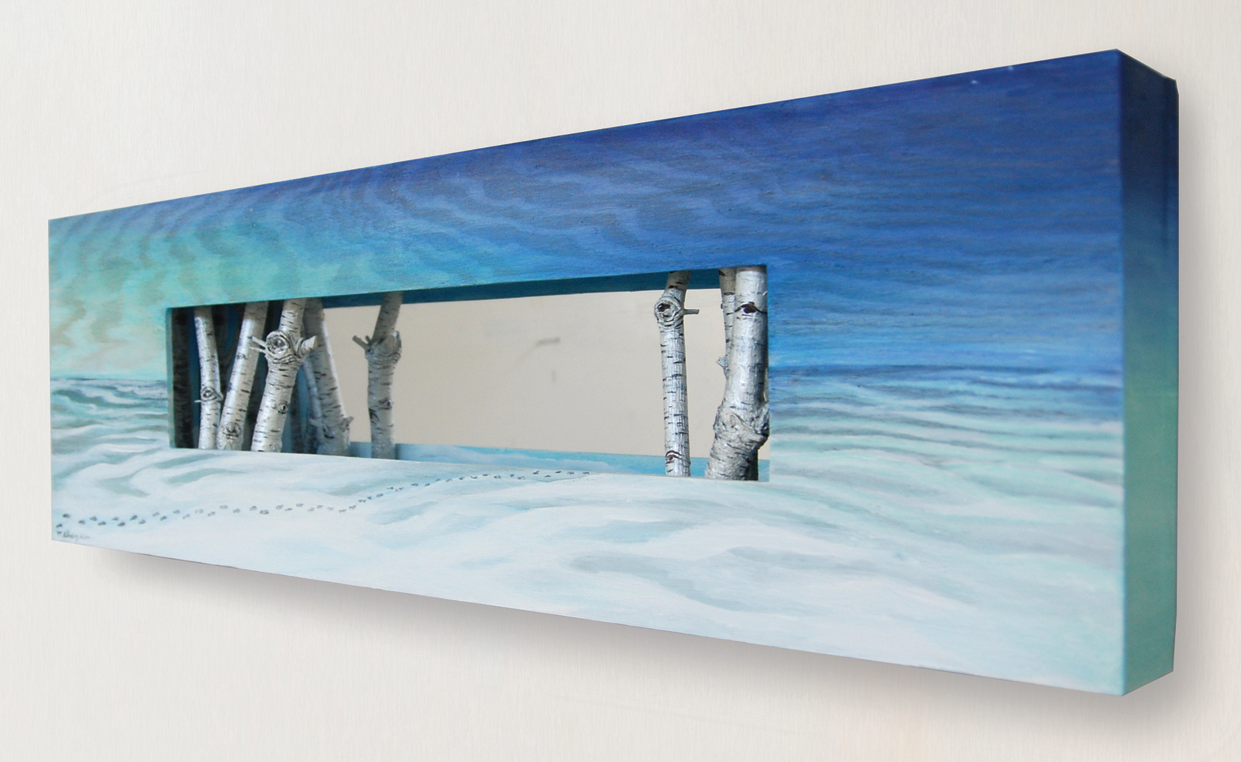
Across the surfaces of these landscape works, multiple layers of texture quietly undulate, like ripples spreading across water. Kim also discovered a new material: rotary-cut wood veneer, in which the natural grain remains fully visible. She began using this wood grain as a painting support.
“Rotary-cut wood grain is like a lifelong diary recorded by a tree. You might think of it as the tree’s fingerprint. I enjoyed reading the patterns of its grain. At the time, I was reading a book about the spiritual world of plants. I became fascinated by the beauty of wood grain, which seemed to have inscribed within it stories told by winds that had traversed the universe. I believed that only works of art elevated to a spiritual level could commune with the mysteries of the universe.
Through immersive meditation, I translated the messages of wood grain into paintings. It was a process of aligning the messages that the grain conveyed to me with my imagination. In the flowing patterns of wood grain, I recalled the landscape paintings of Lee Sang-beom, known as Cheongjeon. The wind blew through the empty spaces of his landscapes. That wind, into the grain of those trees…”
Through wood grain, Kim contemplates the memories and time preserved within nature. A tree is not merely a support for painting but a living presence that retains the traces of passing years, rain and wind, survival and solitude, and the marks of life itself. By revealing its “grain,” Kim visualizes the spirit permeating matter. She extends the patterns of wood grain across the entire pictorial surface, giving form to the rhythms of the universe through wave-like movements. Stillness and turbulence, generation and extinction, and the tensions and resonances between them emerge simultaneously.
Richard Vine proposed the critical term “Zen Surrealism” to describe these later works.³) They may be understood as a Western formal articulation of Eastern spirituality, or conversely, as an Eastern spiritual reinterpretation of Western artistic form. His formulation suggests that Kim’s later works occupy an intersection between Zen meditation and surrealist sensibility.
The Zen meditativeness referred to here presumably carries the characteristics of a Westernized understanding of Zen. Rather than referring directly to the doctrines or practices of the Chan/Seon school of Buddhism, it denotes Zen as translated into Western counterculture and circulated internationally.
It is not difficult to identify a Zen sensibility in Kim’s later work. Qualities associated with Zen culture—meditation on nature, simplicity, detachment from worldly concerns, quietude, austere refinement (枯高), and subtle profundity (幽玄)—are especially prominent in her landscapes. As human narratives disappear from the picture plane, wood grain is transformed from a material trace into a meditative vibration.
These landscapes do not remain within the conventional realm of landscape painting as the tranquil observation of nature. At the moment when mountains, rivers, wind, and cosmic rhythms are discerned in the grain of wood, the material surface becomes a psychological and cosmic space extending beyond visible reality. It is precisely through this transformation that Kim’s later works reveal their surrealist sensibility.
Zen Surrealism: A Sensibility of Transcendence
There is an important aspect of Kim’s artistic journey that should not be overlooked. Since the period of the National Art Exhibition, she has never adhered to the tradition of the “rectangular canvas.” Her practice has consistently been characterized by free experimentation with materials. Consequently, her artistic forms have always remained open. Shaped canvases, rigid Styrofoam, box structures, mirrors, wood grain… One might describe this as a kind of fetishism toward objects.
Unlike the commodity fetishism of consumer society, however, it represents an attitude of sustained attention to the life energy condensed within things. Whereas shadows, boxes, and mirrors initially served as devices accommodating inner anxiety and desire, wood grain later emerged as a material embodiment of the traces of life.
Ultimately, the materials Kim employs are objects of psychological projection and mediators through which she contemplates existence. She enters into prolonged dialogue with things, observing them to the very end. This sustained immersion in objects cannot be separated from the landscapes of her inner life. Marriage and divorce, migration to the United States and remarriage, and the prolonged solitude and isolation of living as a minority overlap, transforming her later landscapes from simple representations of nature into landscapes of existential solitude.
An atmosphere of melancholy permeates Kim’s work. Since ancient Greece, melancholy has been understood not merely as a pathology of the artist but also as a source of creativity. Withdrawal into one’s own world, solitude, and persistent contemplation of an object constitute a creative movement between the inner self and the external world. Kim’s work can likewise be read through this aesthetics of melancholy. Such inward movement becomes concrete in the way she engages with materials. Her interpretation of wood grain also intersects with the recent philosophical current of new materialism.
New materialism understands matter not as a passive object dominated by human beings but as an active entity capable of generating and undergoing change. For Kim, wood grain is not simply a support for painting. It is another living being. The artist reads and resonates with the patterns of its life, discovering images within them. In this respect, her later landscapes can enter into dialogue with contemporary new materialist thought, which reconsiders the vitality of matter and the agency of nature.
Since her first solo exhibition, Kim has repeatedly referred in her writings and statements to psychoanalysis, Buddhist Yogācāra philosophy, the collective unconscious, Zen philosophy, microbiology, quantum mechanics, and cosmology. Her work stimulates spiritual awareness beyond scientific order or rational logic. How, then, might we interpret the thematic concerns of Kim’s art within the discourse of contemporary art?
In the Context of Contemporary Art
Richard Vine’s concept of “Zen Surrealism,” discussed above, offers an intriguing point of departure for understanding Kim’s later work within contemporary art. Rather than assigning her practice to a particular artistic school, the term serves as a critical expression identifying how meditative emptiness and a sense of transcendence beyond reality converge in her later paintings. How, then, might her work be connected to Surrealism?
Kim’s surrealist sensibility was evident from her first solo exhibition, forty years ago. Her practice maintained a certain distance from the dominant artistic discourses of her time. Rather than pursuing social messages or collective artistic action, she chose early on to investigate the individual psyche, meditative thought, the origins of life, and the realm of the unconscious.
Kim’s work acquires greater richness when read in relation to “transnational Surrealism,” a current receiving renewed attention in contemporary art. This is not a historically defined movement centered on Europe, but a transformed and expanded understanding of Surrealism shaped through its encounters with regional cultures and religions, postcolonialism, feminism, migration and exile, and Indigenous traditions.⁴) Within this framework, the surreal emerges at moments when the surface of local realities connects with deeper layers of consciousness.
Kim’s work evokes sensations, qi (氣), life, and traces of memory latent beyond the visible world, recalling the deep repository of consciousness associated with ālayavijñāna (阿賴耶識), or storehouse consciousness, in Buddhist Yogācāra thought. Her practice may be understood as an instance of expanded Surrealism that invites us to reconsider the movement through East Asian meditativeness, women’s interiority, and the vitality of nature and matter. Kim is among the representative Korean artists whose work embodies the surrealist sensibility now receiving renewed attention within transnational Surrealism.
Ultimately, the “anachronism” of Kim’s art was not a sign of belatedness but of anticipation. Although she stood at the margins of the art world in her own time, her work now intersects with the central concerns of contemporary art discourse. This is precisely why Wheiza Kim’s art deserves to be read anew today.
Notes
1) Interviews with Wheiza Kim, November 27, 2025, and July 16, 2026. All statements by the artist quoted in this essay are drawn from these interviews.
2) Donald Kuspit, “Cloud Pole Ville,” in 《Wheiza Kim》, exhibition catalogue for Wheiza Kim’s solo exhibition, Art Space Seoul, May 14–28, 1999.
3) Richard Vine, “Wheiza Kim’s Zen Surrealism,” in 《Psychological Scenery: Homage to Tree Soul》, exhibition catalogue for Wheiza Kim’s solo exhibition, Youngeun Museum of Contemporary Art, June 24–September 24, 2023.
4) A major international exhibition representing transnational Surrealism was 《Surrealism Beyond Borders》, held at The Metropolitan Museum of Art (2021–2022) and Tate Modern (2022). Featuring approximately 300 works produced in 45 countries, the exhibition reinterpreted Surrealism not as a Europe-centered artistic movement but as a global network. In Korea, 《Surrealism and Korean Modern Art》 was held at the National Museum of Modern and Contemporary Art, Korea, Deoksugung, from April 17 to July 6, 2025, presenting Surrealist works by 49 artists spanning the Japanese colonial period through the 1980s.