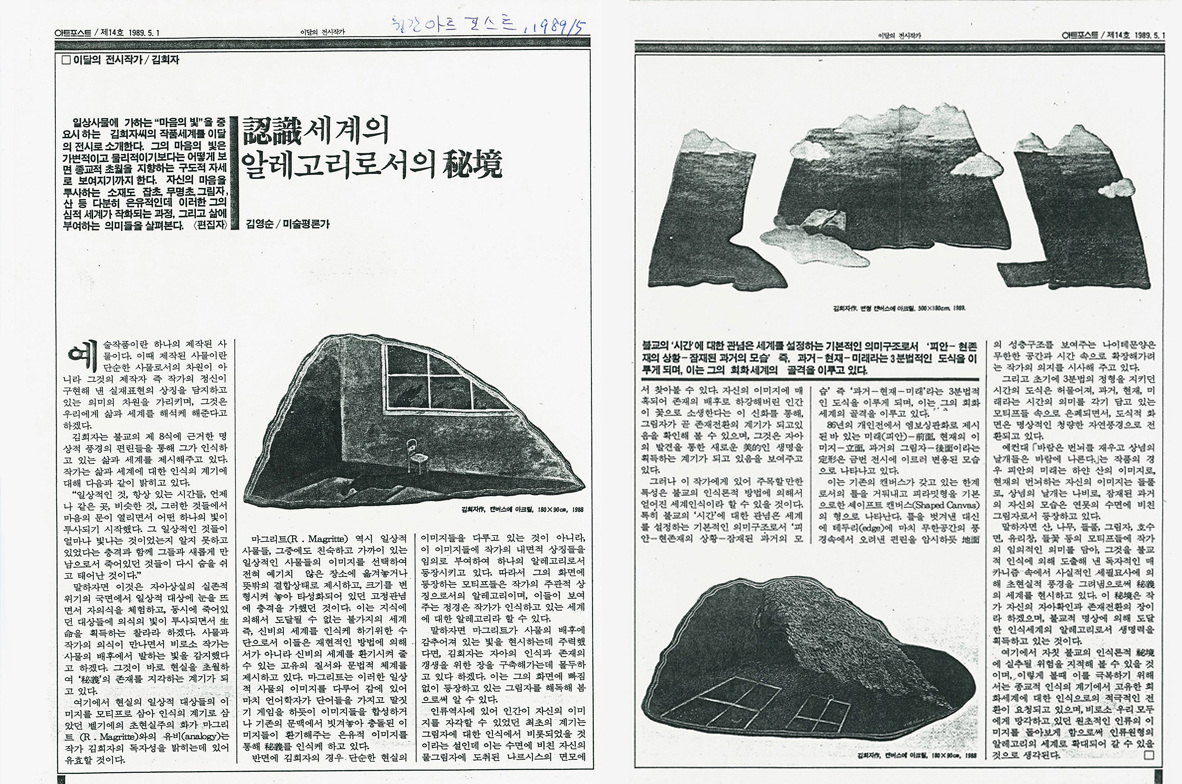
Press
1989.05.01
Kim Young-soon | Art Critic
Wheiza Kim's artistic world, which places
particular importance on the "light of the mind" cast upon everyday
objects, is introduced in this month's exhibition. Rather than being mutable or
physical in nature, this light of the mind may be understood as reflecting a
spiritual quest directed toward religious transcendence. The motifs onto which
she projects her mind—including weeds, nameless grasses, shadows, and mountains—are
highly metaphorical. This article examines the process through which her inner
world is transformed into pictorial form, as well as the meanings she
attributes to life. (Editor's Note)
A work of art is an object that has been
created. Yet such a created object does not exist merely on the level of a
physical thing. Rather, it possesses a dimension of meaning that embodies the
symbolic expression of the maker's spirit—that is, the artist's consciousness.
In this sense, a work of art enables us to interpret life and the world.
Through fragments of meditative landscapes
grounded in the Buddhist concept of the eighth consciousness, Wheiza Kim
presents the life and world as she perceives them. The artist describes the
moment that awakened her awareness of life and the world as follows:
"Everyday things, the passage of time
that is always there, places that always seem the same, and familiar things
resembling one another—through these, the door of my mind began to open, and a
certain light began to shine upon them. I was struck by the realization that I
had never known how radiant these ordinary things were. Through encountering
them anew, things that had seemed lifeless began to breathe and come alive
again."
In other words, at a moment of existential
crisis marked by the loss of self, the artist awakens to ordinary objects and
experiences self-consciousness. At the same time, as the light of consciousness
is projected onto previously lifeless objects, they acquire life (生命). Through the encounter between objects and the artist's
consciousness, she comes to perceive the light emanating from behind their
visible appearances. This becomes the occasion for transcending phenomena and
recognizing the existence of esoteric meaning (秘義).
In this context, an analogy with the
Belgian Surrealist painter René Magritte, who employed images of ordinary
objects as motifs and as occasions for perception, may prove useful in
clarifying the distinctive character of Wheiza Kim's work.
Magritte likewise selected images of
everyday objects, particularly those that were familiar and close at hand, and
placed them in entirely unexpected settings, presented them in surprising
combinations, or altered their scale, thereby challenging habitual assumptions
and established conventions. These strategies served as means of bringing into
awareness an unknowable realm that could not be reached through knowledge alone—that
is, a world of mystery.
Rather than representing this mysterious world directly,
his works established their own order and grammatical system capable of evoking
it. In his treatment of everyday imagery, Magritte combined images or displaced
them from their conventional contexts, much as a linguist might engage in a
word game. Through the metaphorical images evoked by these layered
combinations, he made esoteric meanings (秘義)
perceptible.
In Kim's case, however, she does not simply
deal with images drawn from reality. Instead, she arbitrarily assigns symbols
from her inner world to these images, allowing them to emerge as allegories.
Consequently, the motifs appearing in her paintings function as allegories of
the artist's subjective symbolism, while the scenes they present may be
understood as allegories of the world as she perceives it.
In other words, whereas Magritte
concentrated on making manifest the light concealed behind objects, Kim is
concerned with constructing a realm for self-awareness and the renewal of
existence. This becomes apparent when we examine the shadows that appear
consistently throughout her paintings.
The Buddhist conception of time
serves as a fundamental semantic structure through which the world is
conceived, forming a tripartite schema of “the other shore—the condition of
present existence—the latent image of the past,” that is, past, present, and
future. This schema constitutes the underlying framework of her pictorial
world.
One theory holds that the earliest occasion
on which human beings became aware of their own image arose through the
recognition of shadows. This idea may be considered in relation to the myth of
Narcissus, who became captivated by his own reflection on the surface of water.
Through this myth, in which a man enchanted by his own image descends beyond
the realm of existence and is reborn as a flower, we may recognize the shadow
as an occasion for existential transformation. It also suggests that the discovery
of the self can become a means of recovering a new form of aesthetic life (美的).
What deserves particular attention in Kim's
work, however, is her perception of the world as derived from Buddhist
epistemological thought. In particular, the Buddhist conception of time serves
as a fundamental structure of meaning through which her pictorial world is
organized. The threefold schema of "the other shore—the condition of
present existence—the latent image of the past," or "past–present–future,"
forms the underlying framework of her paintings.
In her 1986 solo exhibition, this
established configuration was presented through embossed prints: the future, or
the other shore (彼岸), on the front surface (前面); the image of the present on the standing plane (立面); and the shadow of the past on the reverse surface (後面). By the time of the present exhibition, however, this
configuration has undergone a transformation.
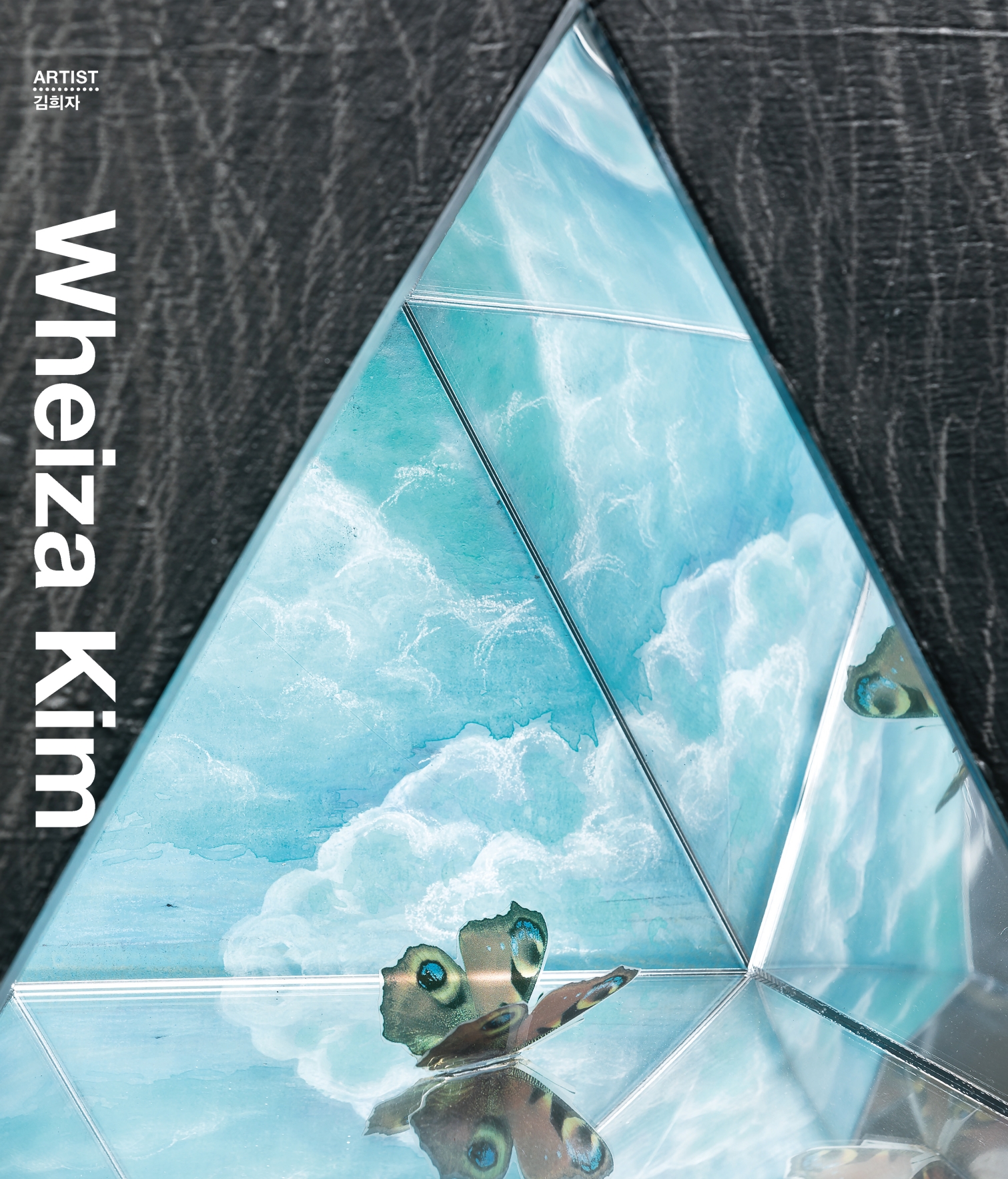
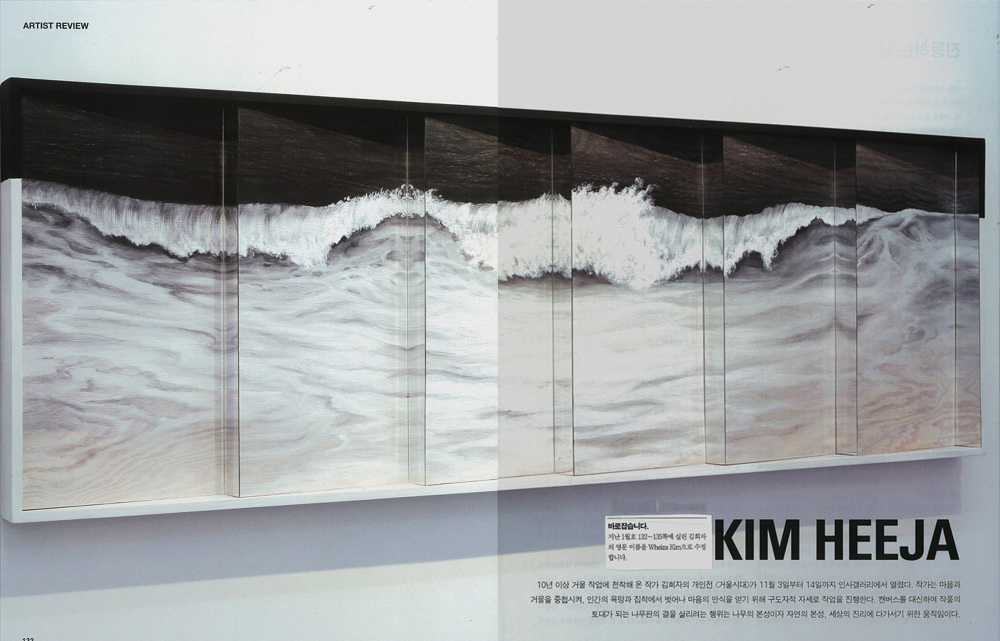
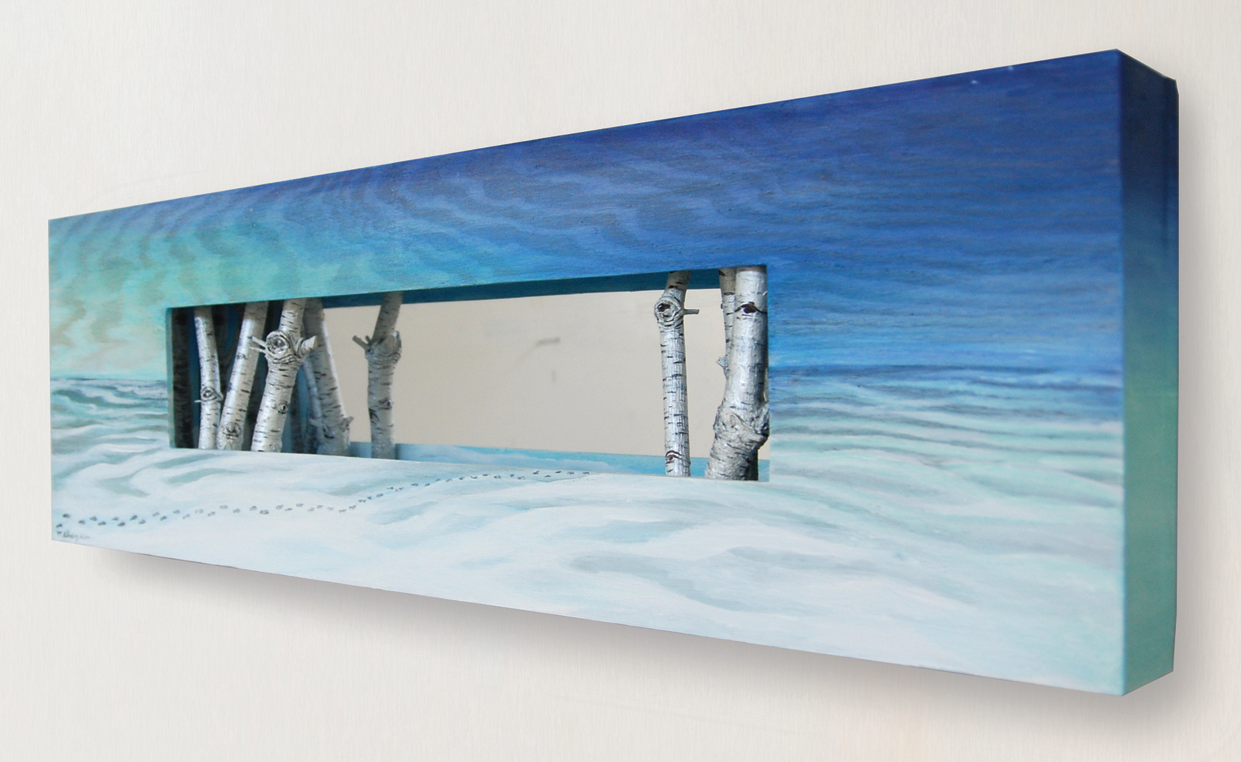
Kim rejects the limitations imposed by the
conventional frame of the canvas and adopts shaped canvases based primarily on
pyramidal forms. In place of the removed frame, the edges of these works bear
patterns resembling the stratified layers of the earth, as though they were
fragments cut from a landscape extending into infinite space. These
tree-ring-like patterns suggest the artist's determination to expand into
boundless dimensions of space and time. Through their stylized forms, they also
reveal structures of growth and maturation, further expressing her aspiration
toward the infinite.
The temporal schema that initially
maintained a fixed threefold structure has also begun to dissolve. The meanings
of past, present, and future are now concealed within individual motifs, while
the formerly schematic compositions are transformed into serene, meditative
landscapes. These temporal dimensions are integrated into simultaneous
expressions within a single pictorial field.
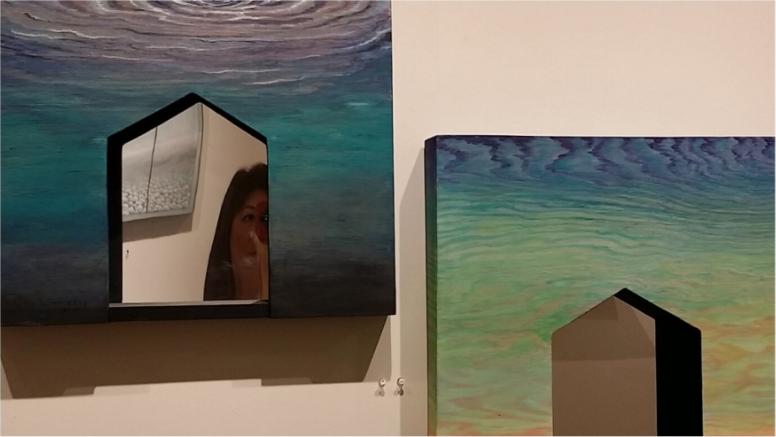
For example, in The breeze calms
down the delusions; the wings of thought are blowing in the wind, the
future associated with the other shore is represented by the image of a white
mountain, while the artist's present self, troubled by worldly afflictions,
appears in the form of wild grasses. The wings of thought are represented by
butterflies, and the latent image of her past self emerges as a reflection upon
the surface of a pond.
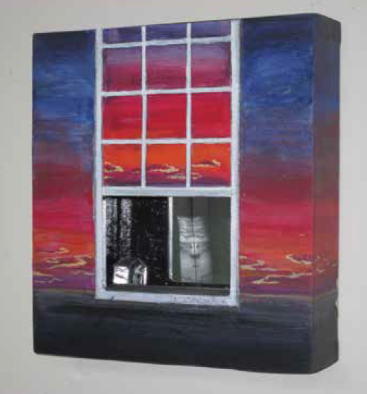
In this way, Kim assigns subjective
meanings to motifs such as mountains, trees, wild grasses, shadows, lake
surfaces, windows, and wildflowers. Within a distinctive mechanism derived from
Buddhist modes of perception, she employs meticulous, realistic rendering to
construct Surrealist landscapes, thereby making manifest a world of esoteric
meaning (秘義). This hidden realm (秘境) may be understood as a space in which the artist affirms her own
identity and undergoes an existential transformation. Through Buddhist
meditation, it acquires vitality as an allegory of the world of perception.
At this point, however, it is necessary to
recognize the danger that the artist's work might become confined to an
esoteric realm (秘境) of Buddhist epistemology. To
overcome this limitation, a more active transition is required—from religious
modes of perception toward an awareness of the autonomous possibilities of
painting. Only through such a transformation can her work lead us to reconsider
the primordial images of humanity that we have forgotten, thereby expanding
into an allegorical world of human archetypes.