Press
July, 1990
Kim Bok Young | Art Critic
Among Wheiza Kim’s attempts over the past
several years to reveal the hidden dimensions of existence through motifs such
as nameless weeds, human shadows, snails, lakes, curtains, and butterflies, all
employed to convey esoteric meanings, this solo exhibition stands out as
particularly noteworthy.
Although Kim’s works sometimes display the
distinctive characteristics of an Expressionist style, they are especially
remarkable for their approach to the structures and meanings of existence,
including the artist’s own being, from a Buddhist perspective that treats them
within a particular context of deconstruction, both in thought and technique.
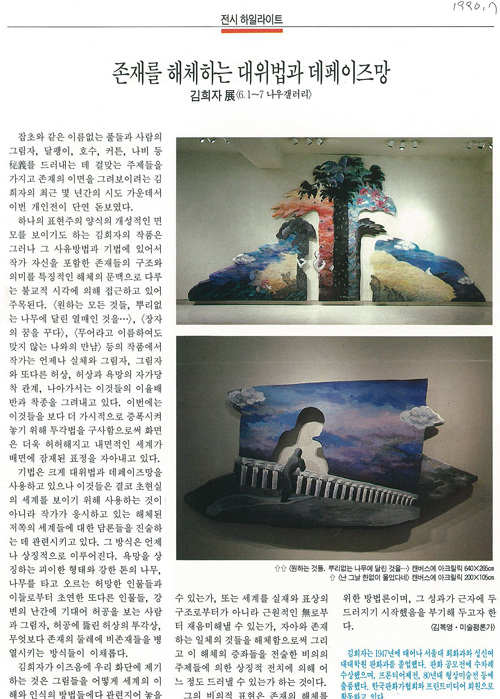
In works such as The greedy fruits of a rootless tree,
Dreaming of Sun Tzu's dreams, and Encountering
Myself, Whom No Name Can Adequately Describe, the artist consistently
depicts the relationships between reality and shadow, shadow and further
illusion, and the self-contradictions of illusion and desire, extending to
their antinomies and intricate entanglements. In this exhibition, she employs
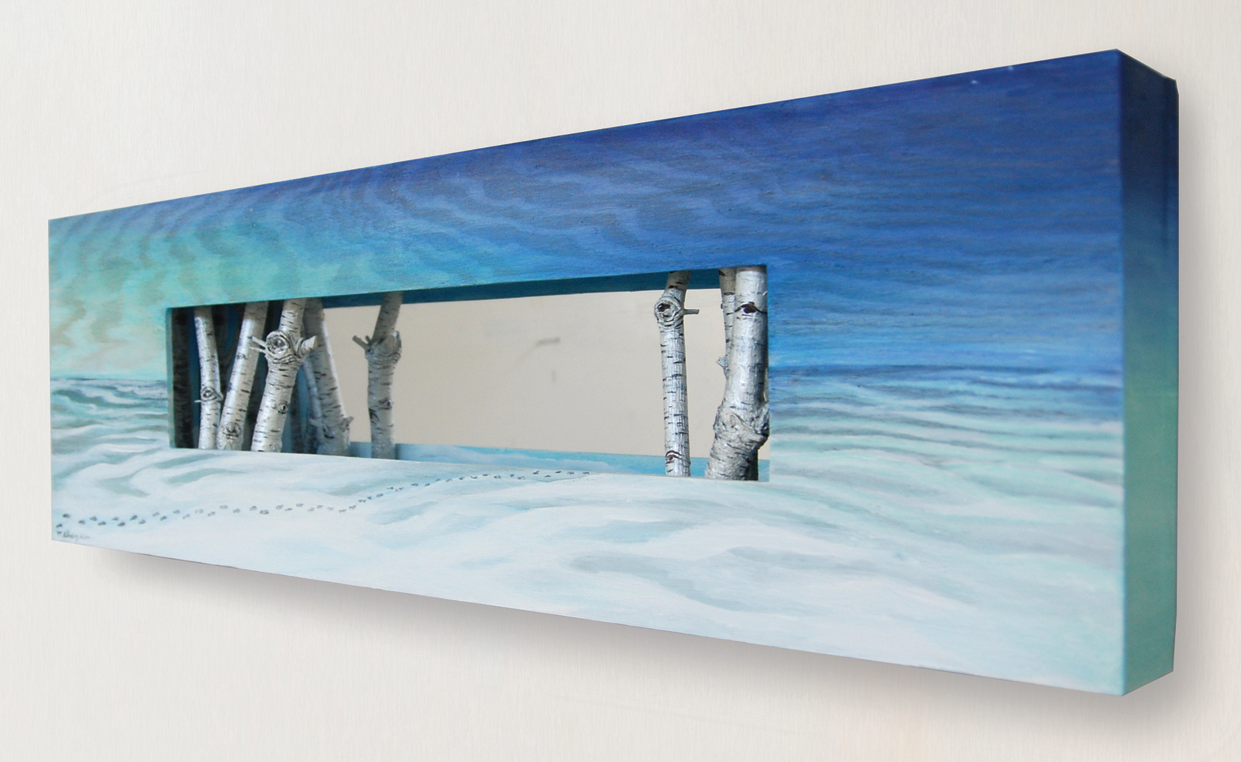
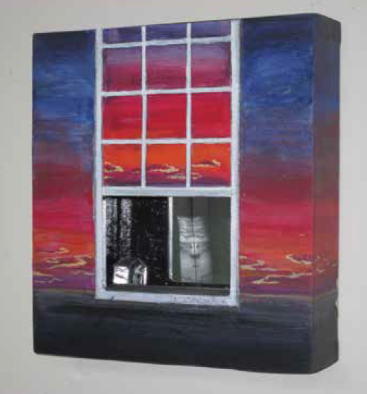
an openwork technique to amplify these relationships and make them more
visually apparent. As a result, the pictorial surface becomes increasingly open
and void-like, suggesting an inner world that remains latent behind the visible
surface.
Her principal techniques are counterpoint
and dépaysement. Yet these are employed not to present a Surrealist world, but
rather to articulate a discourse on the deconstructed realm beyond ordinary
existence toward which the artist directs her gaze. Her approach is invariably
symbolic. Particularly striking are the strangely shaped trees rendered in
intense tones to symbolize desire; the illusory figures climbing these trees
and other figures who remain detached from them; the person leaning against a
riverside railing and gazing into empty space, together with the accompanying
shadow; the openwork silhouettes of illusory forms cut into empty space; and,
above all, the juxtaposition of non-being around the contours of being.
What Kim raises as a question for the
Korean art world at this moment is how painting can be related to ways of
understanding and perceiving the world. Can the world be reconsidered not
through the structures of reality and representation, but from the standpoint
of primordial nothingness (無)? And to what extent can
the deconstruction of the self and all existing things, together with the
overlapping structures produced by that deconstruction, be revealed through the
symbolic displacement of the aforementioned esoteric motifs?
Her esoteric mode of expression constitutes
a methodology for the deconstruction of existence, and it is worth noting that
the achievements of this approach have recently begun to emerge with increasing
clarity.
Wheiza Kim was born in 1947 and graduated
from the Department of Painting at Seoul National University and the Graduate
School of Sungshin Women’s University, where she studied printmaking. She
received several awards in printmaking competitions and participated in
exhibitions including the Frontier Festival and the Figurative Art Exhibition
of the 1980s. She is a member of the Korea Printmakers Association and Print
Media.