Press
April, 1991
Kim Young-soon | Art Critic
Wheiza Kim was born in Busan in 1947. She graduated from the College of Fine Arts at Seoul National University, where she studied painting, and from the Graduate School of Sungshin Women's University, where she studied printmaking. She received a Special Selection Award at the Korea Printmakers Association Exhibition in 1986 and an Excellence Award at the 7th Korea Contemporary Printmakers Association Exhibition in 1987. Since 1986, she has held three solo exhibitions and participated in numerous special and group exhibitions, including the Exhibition of Contemporary Korean Artists in Mexico, the Korea–U.S. Print Exchange Exhibition, the 7th Seoul International Biennale, and the Exhibition of 55 Korean Women Artists. She is currently a member of the Korea Printmakers Association and Print Media.
“What is that state in which I remain entirely myself, without sensing anything foreign within me? Whatever situation or form I employ to express it, the result is already nothing more than an accumulation of cultural preconceptions.
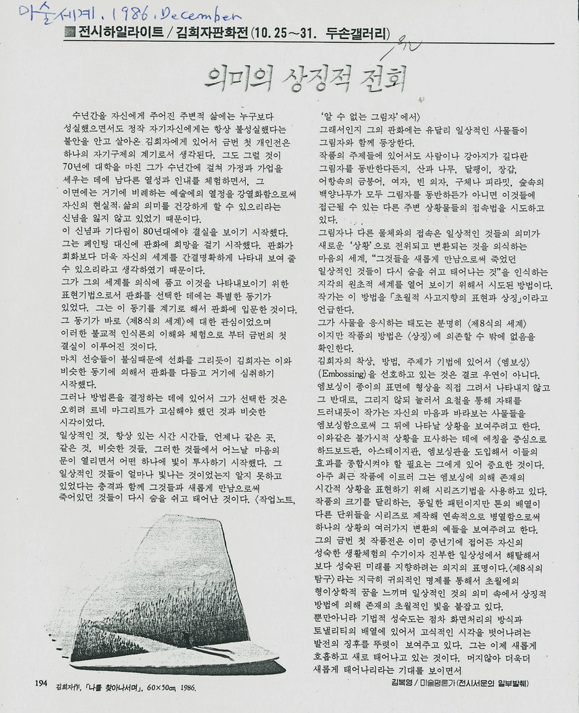
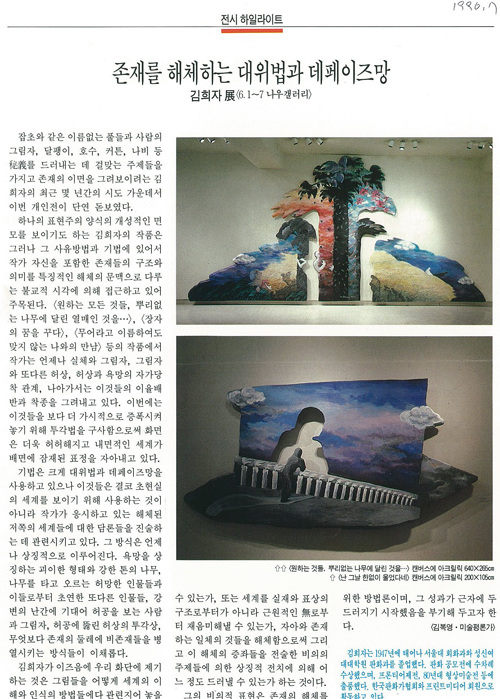
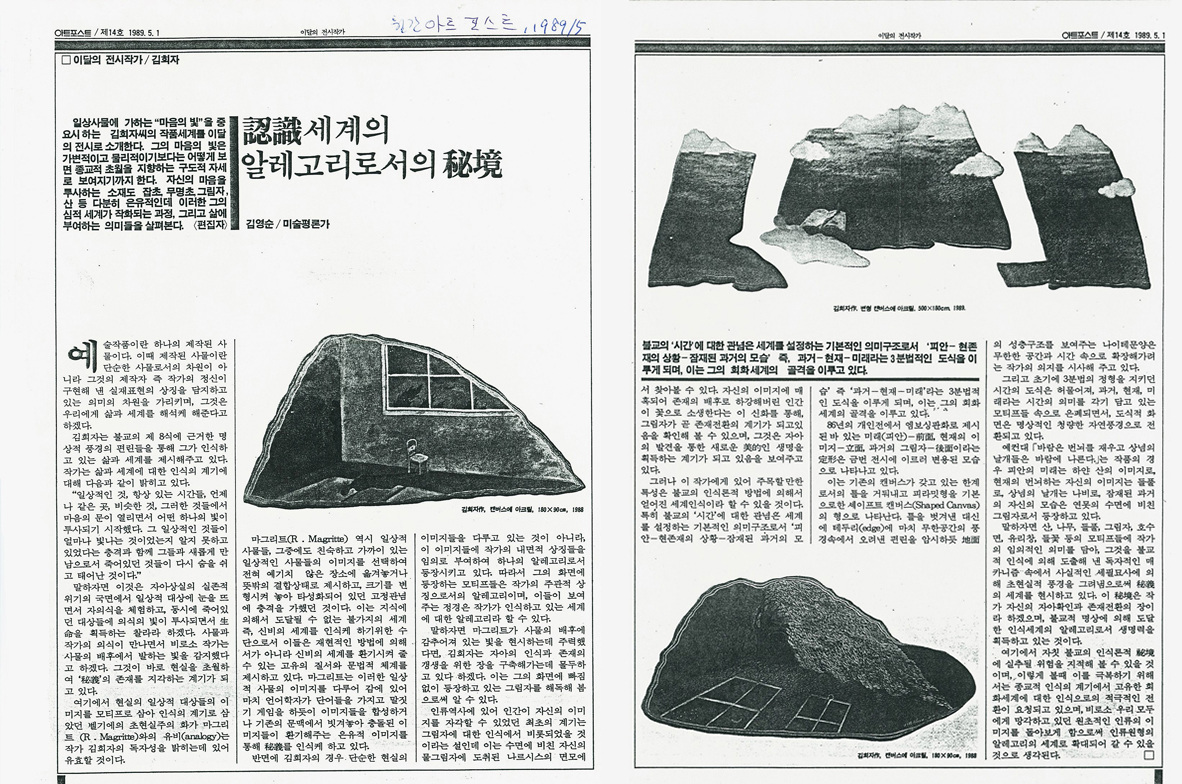
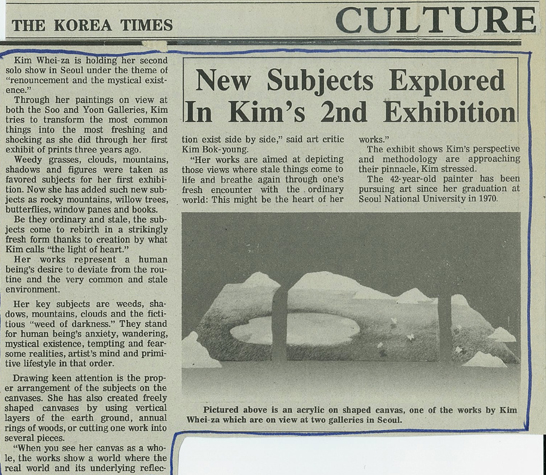
I want to depict what people cannot see. For the place where the most essential reality of our existence resides is invisible. The most important part of my paintings is the area cut away from the pictorial surface. Within that space, I wish to present the absence of non-being (無) and the boundlessness of emptiness (空). My task, it seems, is to present as naturally as possible the contradiction that, in order to make visible what is absent, I have no choice but to arrange what is present. I know that fragments of emotion, aesthetic consciousness, and sculptural concepts are nothing more than pigments dissolved into paint. Yet without them, what could I possibly bring forth and reveal?”
More than most artists, Wheiza Kim has transformed her questioning of the constraints imposed upon women, arising from her deeply personal experiences, and her sudden awakening to self-awareness into artistic achievement through religious meditation. In this respect, her work may be regarded as an exemplary form of feminist art.
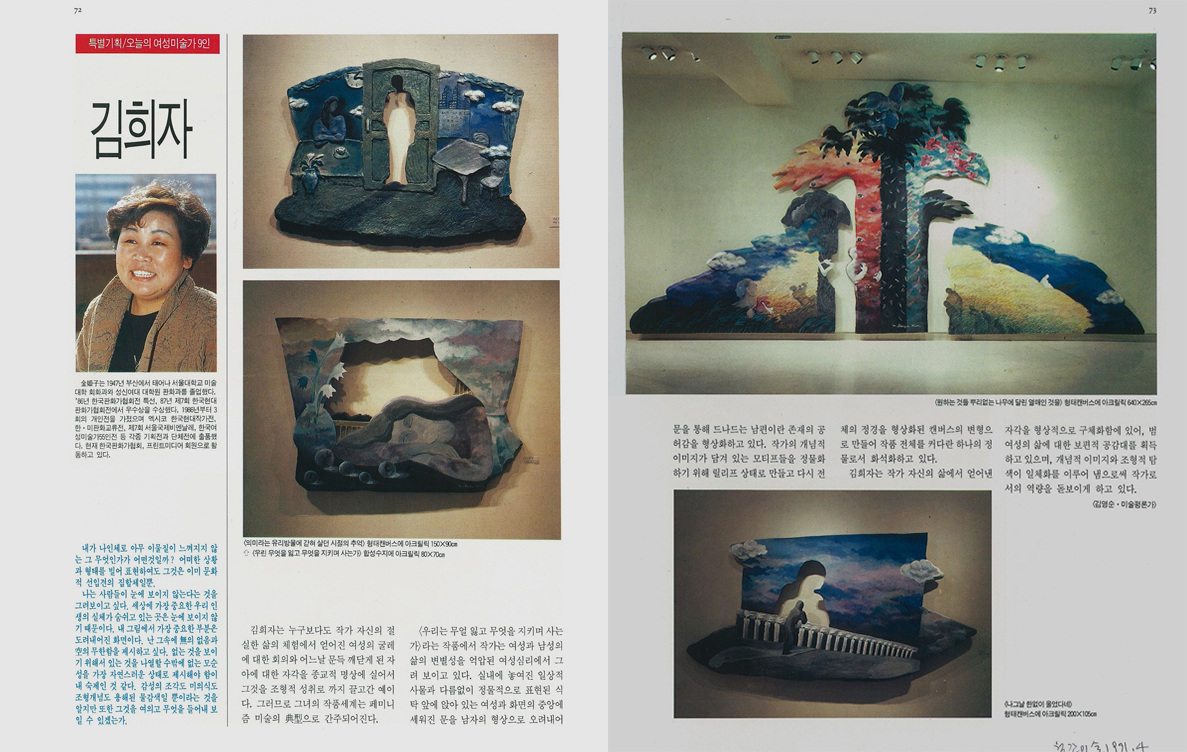
In What Have We Lost, and What Do We Preserve in Life?, the artist depicts the distinctions between women's and men's lives from the perspective of a repressed female psyche. A woman seated at a dining table is rendered as a still-life object, no different from the ordinary objects placed within the domestic interior. At the center of the composition, a door is cut into the shape of a man, giving form to the sense of emptiness associated with the husband's presence as he passes in and out through the doorway. To transform the motifs carrying the artist's conceptual imagery into still-life elements, Kim renders them in relief. She then transforms the entire scene through the shaped canvas, effectively fossilizing the composition as one monumental still life.
In giving concrete visual form to the self-awareness gained through her own life experiences, Wheiza Kim establishes a sense of shared understanding that extends to women's lives more broadly. By integrating conceptual imagery with formal exploration, she demonstrates her artistic capabilities.