Press
1993
Abraham Ilein | Art Speak
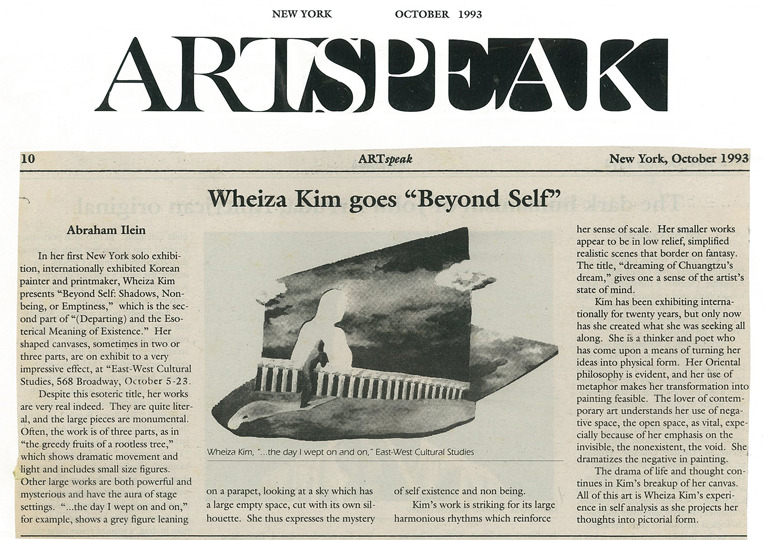
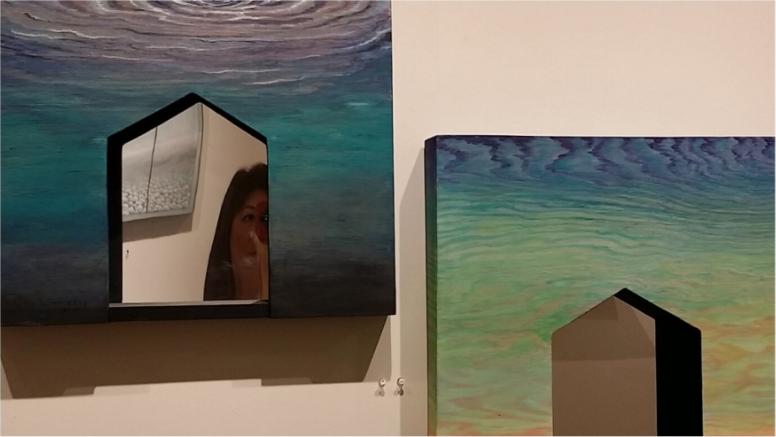
In her first New York solo exhibition, internationally exhibited Korean painter and printmaker, Wheiza Kim presents “Beyond Self: Shadows, Non-being, or Emptiness,” which is the second part of “(Departing) and the Esoterical Meaning of Existence.” Her shaped canvases, sometimes in two or three parts, are on exhibit to a very impressive effect at East-West Cultural Studies, 568 Broadway, October 5-23.
Despite this esoteric title, her works are very real indeed. They are quite literal, and the large pieces are monumental. Often, the work is of three parts, as in “the greedy fruits of a rootless tree,” which shows dramatic movement and light and includes small size figures.
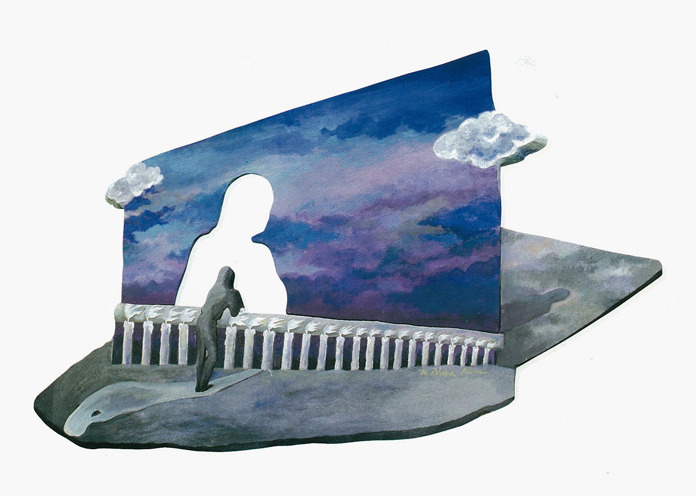
Other large works are both powerful and mysterious and have the aura of stage settings. “...the day I wept on and on,” for example, shows a grey figure leaning on a parapet, looking at a sky which has a large empty space, cut with its own silhouette. She thus expresses the mystery of self existence and non being.
Kim’s work is striking for its large harmonious rhythms which reinforce her sense of scale. Her smaller works appear to be in low relief, simplified realistic scenes that border on fantasy. The title, “dreaming of Chuangtzu’s dream,” gives one a sense of the artist’s state of mind.
Kim has been exhibiting internationally for twenty years, but only now has she created what she was seeking all along. She is a thinker and poet who has come upon a means of turning her ideas into physical form. Her Oriental philosophy is evident, and her use of metaphor makes her transformation into painting feasible. The lover of contemporary art understands her use of negative space, the open space, as vital, especially because of her emphasis on the invisible, the nonexistent, the void. She dramatizes the negative in painting.
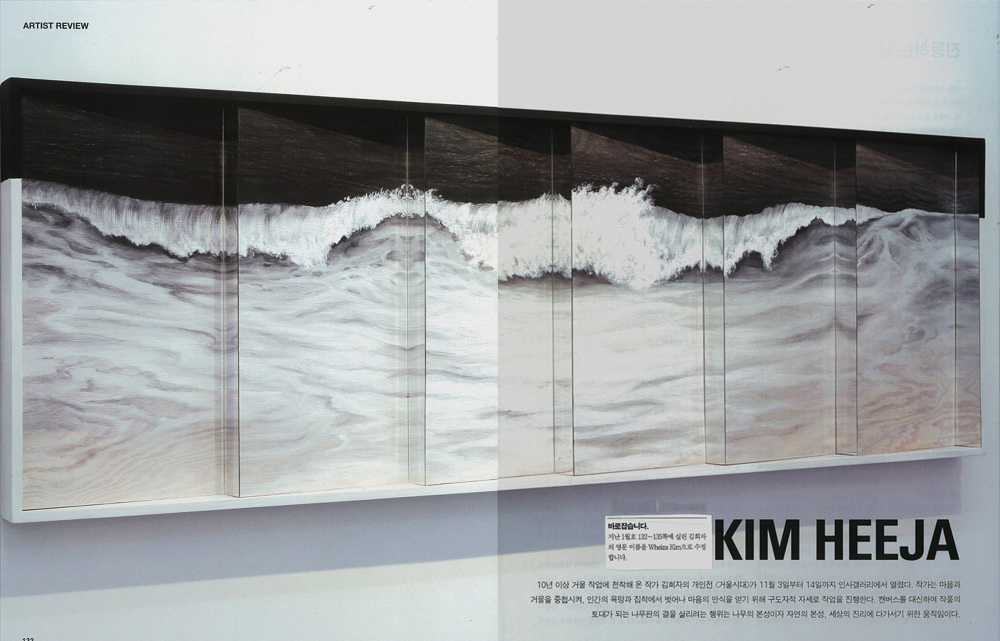
The drama of life and thought continues in Kim’s breakup of her canvas. All of this art is Wheiza Kim’s experience in self analysis as she projects her thoughts into pictorial form.