Critiques
March, 1989
Kim, Bok Young | Art Critic, Ph.D
Mrs. Whei Za Kim, who had her first show in October 1986 with themes on the Eighth Consciousness, a Buddhist perception theory, is now having her second exhibit with the same contextual works after three years.
Her first exhibit, which took the form of print art, showed us how the most ordinary things could be transformed into the most refreshing and shocking. It was aimed at, in her words, depicting a situation in which “those dead, stale things come to life and breathe again through meeting with them anew.”
This second show is packed up with her intent to develop and expand those ideas into painting. First, we can have a glimpse of her great aspiration, seeing that she combines both Yun’s Gallery and Soo Gallery into one exhibit space and also her paintings range from very big ones to small ones. So, we can expect she would be able to treat the genuine nature of her works, which are hidden behind her aspiration, with better clarity and depth.
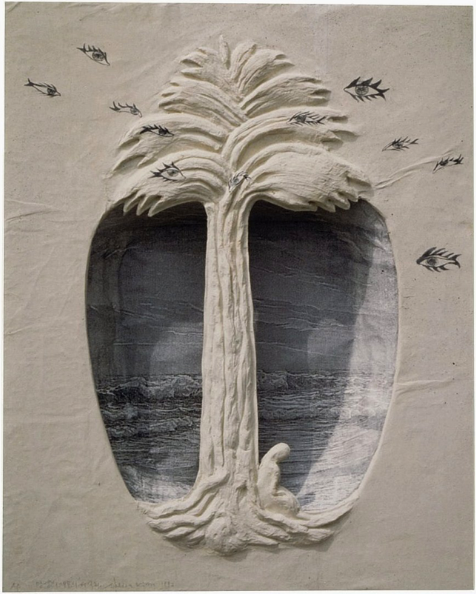
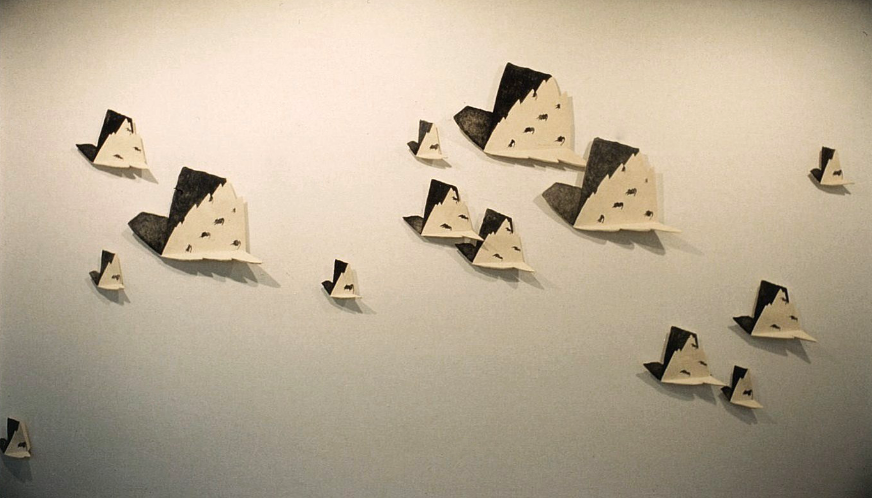
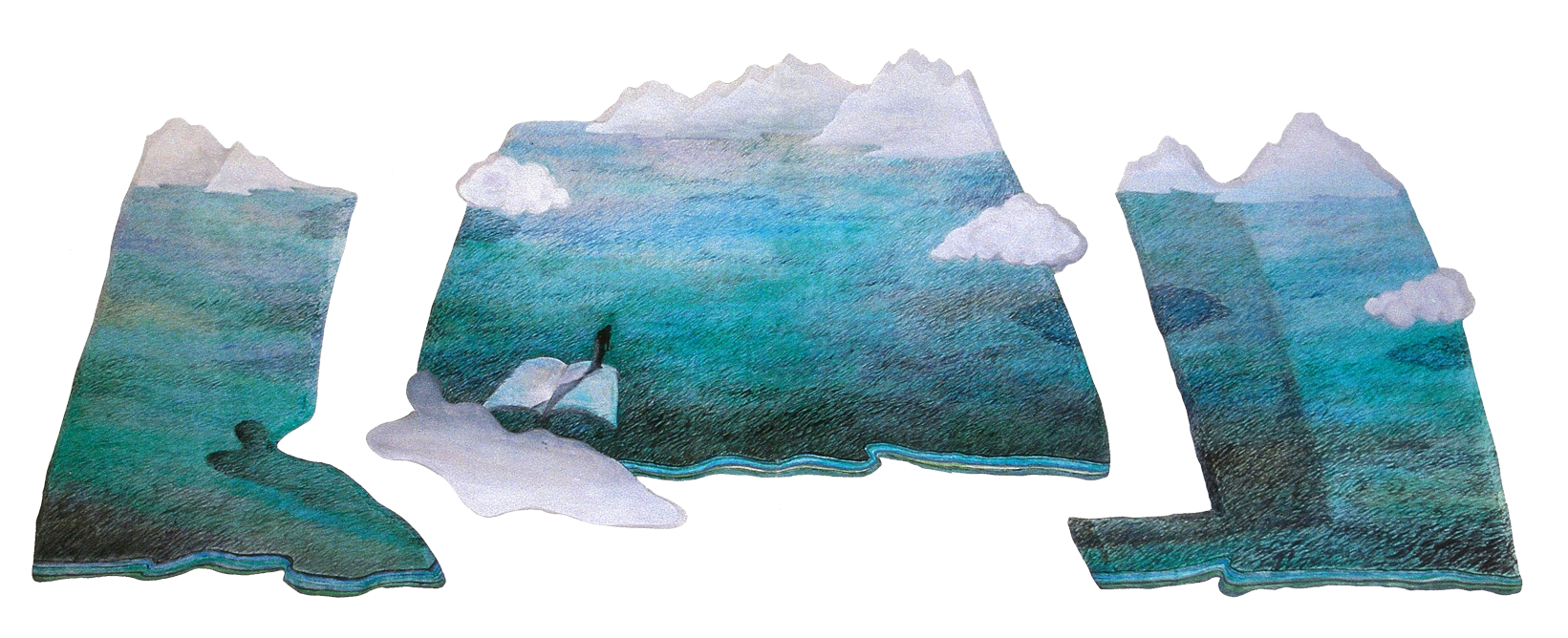
We’d better note that most of the subjects dealt with in her previous show are still being worked on at this show. For example, grass weeds, the Weed of Darkness, clouds, mountains, shadows and human forms are continuously used in favor. And now, further developing them, she added things like mountains of solid rock, willow trees, lakes, butterflies, and windows.
These themes, through their specific combination in each work, construct a completely new meaning field; and they are given special locus of existence in the field. The subjects, nothing more than most ordinary and even stale at times, can be turned into a phase born again afresh with their striking newness, when an artist casts 〈the light of mind〉 on them, to quote her words.
How does she handle and turn them into such a striking phase and then achieve a new meaning field? This is the focus of our concern. An important clue might be found in the question, what 〈the mind light〉 is, which she says she casts on them while doing it.
The mind light has a significant meaning in the viewpoint of the Buddhist perception theory, her major concern. It’s neither the physical light emitted from the sun, nor those coming from psychological moments of human caprice all the more. Transcending both man’s senses and the physical world of nature, it lies in the realm of existence called the Eighth Consciousness full of mystical implication. When this light, emitted through the artist’s mind eye, is casted upon something, the real nature of things can be understood.
To reach such a realm, a religious practioner might do Zen meditation or take some ascetic practices; but for her, an artist, it might be regarded well enough to engage herself in searching for some creative mechanisms suitable to express this unknown world, with her strong desire for the realm at the bottom of her heart.
Let’s talk about some aspects of Kim’s ‘motive’. This can be explained by the term, 〈renouncement〉. The artist passionately wishes to renounce or leave her self and her circumstances, all too common and stale as she feels, while having anxieties on them.
When I’d like to take a rest, feeling tired, I always have to leave. From the bondage of prejudices or any consciousnesses, I must go off with no hesitation of any sort. No more removing the Weeds of Anxiety, no more rooting out the Weeds of Darkness. Now it seems I’m going to be disintegrated just like clouds. 〈her work note〉)
This paragraph gives us a cross section of her mind and heart to leave. In other words, if you want to get to the wondrous realm of existence, that are described in the Eighth Consciousness, you must leave your ordinariness dotted with human prejudices and consciousnesses. For her, the ordinary is compared to ‘removing the Weeds of Anxieties’ and ‘rooting out the Weeds of Darkness’, while renouncing the ordinary was likened to her self being ‘disintegrated just like clouds’.
This motivation gave birth to the title of this show, 〈Contemplating on Delusions〉. In her series of works, this artist composes and shows her mechanism of renouncement in a clear and orderly perspective.
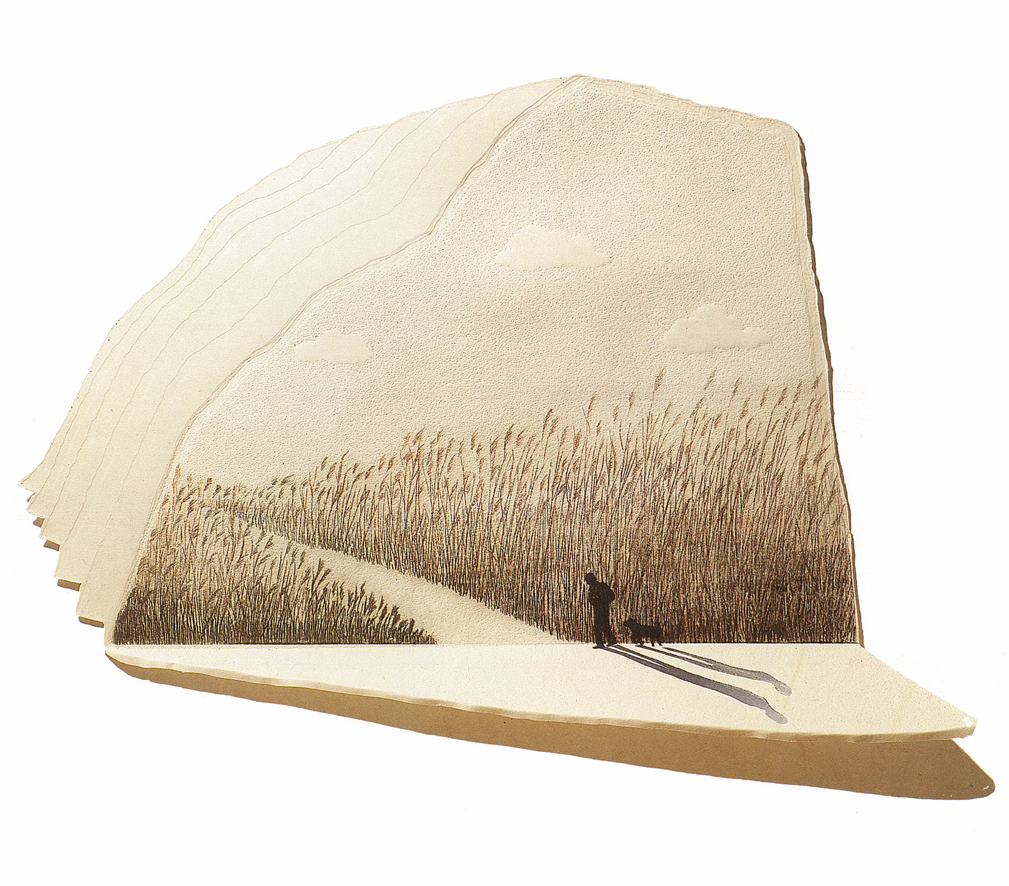
Here, let’s have a brief discussion on the mechanism of her works that she conceived to reach the esoteric meaning of existence. This can be summarized into two parts. One of them is giving specific meaning functions to the ordinary subjects enumerated a while ago, that is to say, allocating specific contents to them which the artist wants to symbolize. The most important things include grass weeds, the Weed of Darkness, shadows, mountains, and clouds, all in five. Each of them has its repective meaning function. The grass weeds, an all-time presence in her paintings - she always draws rough weeds lavishly - symbolizes the five desires and seven sentiments of human-beings such as futile dream, hope, and missing for someone, that cause people to have anxieties and delusions. In a broad sense, they represent human-beings’ permanent wandering and at the same time in its paradox it is considered as a symbol of the resting place on which one would like to lie down. The Weed of Darkness often makes its appearance in the shape of a black tree. This plant, her own creation, stands for the primitive stage of human life or one’s mental state enslaved to greedy desires with no wisdom or knowledge. On the other hand, the shadow stands for the unknowable, mystical exisence or the esoteric meaning of existence or her real Self or original face, the object she wants to see. On the contrary, the mountain is described as tempting and fearsome realities as well as the peaceful refuge to which one would go back some day. Finally, the cloud represents the artist’s mind itself.
Another aspect of her mechanism can be explained by the proper way she arranges those subjects, which have such meaningful functions, on the canvas. That is, on the weighty area of the canvas was set what she sees, feels, and perceives in her every day life (putting grass weeds on the center more often than not), while on the right and left or front and back or around them were arranged reflections of some latent and mysterious things (often with shadows, lakes, windows, and books). Also, forming the canvas edge just like vertical layers of the earth ground or annual rings of wood, and cutting one into several pieces with audacity or changing its form, she creates free shaped canvas.
With such special symbolic functions of her subjects and her invention of such a special arrangement mechanism, Kim intends to reveal the mystic meaning of existence, the unthinkable, not just a description of realities. When you see the canvas as a whole, the works show a world where the real world and its underlying reflection exist side by side and the mystic reflections of the Eighth Consciousness, which are mysteriously draped beyond such coexistence.
Here lies, I must emphasize, the true meaning of her recent series of works with the title of 〈Contemplating on Delusions〉, which was aimed at manifestating the secrete meaning of existence. If she was motivated by her hope to free her real self and get out of the ordinariness full of delusions and sufferings, it might be said of course quite natural.
This artist shows another side of her solidity in developing this kind of trial, which began on prints, into painting. This work is not meant for her to run away from delusions and sufferings in life or to draw a world detached from realities in complacency; if one thinks so, it might be a grave misunderstanding. On the contrary, the correct perspective might be: she has tried to set forth an earnest approach to see realities afresh by methodologically breaking the ordinary realities into parts.
When you consider this, the artist tries to shed light again on realities and re-create them as well as actively projects her intention to reconstruct realities. You may regard her following remarks as its manifestation.
Won’t there be a way to draw that doesn’t exist, not always drawing what there are? No way for me to draw nothingness? 〈quotation from her diary〉
Here we can understand she has kept in her consciousness a motive to (re-nounce) ordinariness in order to draw the active nothingness, and in turn the will to leave was devoted to revealing the mystic meaning of existence most precisely and clearly.
This effort to show the world of mystic meaning with symbolism should never be misunderstood, to say it again, as turning one’s face away from or distorting sound realities or disclosing the world of paradox with simple curiosity of any sort: her underlying intent is not that at all. In place of that, her works should be read as a 〈criticism〉 of life in this world. As the artist said, her works are aimed at depicting those views where stale things come to life and breathe again through one’s fresh encounter with the ordinary world: this might be the heart of her works.
This exhibit shows us Kim’s perspective and methodology, which have become more steadfast lately, are approaching to their accomplishments, I believe.