Press
1995.12.24
Lee Joo Heon | Art Critic
Wheiza Kim’s Symbolic Art: Breaking the Boundaries of the Canvas
“Doubt and answers, hope and despair repeat themselves, and whenever I fall, I cling tightly to my hwadu (meditative question) for support. Perhaps the great freedom of harmony and perfection will never come to me. Yet I believe that what I discover through my inquiry is all that is allotted to me, and through the work I am doing now, I stubbornly refuse to abandon the dream of becoming a butterfly and flying across the entire sky. No, I simply cannot abandon it.”
There is a time in life when the reach of our questioning extends far into the distance. It is the time when even a single falling leaf can bring tears to our eyes. In those days, the greater our doubts, the more earnestly we inquire into life, and even the smallest realization can make our entire being tremble with emotion. Yet as time passes, as we grow older and enter what is commonly called the established generation, both consciousness and feeling become fossilized. Or, even if they do not become entirely fossilized, the reach of our questioning and the rhythm of our emotional responses grow painfully short. Our questioning gaze increasingly turns only toward the people around us, while our minds are easily swayed by material concerns...
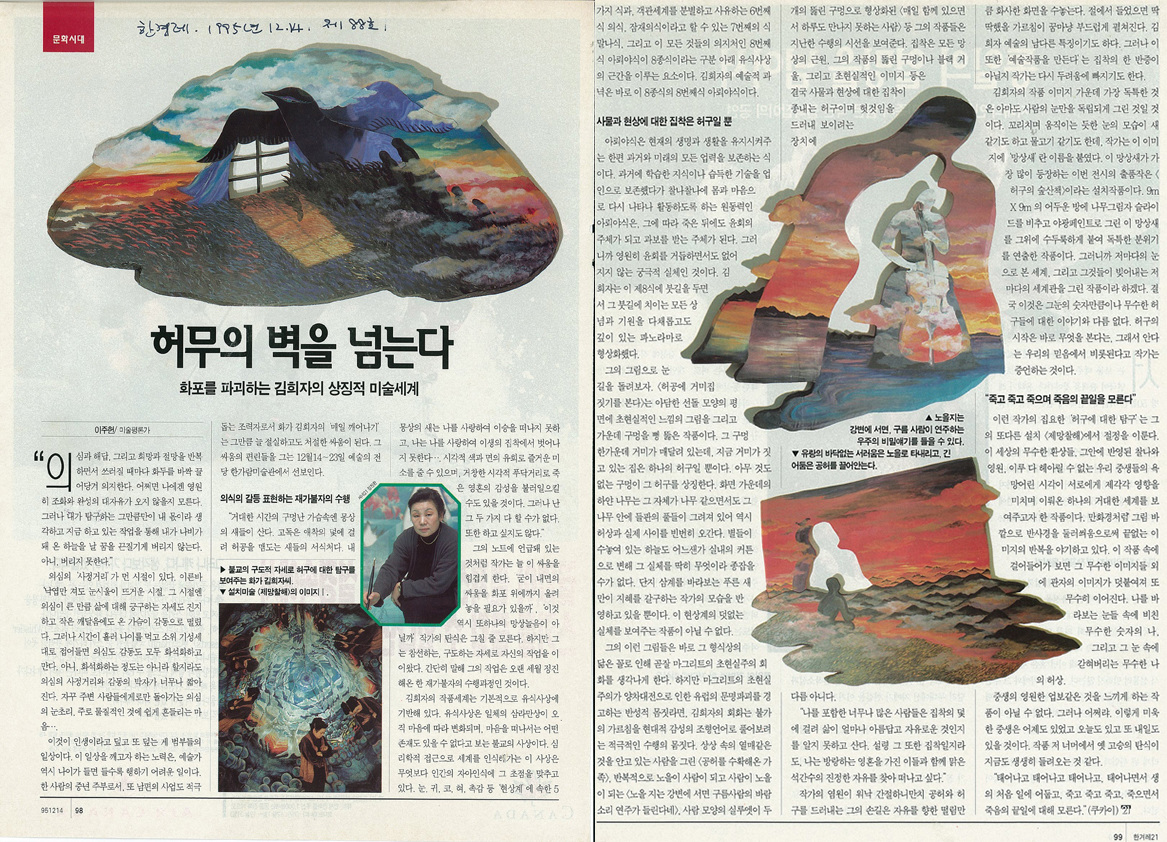
This is the everyday life of ordinary people, who repeatedly cover over such concerns and accept them as life itself. The effort to break free from this routine becomes increasingly difficult with age, even for an artist. As a middle-aged housewife who also actively assists her husband in his business, the painter Wheiza Kim finds that her attempt to “awaken every day” is an ever more urgent and arduous struggle. Fragments of that struggle are presented in her exhibition at the Hangaram Art Museum, Seoul Arts Center, from December 14 to 23.
The Spiritual Practice of a Lay Buddhist Expressing the Movements of Consciousness
“In the hollow heart of immense time dwell the birds of reverie. Solitude is the habitat of birds caught in the snare of attachment, circling through empty space. The birds of my reverie cannot depart from this world because they love me, and I cannot free myself from the attachments of this life because I love myself. I might bring a pleasant smile through the visual interplay of color and plane, or awaken the sensibilities of deadened souls through a grand visual ritual. Yet I can do neither of these things, nor do I wish to.”
As her notes suggest, the artist constantly engages in this difficult struggle. “Is it really necessary to carry my inner struggle onto the canvas?” “Might this, too, be nothing more than another play of delusion?” Such doubts never cease to trouble her. Nevertheless, she has continued her work with the attitude of someone practicing Zen meditation and pursuing spiritual enlightenment. In short, her artistic practice is itself the process of spiritual cultivation undertaken by a lay Buddhist who has devoted many years to disciplined practice.
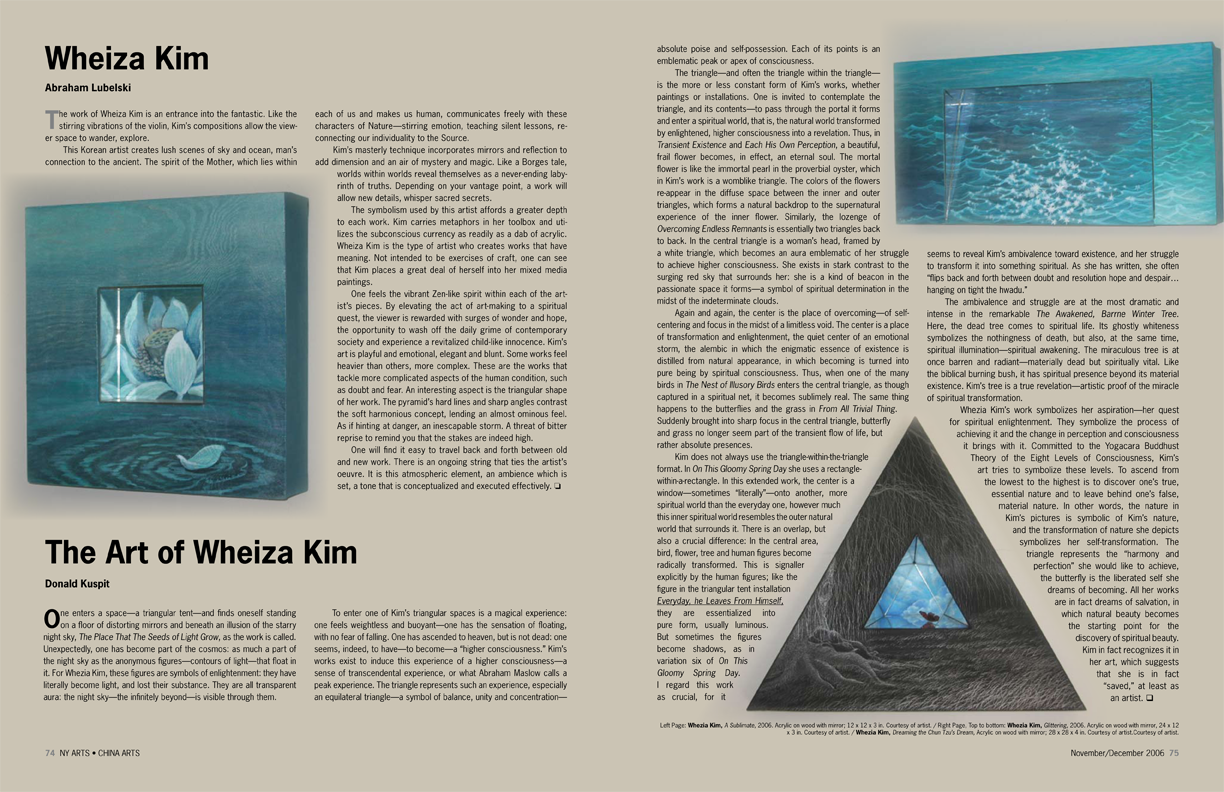
Kim’s artistic world is fundamentally grounded in the Buddhist philosophy of Consciousness-Only (Yogācāra). According to this philosophy, all phenomena in the universe are transformed according to the mind, and nothing can exist independently of consciousness. This approach to understanding the world through the workings of the mind places particular emphasis on human self-awareness. The eight consciousnesses comprise the five sensory consciousnesses associated with sight, hearing, smell, taste, and touch; the sixth consciousness, which discriminates and reflects upon the objective world; the seventh consciousness, known as manas, which may be understood as a form of latent self-consciousness; and the eighth consciousness, ālayavijñāna, or storehouse consciousness, which serves as the underlying basis of the other consciousnesses. Together, these eight forms of consciousness constitute a central framework of Yogācāra thought. The ultimate focus of Kim’s artistic inquiry is the eighth consciousness, ālayavijñāna.
Attachment to Objects and Phenomena Is Nothing but Illusion
Ālayavijñāna sustains present life while preserving the karmic forces accumulated through the past and extending into the future. Knowledge acquired and skills learned in the past are retained as karmic seeds, which manifest from moment to moment through the activities of body and mind. In this sense, ālayavijñāna functions as the driving force behind the continuity of existence, becoming the subject of rebirth and the recipient of karmic consequences even after death. It is thus understood here as an ultimate underlying reality that persists through the endless cycle of reincarnation. Kim directs her brush toward this eighth consciousness, transforming the countless thoughts and aspirations encountered along the way into a varied and profound panorama.
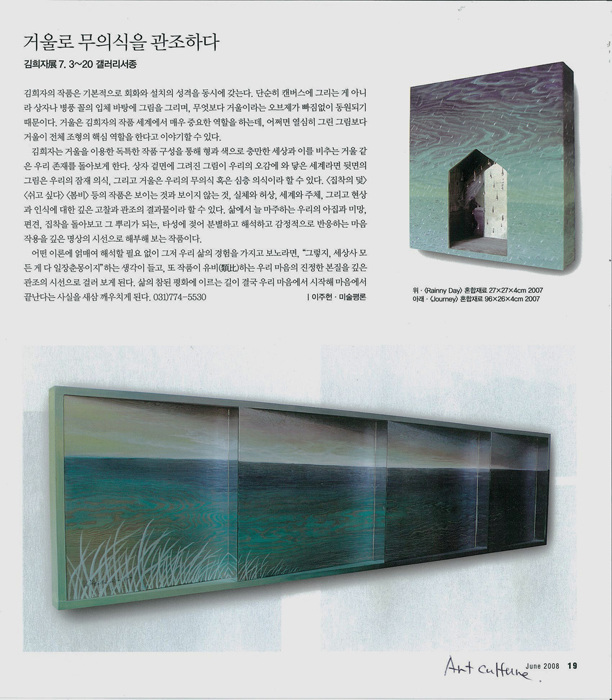
Let us turn to her paintings. In Watching a Spider Build Its Web in Empty Space, the artist paints a surreal image on a modest, standing-stone-shaped surface and cuts a large hole through its center. A spider hangs in the middle of the opening, yet the web it is constructing is ultimately an illusion. The empty hole symbolizes this illusion. The white tree at the center of the composition appears to be a tree, yet its interior contains images of grasses growing in a field, moving continually between illusion and reality. A sky embroidered with stars suddenly becomes an interior curtain, making it impossible to determine its true identity. Only a blue bird gazing upon the three realms of existence seems to reflect the artist’s own pursuit of wisdom. The work thus reveals the transience and insubstantiality of the phenomenal world.
Because of their formal similarities, paintings such as these often bring to mind the Surrealist works of René Magritte. Yet whereas Magritte’s Surrealism may be understood as a reflective gesture warning against the destruction of European civilization brought about by the two World Wars, Kim’s painting represents an active form of spiritual practice, seeking to reinterpret Buddhist teachings through the visual language of contemporary sensibility. Works such as The Family That Harvested Emptiness, depicting figures holding what appear to be imaginary fruits; Standing by the River at Sunset, I Hear the Wind Music of the Cloud People, in which the sunset repeatedly becomes human and human figures become the sunset; and A Person Who Is Always with Me Yet Whom I Have Never Met for a Single Day, in which human silhouettes take the form of two empty openings, all reveal the perspective of an artist engaged in a demanding spiritual quest. Attachment is the source of all delusion. The openings cut into her works, the black mirrors, and the surreal imagery are ultimately devices intended to reveal that attachment to objects and phenomena is, in the end, nothing more than illusion and emptiness.
“Far too many people, myself included, live caught in the snare of attachment, unaware of how beautiful and free life truly is. Even if this pursuit itself may be another form of attachment, I wish to set out with wandering souls in search of clear spring water and genuine freedom.”
Because the artist’s aspiration is so deeply felt, the gestures through which she reveals emptiness and illusion fill her canvases with a radiance equal to her longing for freedom. Teachings that might have seemed rigid if heard in a Buddhist temple unfold here with the softness of a dream. This is one of the distinctive qualities of Kim’s art. Yet she sometimes becomes troubled again by the possibility that even the act of “making artworks” may itself be another manifestation of attachment.
Perhaps the most distinctive imagery in Kim’s work consists of eyes depicted independently of the human body. These eyes appear to move and flicker like tails, sometimes resembling birds and at other times fish. The artist calls them “Birds of Delusion.” The work in which these birds appear most prominently in the present exhibition is an installation entitled A Walk Through the Forest of Illusion. In a darkened room measuring 9 x 9 meters, slides of tree shadows are projected, while numerous images of these birds, painted with fluorescent paint, are attached throughout the space, creating an unusual atmosphere. The installation may be understood as depicting the world as seen through countless individual eyes, together with the different worldviews they generate. Ultimately, it is a meditation on the innumerable illusions that exist in numbers as great as those eyes themselves. The artist suggests that illusion begins with our conviction that we see something and therefore know it.
“Dying and Dying, Yet Never Knowing the End of Death”
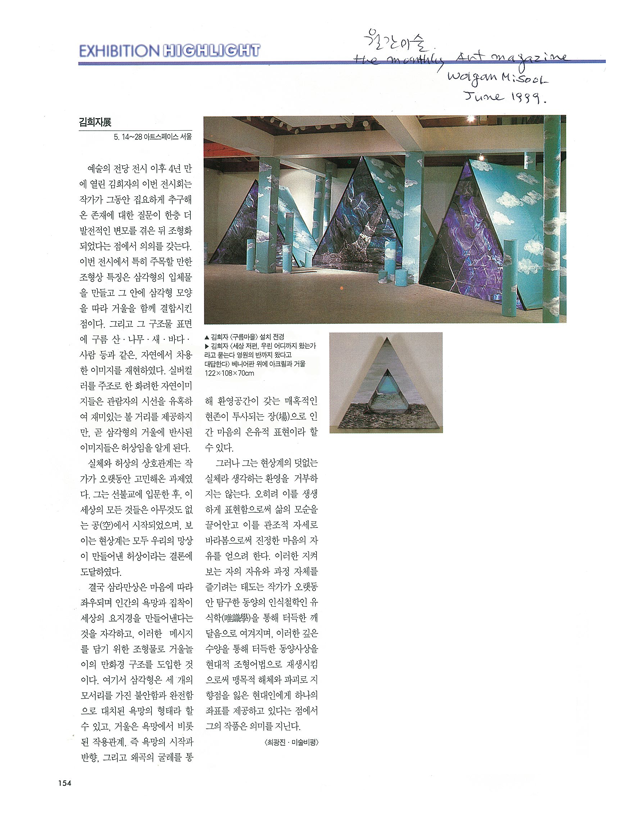
The artist’s persistent “inquiry into illusion” reaches its culmination in another installation, Indra’s Net. This work seeks to present a vast world formed through the countless illusions of existence, the fleeting moments and eternity reflected within them, and the desire-filled lives of sentient beings whose innumerable actions continually influence one another. By surrounding the painting with reflecting mirrors in a kaleidoscopic arrangement, the artist generates an endless repetition of images. Upon entering the work, viewers find that their own reflections are added to the countless existing images, multiplying without end. Innumerable versions of myself appear reflected in the eyes that gaze back at me, and within those eyes are trapped the countless illusory images of myself.
It is difficult not to sense in this work something resembling the eternal karmic burden of sentient beings. Yet what can be done? Such deluded beings existed yesterday, exist today, and will continue to exist tomorrow. From somewhere beyond the work, one can almost hear the lament of an ancient Buddhist master, still vividly resonating:
“Born and born and born again, yet remaining ignorant of the beginning of life; dying and dying and dying again, yet never knowing the end of death.” (Kūkai)