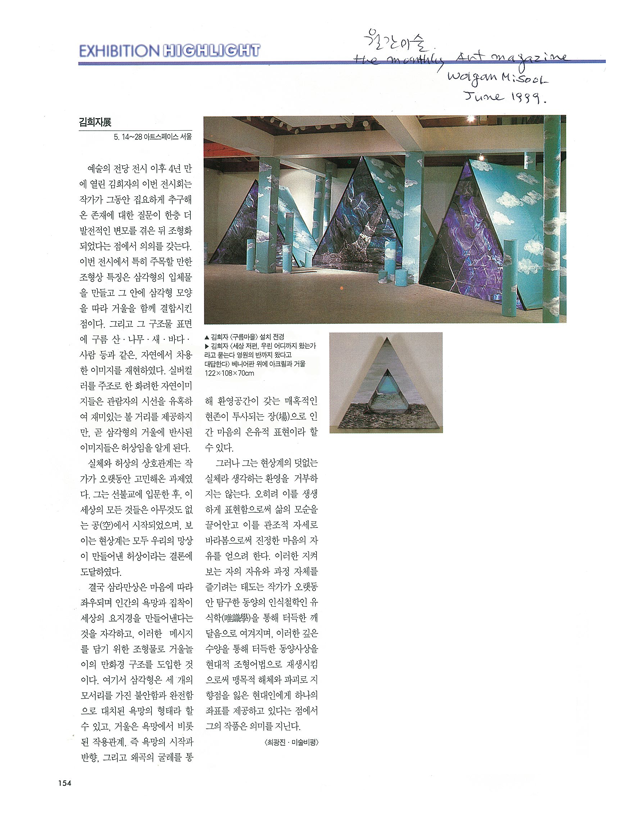
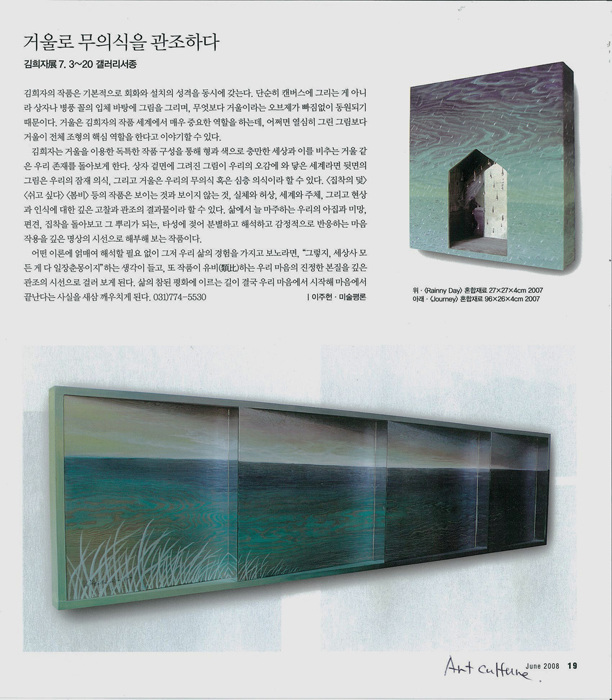
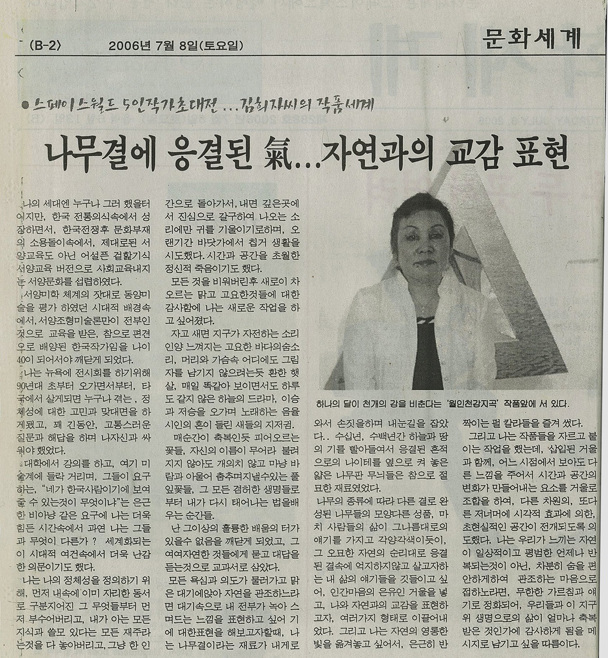
Press
January, 1995
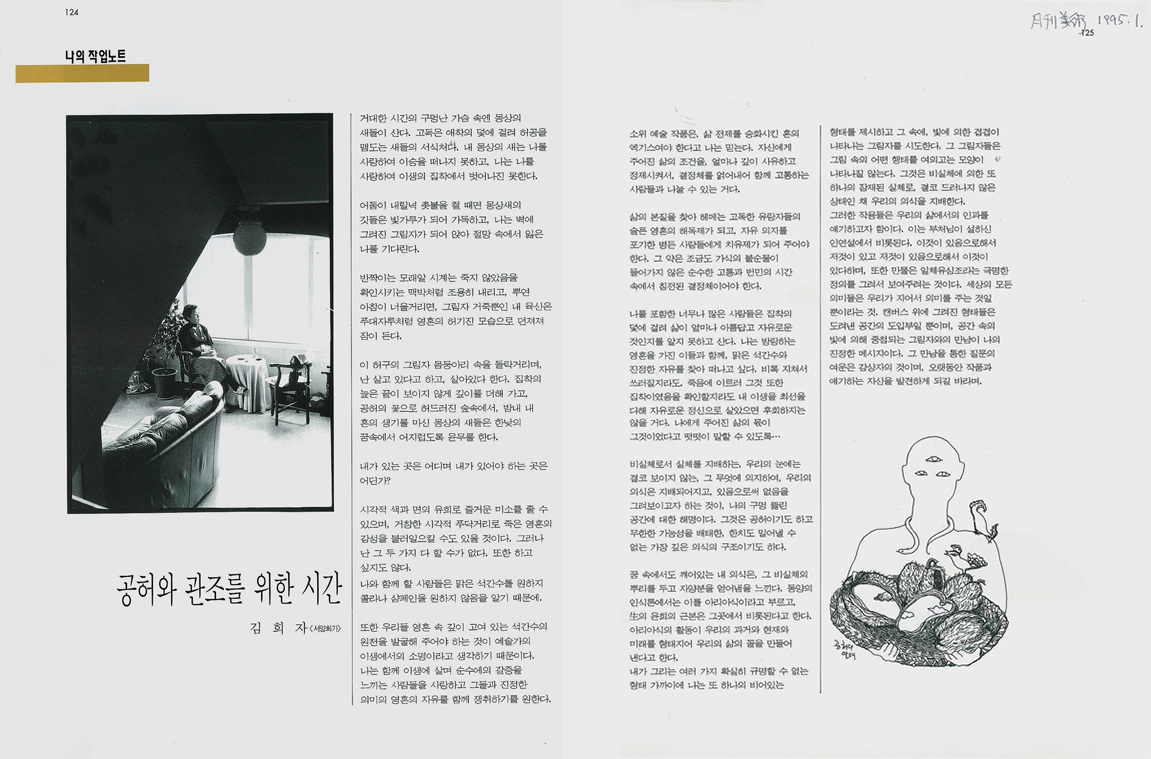
Wheiza Kim | Western Painter
In the hollow heart of immense time dwell
the birds of reverie. Solitude is the habitat of birds caught in the snare of
attachment, circling through empty space. The birds of my reverie cannot depart
from this world because they love me, and I cannot free myself from the
attachments of this life because I love myself.
When darkness falls and I light a candle,
the feathers of these birds of reverie become particles of light that fill the
air. I become a shadow cast upon the wall, sitting and waiting for the self I
have lost in despair.
The glittering grains of the hourglass fall
quietly, like a pulse assuring me that I am still alive. When the hazy morning
begins to drift, my body, nothing more than the outer skin of a shadow, is cast
aside like an empty sack, bearing the hunger of the soul, and falls asleep.
Moving in and out of this illusory body of
shadows, I say that I am living, that I am alive. The swamp of attachment grows
ever deeper, its bottom nowhere in sight. In a forest overgrown with flowers of
emptiness, the birds of reverie, having drunk the vitality of my soul
throughout the night, whirl in a dizzying dance in the dreams of midday.
Where am I, and where is the place where I
ought to be?
I might offer a pleasant smile through the
interplay of temporal colors and light and dark, or awaken the sensibilities of
deadened souls through a grand visual spectacle. Yet I can do neither of these
things, nor do I wish to.
For I believe that the aspiration of an
artist's reason should be to uncover the source of the clear, springlike waters
lying deep within our souls.
I love those who share this life with me
and thirst for purity, and I wish to attain, together with them, freedom of the
soul in its truest sense.
I believe that a work of art should be the
very essence of a soul that has sublimated the entirety of life. What matters
is how deeply one reflects upon and refines the conditions of one's existence,
distilling them into a crystallized essence that can be shared with others who
suffer.
Art should serve as an antidote for the
sorrowful souls of lonely wanderers searching for the essence of life, and as a
remedy for those who have grown ill after abandoning their free will. That
remedy must be a crystallized essence distilled through periods of pure
suffering and anguish, without even the slightest impurity of pretense.
Far too many people, myself included, live
caught in the snare of attachment, unaware of how beautiful and free life truly
is. I wish to set out with those wandering souls in search of clear spring
water and genuine freedom. Even if I grow weary and collapse, even if, at the
moment of death, I discover that this pursuit itself was another form of
attachment, I will have no regrets if I have lived this life to the fullest
with a free spirit. I wish to be able to say, without hesitation, that this was
the portion of life entrusted to me...
What governs substance while itself
remaining insubstantial is something invisible to our eyes, something upon
which our consciousness nevertheless depends and by which it is governed. My
attempt to depict absence through presence is an explanation of the perforated
spaces in my work. Such a space is emptiness, but it is also the deepest recess
of consciousness, where infinite possibilities are excluded and nothing can be
trusted with certainty.
Even in dreams, my consciousness remains
awake, and I feel that it draws nourishment from the roots of this
insubstantial realm. In Eastern theories of consciousness, this is called ālayavijñāna,
or storehouse consciousness, from which the cycle of birth and rebirth is said
to originate. The workings of ālayavijñāna are said to shape our past, present, and future, giving form to
the patterns of our lives.
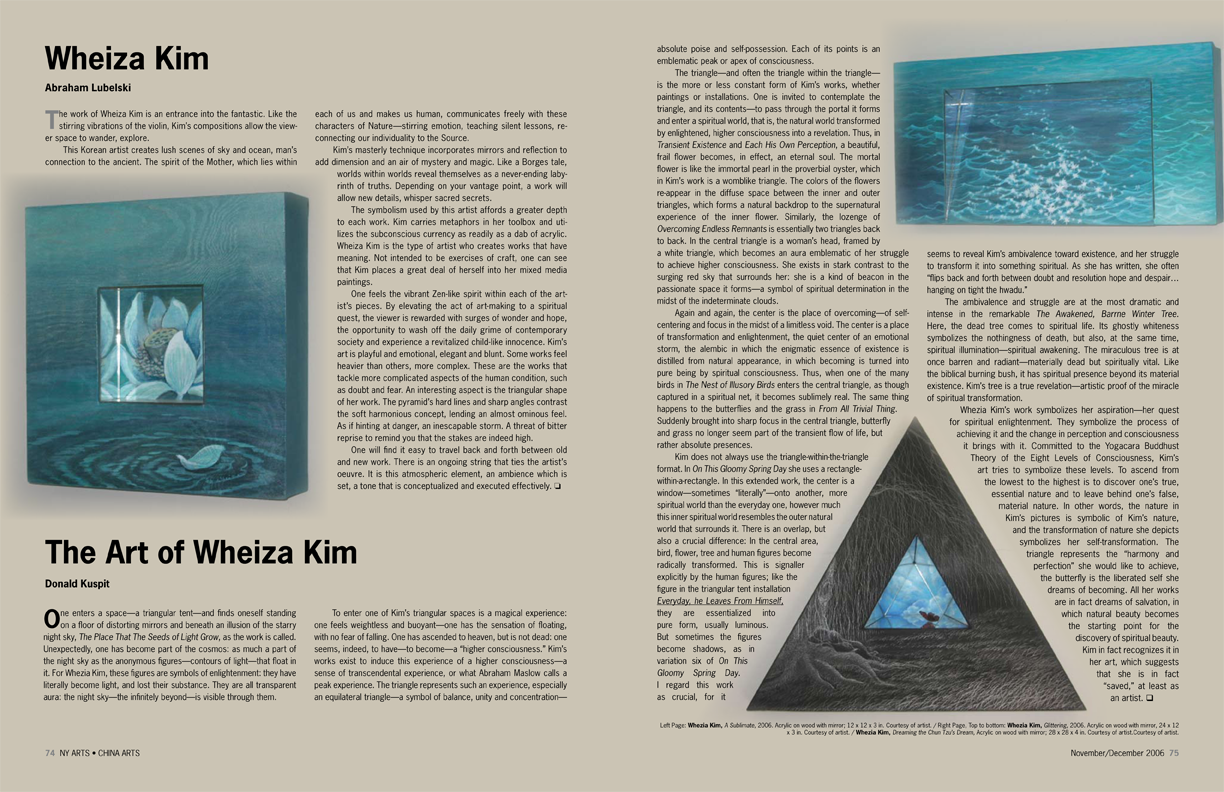
Alongside the various forms I paint, whose
nature cannot be clearly defined, I introduce yet another empty form, within
which I attempt to create shadows bearing afterimages produced by light. These
shadows assume no recognizable shape except through the forms within the
painting. They constitute another latent reality arising from the
insubstantial, governing our consciousness while remaining concealed from view.
Through these interactions, I seek to speak
of causality in our lives. This derives from the Buddhist teaching of dependent
origination: because this exists, that exists; because that exists, this
exists. I also seek to give visual expression to the proposition that all
things are created by the mind. All meanings in the world are merely meanings
that we ourselves construct and assign. The forms painted on the canvas are
only an introduction to the spaces that have been cut away. My true message
lies in their encounter with the shadows that overlap within those spaces
through the action of light. The lingering questions arising from that
encounter belong to the viewer. I hope that, through a prolonged dialogue with
the work, viewers will come to discover themselves.