Critiques
1994
Siri Huntoon | Art Critic
The paintings of Wheiza Kim reveal a mysterious world where windows lie on the floor like an eerie transparent carpet, a plot of grass has been lifted from a broad plain (leaving a white rectangle where dark earth might be expected) to hover in the sky, and doors lie ajar in the corner of a room whose walls have disappeared into cloud.
Throughout her long career as a painter and printmaker, Wheiza Kim has shown a playful, perhaps Surrealist-inspired willingness to explore new possibilities. This experimentation is perhaps most immediately noticeable in the way she manipulates contours of her images.
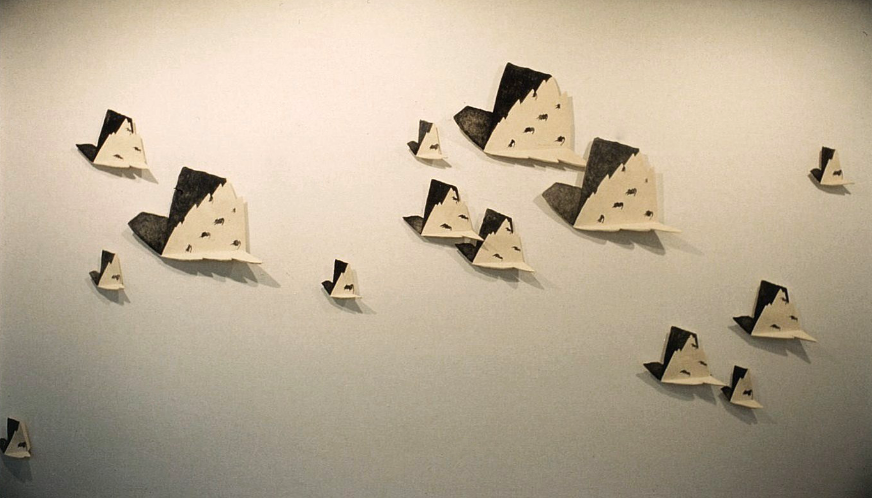
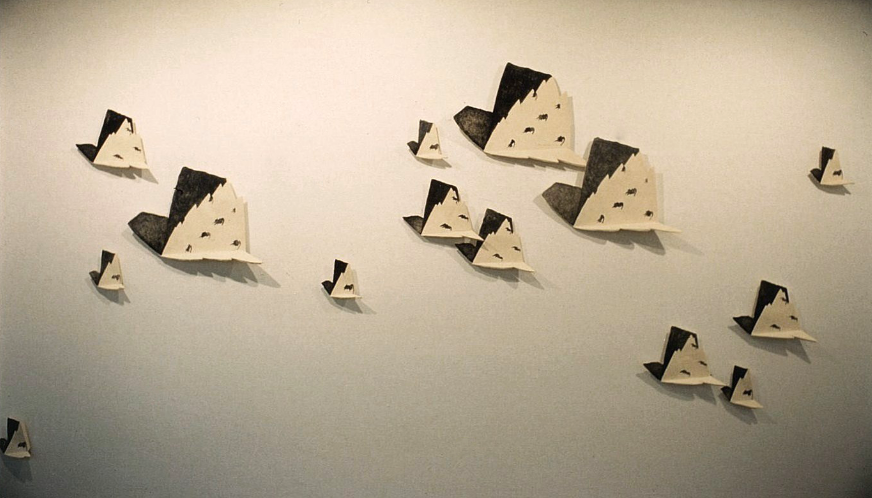
In the 1980s, she made a series of etchings entitled Everyone's Respective Island where the outer edge of the paper served to shape a form; a jagged mountain peak, for example, was outlined by the molded edge of the paper itself. These etchings were also embossed, and folded to create shadows falling on the wall.
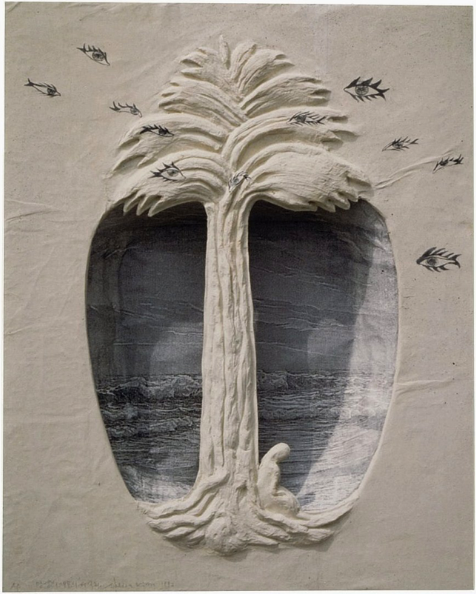
More recently, she has built her shadow effects into the iconography of the pictures themselves, sculpting the interior of the canvas, cutting it so that an object (perhaps a tree, or a person) juts out into the empty space she has carved out around it, and throws a silhouette against the white wall behind the picture. Here, she plays with the traditional injunction not to leave "a hole in the middle" of the composition - with startling effect. For Kim the cutaway also signifies the idea of emptiness, of the conundrum of the void as the core of reality.
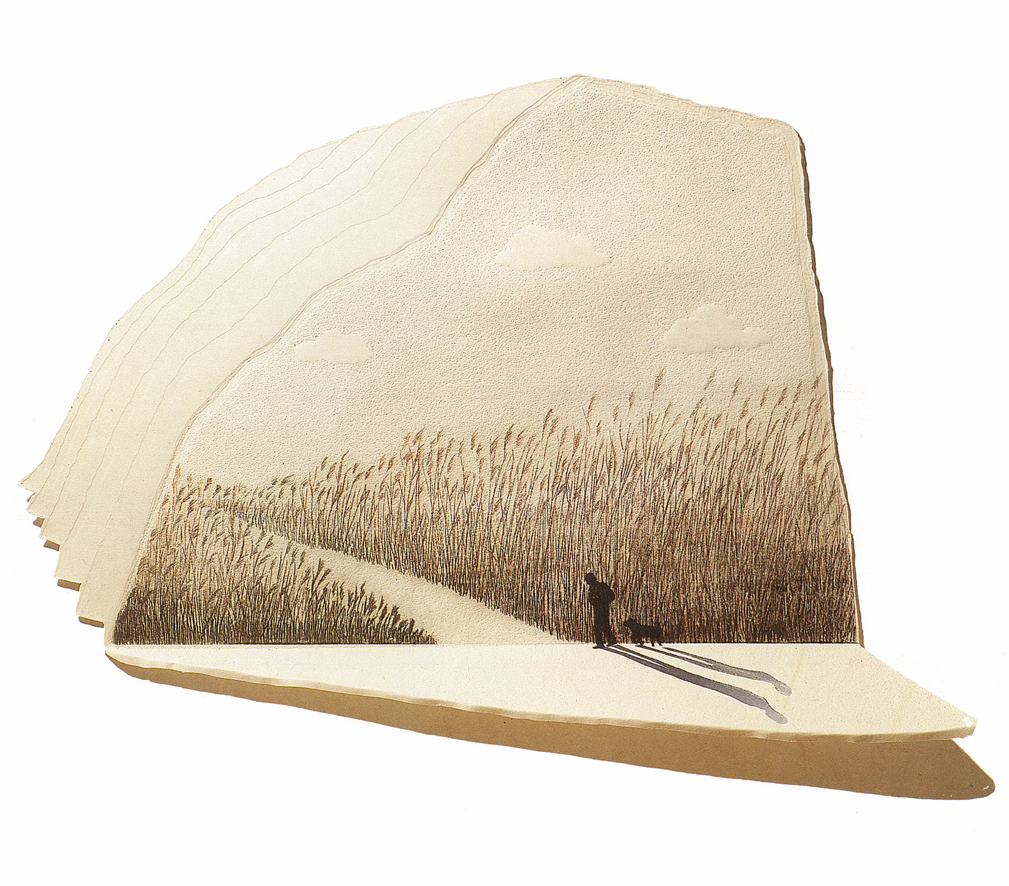
In a medium which some contemporary critics and artists consider "finished" - oil painting - Kim has found room for continued metamorphosis. Clearly, she is an artist with whom nothing can be taken for granted. She willingly embraces the traditional techniques of oil painting and printmaking, but shuns the dull constraint of the customary rectangle. The artist's ideas determine her final approach; she does not let typical uses of materials restrict her vision. Her shadow effects, for example, add a slightly theatrical dimension to her work.
Like contemporary American painters Frank Stella and Elizabeth Murray, who also curve and angle their canvasses, Kim's work blurs the distinction between sculpture and painting. But unlike Kim, who in some ways can be considered a landscape artist, Murray and Stella are abstractionists, for whom the form of the ground becomes another abstract figure against the larger field of the exhibition wall. Kim's paintings, by contrast, always tightly enclose a scene; dispensing with the notion of background, she heightens the sensuous appeal of her subjects. We are made to feel the clarity of her inner gaze, as well, as she pares away the inessential.
That sense of sharp focus also brings with it a feeling of emotional intensity. Many of her works show interiors - sometimes grim corners of rooms where chairs sit abandoned, and only a shadow on the floor hints at a human presence. These images powerfully convey universal feelings of anxiety and disillusionment.
Kim's works are the product of a deep self-scrutiny and meditation, guided by serious study of philosophy; her images are artifacts retrieved from a relentless uncovering of emotions and thoughts. However, the emotional intensity she conveys in these interiors fuse intimacy with a suggestion of open space; she does not abandon us to this claustrophobic setting. The artist always provides a means of escape, often depicting a window, an open door, or an endlessly receding passageway.
Although her isolated figures can seem melancholy and entrapped, she suggests that if only they would examine their situation carefully, they might become aware that another perspective is possible, a larger perspective represented by her distant vistas, and doorways which open into an airy beyond.
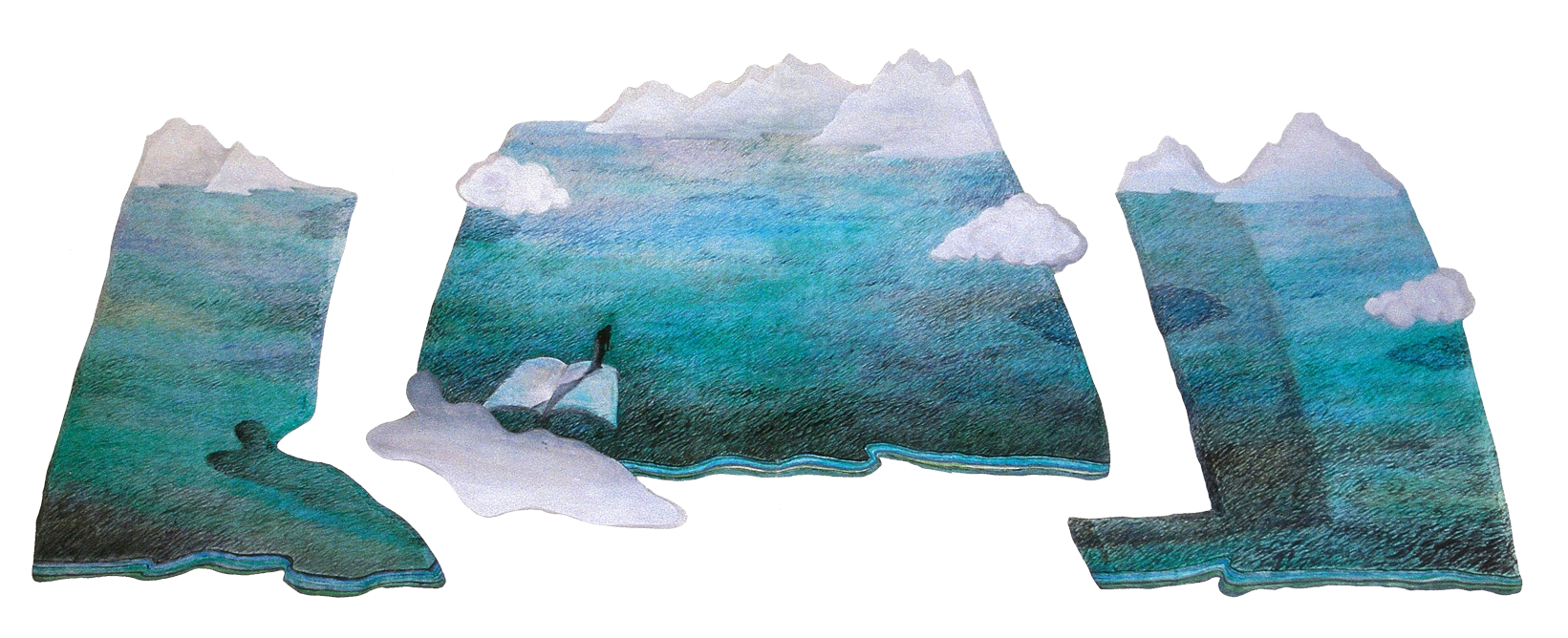
Even in interior views Kim does not lose sight of nature; storms brew up in night skies outside a window, doorways seem made of atmosphere. Nature in all its organic richness, which encompasses so many varied forms, colors, and creatures, is an important inspiration for Kim. In fact, though the interiors form an important part of her work, most of her pictures show natural settings - plains, mountains, and still ponds.
But truly it is an interior landscape Kim envisions. For the artist, natural subjects also represent aspects of meditative practice - in her floating clouds, for example, Kim has written she expresses the "freedom of the unchained soul". The artist's use of a slightly unnatural palette of blues, greens, and greys - reminiscent of Magritte - gives her plants and insects an enchanting, otherworldly aspect. Like the great Belgian painter, Kim uses everyday objects to create haunting pictures, whose enigmatic images are like fragments of a dream barely remembered.
The paintings assert themselves, but only as emissaries beckoning the viewer to enter the meditative world they reveal. The shaped canvasses underscore the partial nature of Kim's landscapes; they beckon us on to look for more, although we sense these are but shards of images, like pieces of a shattered mirror, which will never provide a complete reflection of reality.
While Kim's work draws on the Buddhist thought which has inspired generations of artists before her, like the painting methods of the West which she has appropriated, those philosophical filtered through the lens of individual experience. Thus, to express emptiness, she does not simply paint an open field of color (as a Westerner also inspired by Zen might).
She does not need to abandon representation in order to convey a sense of contemplative stillness, as for example Mark Rothko has done. Instead, the artist has developed her own pictorial language, and work which transmits its effect of quiet calm. Her art mingles a philosophical absorption with Buddhist precepts, with an intuitive understanding of immediate reality - the sway of a leaf in the wind, a teacup on a modest table.
She has achieved the paradox of suggesting the invisible by representing the tangible, or as the artist herself has put it, "I might be named a painter who wants to show the invisible, not as an empty space but as a space to contain the biggest capacity and the fullest meaning." *