Essays
2008
Lee Joo Heon | Art Critic
The world consists of forms and colors. Paintings are also composed of forms and colors. In forms and colors we perceive, think, and express everything. Forms and colors are the medium of spoken and written words, of songs and performances, not to mention of the paintings. Phenomenon is forms and colors, recognition is also forms and colors.
The very obviousness of forms and colors often makes us to regard them as the world itself. We get used to that. It is not until we meet with an accident devastating our lives or with an awakening throwing off our feeling of inertia that we think of the world as something beyond the forms and colors. However, it is not long before we submerge ourselves again in the familiar world by gravity of forms and colors. For we feel at ease with that. We are apt to believe c’est la vie.
Artists are very sensitive to forms and colors by nature. They have an acute awareness of the enormous power of forms and colors. But they know by instinct the limitations of form and colors as well. That’s because the more forms and colors they employ in their works, the more void and empty they feel under the skin. That explains why they always stand on the border.
They depend on forms and colors than anybody else, but at the same time they always wait for an opportunity to jump over them. They try to tell a story beyond forms and colors with forms and colors. Wheiza Kim is one of such artists. Rather, it’s better to put that she stands at the forefront of such artists and tries to articulate the story beyond the forms and colors.
Wheiza Kim’s works basically have the aspect of painting and installation at the same time. That’s because she does not paint merely on canvas but on three dimensional surfaces, like box or folding screen, and that she always employs mirror in his work as an objet. Mirror plays very important role in Kim’s oeuvre; it may be said that the mirror, rather than the meticulous painting itself, takes figuratively essential role in her works.
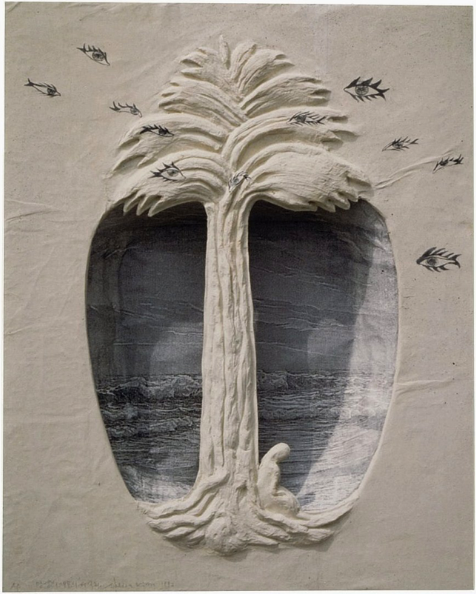
Let’s look at the significance of the mirror in her art through a work titled Scream. Scream is a work of box shape with a hole in its center. Landscape of dark sea and sky is painted on the surface and outer windows are painted on each side of the hole. In the hole is attached a square mirror and the landscape of outside the work is reflected in the mirror. Now, closer look into the hole reveals that the reflection in the mirror is not only the outside landscape. Landscape of inside the hole is reflected, too; that’s because the mirror is bigger than the hole. The other side of the box except the hole is reflected in the mirror. The artist painted on that reverse side of the box. The reverse side image looks like a figure calling for help by waving white cloth on the edge of an island. The reflection of that makes an illusion of painting.
Through this peculiar structure, the artist makes us reflect on the world full of forms and colors and on our existence just like a mirror reflecting the world. It can be said that the painting on the box surface corresponds to a sensory world, the painting on reverse side of it to our subconsciousness, and the mirror image of that to our unconsciousness or the depths of consciousness. The artist says:
“Mirror has been passed for a metaphor of our mind from ancient times. Mirror is the absolute emptiness itself without time or space unless some kinds of border are reflected in that. Thus is our mind, it fluctuates only by the border of outside; it is void by nature but we laugh and cry by attachment and differentiation. People know that images in the mirror are unreal, but they don’t know the delusion in their mind is the same as that, so they can’t control and calm their mind. I want to lead a life settling down the wandering mind and listening to my inner voice. In that wish, contemplating the world with the most clear, transparent and tranquil gaze, I want to be a master of time by expressing and depicting it.”
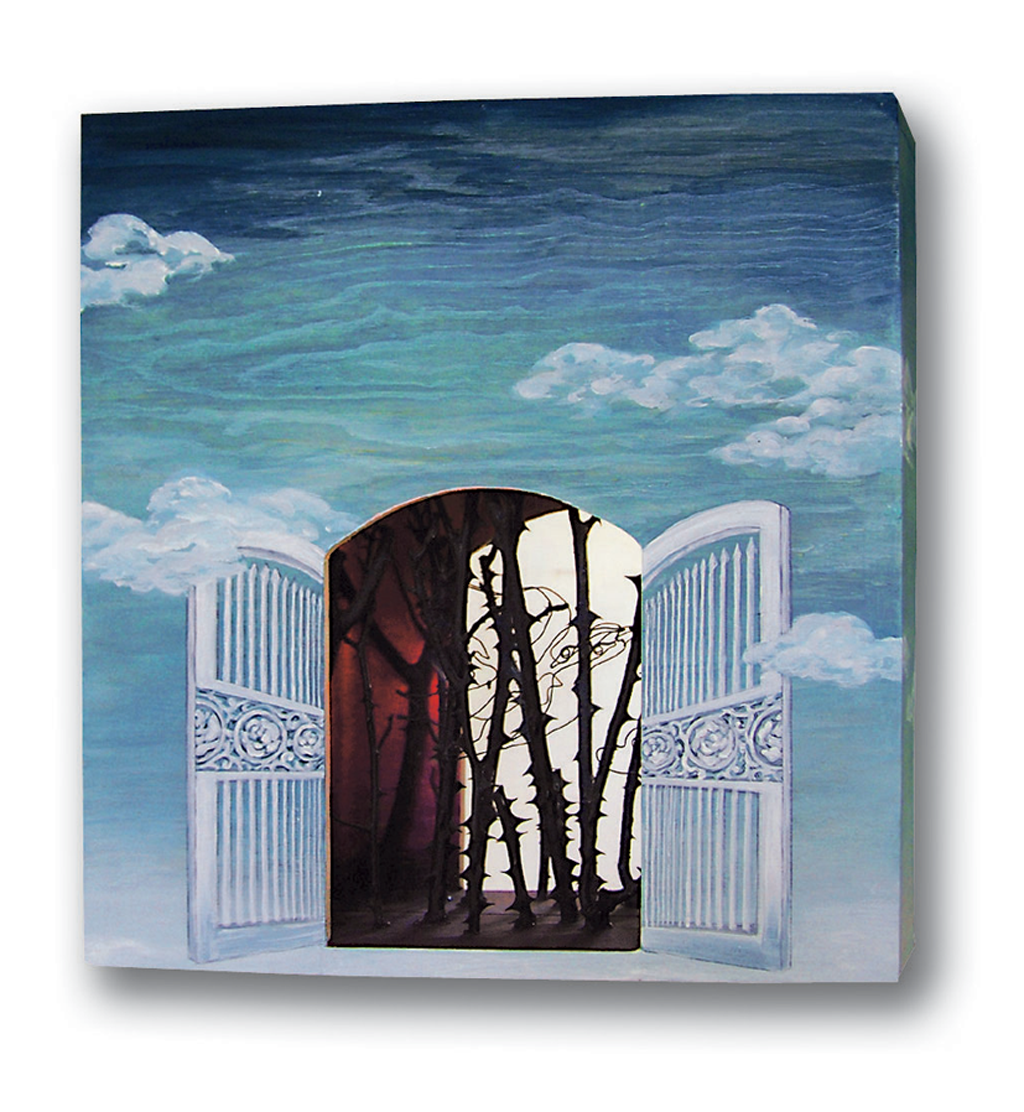
That wish of the artist is recurrent in the works like Obsession's trap, I want to rest, Spring Rain, Night Walk, Sleeplessness in similar style to that of Scream. As these works show, her art is essentially the result of deep examination and contemplation on the visible and the invisible, the world and the subject, the phenomenon and the recognition. At the core of that approach lay her mature understanding about the Mere-Consciousness of Buddhist Epistemology and keen interest in psychoanalytic studies of Freud, Adler, and Fromm.
Her works are of course not the visual ‘chart’ of those theories. They are not an illustration made to be an instrument explaining a stand, hypothesis or argument about Mere-Consciousness or psychoanalysis. They’d rather make us look back on our habitual obstinacy, delusion, prejudice, attachment and dissect our mind-works such as emotional respond, interpretation, differentiation out of inertia, with an eye of deep meditation.
Looking at the works not with some theories but with our own experiences, it dawns upon us an idea like “Right, life is but an empty dream”; it makes us clearly look at the true nature of our mind by analogy with the works with an eye of deep contemplation. It awakens us to the fact that the way to the true peace of life starts from our mind and ends at our mind.
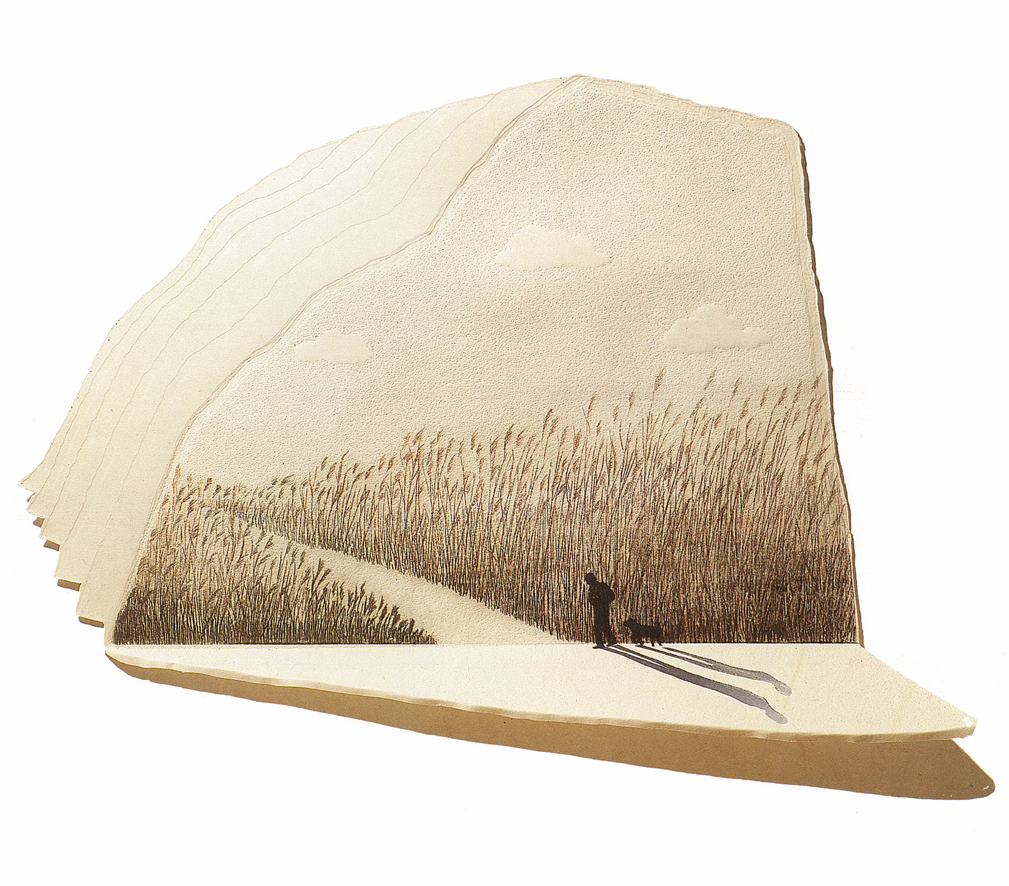
Recently Wheiza Kim has concentrated on works in the shape of long folding screen; these works feature more relaxed, peaceful, and commanding view of her ideas. During the time of making works under the same subject and in the effort of figuratively articulating her ideas more exactly, execution itself has become great burden for her. What actually could be more difficult than making the invisible visible? And that effort itself is apt to be a delusive action.
She has greatly relieved the burden of execution since she moved to a beach house in Riverhead, Long Island and transferred the beautiful scenery into her paintings. Although the vast sea and sky are also within the boundary of forms and colors, the silent and sublime beauty of that made her at a glance more easily remind a dim memory of the world beyond the forms and colors. The great scenery reminding the Mother Nature often sheds new light on the concept of ‘leaving things undone’ of Lao Tse. One of the works begotten by this change of environment is Journey.
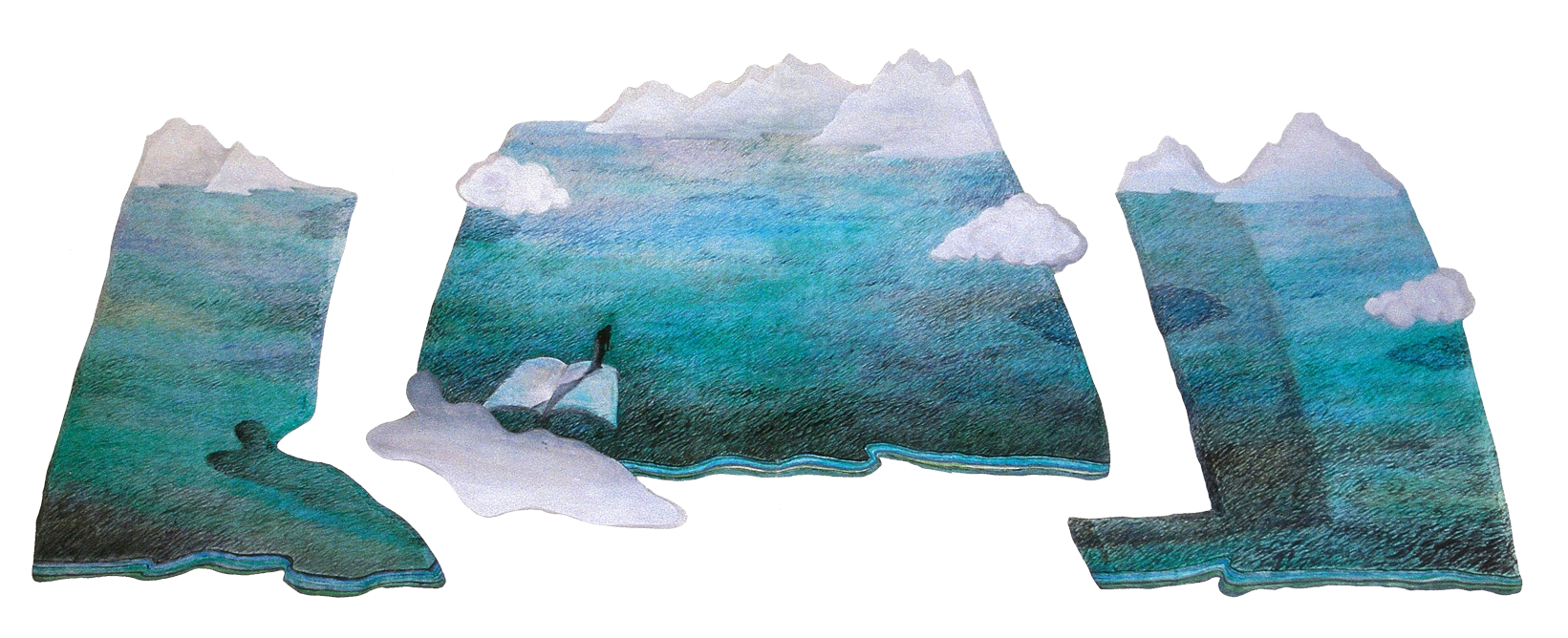
The blue sea spreads out and a small boat goes somewhere across the gentle waves. The boat carries a string instrument instead of a man. Where is it going? The meaning of a musical instrument for us lies not in the shape, size, or weight of it. The sound of it has significance. The musical instrument carried in a boat reminds us the sound carried in it. Where does the sound go which flows into our mind? Does our life, just like the sound, flow in and then flow out? Whatever the truth is, nothing could tell a story more vividly about things flow in and flow out than a boat floating in the sea and a musical instrument carried in it.
It is very impressive in figurative aspect that the grain of the wooden board enhances the natural effect of diffusion and resonance of the waves painted on it. The same trait also can be found in other works of rectangular shape. The artist picked out wooden boards with fastidious care and prepared them elaborately. The surface, finished in this way, seems to be filled with vigor of the earth and life. Inexpressibly subtle nuances of energy are fantastically soaked into our retinas along the grain of the wood.
It is also a very interesting part that between the paintings is a mirror phase and the image of a painting is often reflected on it. In the painting, the phases look like terraced paddy fields and the mirror takes the place of a surface of the phase. The mirror in a work like Journey gives us a message that, even the image of a sailing boat, i.e. the symbol of life, is but an image reflected on our mind. All images cannot be a substance by itself.
All our thought about life is not of our own but a reflection on our mind. How can we naturally escape from the world of false image like a snake shedding its skin? Taking a deep breath and staring calmly at her paintings could possibly clear up our mind like a limpid mirror. That could make us concentrate not on the image but on the mind itself. Even with that alone, her paintings could be great consolation to us.
Translation: Kim Jinhee